When a community watches a military memorial lose its face to a sledgehammer, the criminal law that follows has to carry two truths at once: symbolic property is not ordinary property, and pretrial liberty is not a moral referendum but a risk assessment. The Quantico Iwo Jima case makes both points with unusual clarity.
At a Glance
- Police say they caught a 27-year-old suspect actively striking the Iwo Jima memorial near Marine Corps Base Quantico with a sledgehammer and arrested him at the scene.
- The reported damage included the removal of a sculpted Marine’s head and defacement to other portions of the limestone monument; three felony charges followed.
- Despite the memorial’s significance and prosecutors’ opposition, a judge later granted a $2,500 bond, separating the question of guilt from pretrial risk.
- Monument-protection law treats willful damage to military memorials as categorically serious, while Virginia’s pretrial framework weighs flight and danger in deciding detention.
What Happened: A sledgehammer, a memorial, and an arrest at the scene
Shortly after 10 p.m., Prince William County officers responding to reports of vandalism at the Iwo Jima memorial near the entrance to Marine Corps Base Quantico encountered a man striking the statue with a sledgehammer. Police detained him without incident. The visual damage was not cosmetic: the head of one of the sculpted Marines had been removed, and other portions of the limestone grouping were marred. The police account and contemporaneous reporting describe a scene that left little ambiguity about conduct or instrument—concrete, immediate, and ongoing when officers arrived.
Prosecutors charged the suspect, identified in reports as Miguel Alonso Maldonado Soriano, with felony destruction of property, trespass with intent to damage property, and felony injury to a monument. Those counts track directly to what officers say they witnessed and to the type of target involved: a military memorial with civic and historical significance. Early estimates attributed to police and custodial organizations placed repair costs in the “hundreds of thousands of dollars,” and the Marine Corps Heritage Foundation initiated a restoration fundraising campaign in the aftermath.
Why the law treats memorials differently from ordinary structures
American law has long recognized a distinct public interest in preserving monuments that honor military service. At the federal level, the Veterans’ Memorial Preservation and Recognition Act (VMPRA) criminalizes the willful injury or destruction of memorials on public property that commemorate service—authority Congress designed to carry felony penalties where warranted. Related federal statutes cover national military parks and federal property more broadly, reflecting a policy judgment that symbolic sites warrant elevated protection and deterrence beyond standard vandalism rules.
That policy logic is straightforward. Memorials do more than adorn public space; they transmit civic memory. Damage to a headstone in a national cemetery, to the bronze Marines raising a flag, or to a smaller limestone counterpart does not simply impose replacement costs—it attacks an institution’s public narrative. The law encodes that difference by tying punishment to motive (willful injury), status (military commemoration, public property), and consequence (scale of damage). In practice, state-level felonies for property destruction and injury to monuments—like those charged in the Quantico case—operate in parallel to these federal protections.
How pretrial decisions are made: seriousness matters, but risk governs
Pretrial detention is not a shadow conviction. In Virginia, judges decide bail on individualized findings about two failures the system most needs to avoid: a defendant not appearing for court and a defendant committing new crimes while on release. Tools like the Virginia Pretrial Risk Assessment Instrument (VPRAI) synthesize factors such as prior failures to appear, criminal history, and stability indicators; they inform but do not dictate judicial decisions. Prosecutors argue detention when risk cannot be mitigated by supervision or conditions; defense counsel argues for release calibrated to risk level, not charge headlines.
In the Quantico matter, the commonwealth initially opposed release; a later hearing resulted in a $2,500 bond granted by the chief judge, who effectively concluded that conditions could manage pretrial risk even as serious felony charges remained pending. That outcome does not diminish the gravity of the alleged conduct or prejudge guilt; it reflects the distinct question the bail system is designed to answer. Put bluntly: the law can call a crime grave and still release the accused to await trial under conditions when flight and danger are judged manageable.
The damage question: costs, restoration, and why valuation is hard
Estimating conservation work for historic stone is not a trip to the hardware store. Limestone restoration implicates structural integrity, weathering patterns, patina matching, and the aesthetics of loss versus repair—do you re-carve a head, reattach fragments, or stabilize damage as part of the artifact’s history? Specialists will assess micro-fracturing, load paths, and long-term maintenance burden before tallying costs. That is why early figures are often broad bands; police and custodial stewards cited “hundreds of thousands” and moved quickly to organize funding while conservators and contractors scoped options.
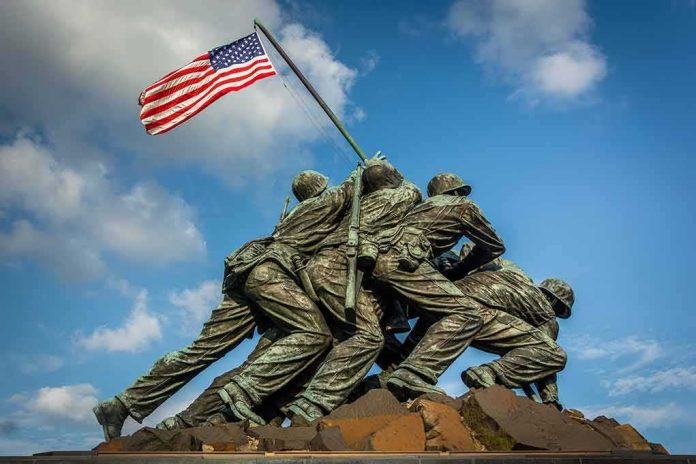
Symbolic stakes amplify this calculus. The memorial near Quantico is a nine-foot limestone homage to the iconic 1945 flag-raising, a regional focal point just miles from the National Museum of the Marine Corps. Restoring such a piece is not only about visual fidelity but about honoring the institutional story it carries. That blend of technical conservation and civic meaning explains both the felony posture and the urgency of restoration appeals reported after the arrest.
Charges and elements: where the law meets the facts
The three reported counts map cleanly to the facts described by police and local outlets. Felony destruction of property concerns willful damage above a statutory threshold; injury to a monument targets the protected class of the object itself; trespass with intent to damage addresses unlawful entry coupled with destructive purpose. The strongest evidentiary backbone, as reported, is contemporaneous observation—officers encountering a person mid-strike with a sledgehammer. That kind of immediacy compresses many trial disputes; it still leaves room for defense arguments about specific elements, but it gives prosecutors a coherent narrative from charge to proof.
The valuation dimension, while not required to prove every count, will matter at sentencing and may matter to whether certain felonies are properly charged. Expect, therefore, to see conservator reports and itemized bids appear later in the case lifecycle—even as early public numbers frame the seriousness for community stakeholders and donors.
$2,500 bond for beheading the Iwo Jima memorial. Men died taking that hill and this court prices it like a parking ticket.
That isn't bail. It's a permission slip.— Pardon My French (@Maeglin931) October 27, 2026
Why this case will be cited for years: a template at the intersection of memory and risk
This episode will outlive the docket because it distills a reliable pattern. When someone visibly attacks a military memorial, the criminal law’s front end—charging—responds with categorical seriousness; the back end—bail—filters that seriousness through individualized, evidence-based risk analysis. Communities sometimes read the second response as discordant with the first. In fact, the two are designed to coexist: protect what we honor, and reserve pretrial incarceration for when liberty creates unmanageable risk. Federal and state frameworks around memorial protection on one side, and Virginia’s risk-informed pretrial system on the other, make that coexistence possible and repeatable.
Sources:
redstate.com, people.com, princewilliamtimes.com, wtvr.com, wsfa.com, nbcwashington.com, stripes.com, insidenova.com, abc6onyourside.com, potomaclocal.com, congress.gov, federalregister.gov