

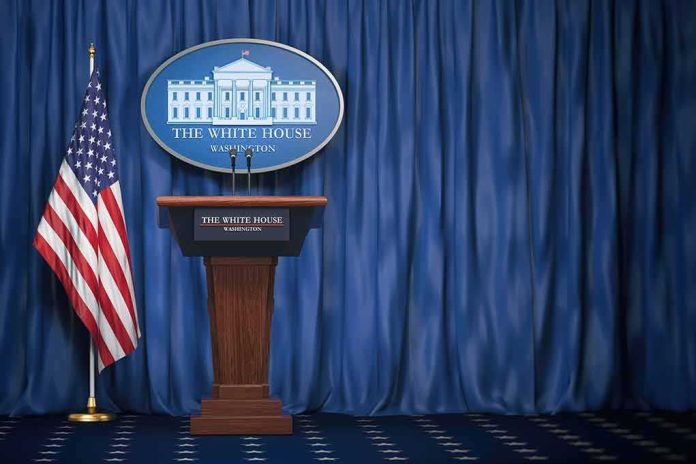
The struggle over the White House briefing room is not about décor; it is about control of proximity, which is power in presidential politics.
The Short Version
- Multiple reports say President Trump has discussed replacing the James S. Brady Press Briefing Room with an indoor swimming pool, raising the idea repeatedly with aides.
- The space sits atop Franklin D. Roosevelt’s former therapeutic pool; Richard Nixon covered it to create the modern press facility, making restoration conceptually straightforward if not yet engineered.
- The White House has not ruled the change out; a senior official said all options remain on the table pending an announcement.
- The proposal comes amid a long history of moving, constraining, or restoring press access near the West Wing depending on each administration’s posture toward proximity.
What is being proposed, and what evidence supports it
Published accounts describe a recurring proposal from President Trump: remove reporters from the West Wing’s Brady briefing room and convert the space into an indoor pool. The reporting traces to multiple contemporaneous outlets that attribute the idea to the president himself and to repeated internal discussions. It includes a specific Oval Office conversation with then–press secretary Karoline Leavitt in August 2026, framed as a legacy project tied to moving the press out of the West Wing. The White House, asked directly, did not deny the concept; Communications Director Steven Cheung said, “All options remain on the table, and we will make an announcement when appropriate.”
The proposal has had a visual life as well: reporting describes a Truth Social post that juxtaposed the existing briefing room (“Fake News”) with a pool rendering labeled “FDR Pool,” and a foam-board mock-up produced to illustrate the physical conversion. These indicate more than an idle aside; they reflect a president engaged in communicating—and socializing—the concept inside and outside the building. While no construction order or budget authorization has been made public, the evidentiary throughline is consistent: Trump has pushed the idea, aides have entertained it, and the White House has kept the door open.
Why this room, and why now: the mechanism and the symbolism
The briefing room is not sacred architecture; it is layered improvisation. Franklin D. Roosevelt’s administration added an indoor pool to the West Wing for his polio therapy, a private space with public resonance. As the television era dawned, Richard Nixon capped that pool and built a press theater and adjacent workspaces to accommodate cameras, cabling, and a growing on-site press corps. In other words, the room already embodies a history of structural repurposing to match presidential needs and media technology. Reverting to a pool is, physically speaking, a restoration in theme if not a trivial engineering task.
But the deeper mechanism is proximity. Reporters in the West Wing hear footsteps, intercept principals in hallways, and calibrate mood by who lingers outside the chief of staff’s office. Moving them—even across West Executive Avenue to the Eisenhower Executive Office Building—changes the tempo and serendipity of contact. Administrations intent on message discipline often look for architectural leverage: fewer impromptu gaggles, more scheduled briefings, more control over the lens line. The Brady room is a pressure valve and a theater; change the valve, and you change the pressure.
How we got here: a century of shifting press proximity
Press access at the White House has never been static. Early twentieth-century correspondents milled outside the building, then gradually won workspace inside. Harry Truman, seeking order and modernization, shifted press conferences to the Indian Treaty Room across the driveway—today part of the Eisenhower building—formalizing a remove between daily work and presidential movement. The Nixon conversion over FDR’s pool institutionalized television-era briefings within the West Wing, a compromise between access and control that endured.
Administrations have periodically tested that equilibrium. During the 2006–07 infrastructure overhaul of the press facility, the corps decamped to a temporary space off Lafayette Square, preserving briefings while surrendering daily proximity to West Wing rhythms. During the 2016–17 transition, senior advisers floated moving the press permanently to the Eisenhower building; the idea was aired, debated, and shelved. The throughline is clear: proximity is negotiated, sometimes ceded under practical pressures, sometimes restored when the politics shift.
What would it take to turn the idea into a project
Conceptual restoration is not the same as practical feasibility. Converting the space into a functioning, code-compliant pool would require structural verification that the slab and surrounding framing can bear the load of water and dynamic occupancy; waterproofing, drainage, and mechanical systems designed for a high-security, historically sensitive envelope; and integration with fire suppression, egress, and blast considerations unique to the Executive Residence campus. Historic preservation review would be a factor as well; while the FDR pool’s footprint offers precedent, modern standards and decades of intervening build-outs complicate a simple “reopen the lid” narrative. None of those steps are documented publicly to date.
On the operational side, relocation of the press corps is not merely a seating chart. It implicates credentialing regimes, perimeter security, live-broadcast infrastructure, and the choreography of daily briefings, pool sprays, and stakeouts. The Eisenhower building is the obvious overflow site—used before during renovations—but turning “temporary” into “permanent” alters expectations and practices built over five decades. That change, if chosen, would not erase press access; it would recode it—more scheduled, less incidental, and mediated by architecture as much as policy.
Swimming With the Sharks? Trump Reportedly Wants to Repurpose WH Briefing Room https://t.co/mnpYuiJrrh
— Rachel Morse (@rm36863307) October 21, 2026
Where the real stakes lie
Debate will fixate on optics: a president replacing a room for reporters with water is irresistible symbolism. The substantive stakes are drier and more durable. White House communications is an ecosystem of corridors, camera positions, and choke points that either enable or frustrate unscripted contact. Administrations choose their preferred balance, and buildings remember those choices. FDR added privacy; Nixon added television; a pool conversion would add distance. The White House statement preserving “all options” signals this is an active choice set, not a rhetorical flourish.
Bottom line
According to multiple reports, President Trump has repeatedly advocated converting the Brady briefing room back into a pool and relocating reporters, with the White House declining to rule it out. The idea sits squarely in a long tradition of presidents reshaping the built environment to fit their media strategy. Should it move from concept to project, the most consequential change will not be aquatic—it will be the redefinition of physical proximity between the presidency and the press, and with it, a recalibration of how power communicates from the West Wing.
Sources:
redstate.com, washingtonexaminer.com, yahoo.com, bloomberg.com, rawstory.com, politico.com