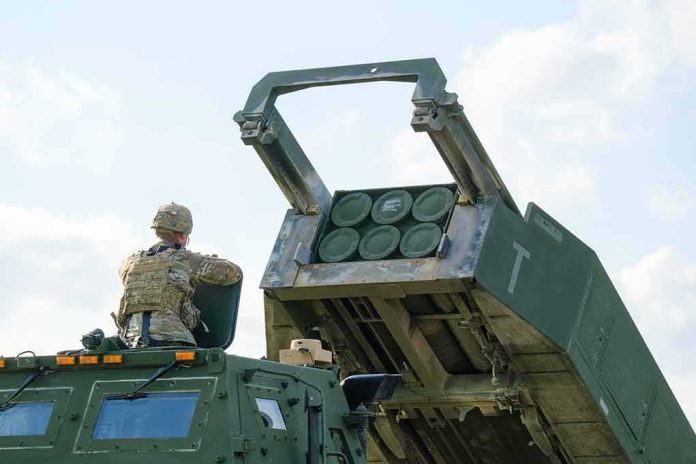
The first Tomahawk launch by the Army’s Europe-aligned Typhon battery is less about a single missile leaving a trailer in the desert and more about a new chapter in land-based deep strike: soldiers in a Europe-focused formation have now proven they can operate a naval cruise missile from a road-mobile Army system.
The Short Version
- On September 28, 2026, soldiers from the 3rd Battalion, 12th Field Artillery Regiment launched a Tomahawk from the Army’s Typhon system at Naval Air Weapons Station China Lake, California.
- This was the first Tomahawk live fire for the Europe-aligned Typhon battery, and the third Typhon firing in the continental United States, according to reporting.
- The crew completed five weeks of training with Navy personnel and Lockheed Martin field-service representatives before the event.
- Army leaders frame Typhon as expanding options for combatant commanders by adding a road-mobile, land-based Tomahawk capability to the joint force.
What happened and why it matters
Soldiers assigned to the U.S. Army’s Multi-Domain Command–Europe executed their first Tomahawk Land Attack Missile launch from the Typhon Mid-Range Capability on September 28 at China Lake. Reporting identifies the firing unit as the mid-range capability battery of 3rd Battalion, 12th Field Artillery Regiment; the launch was described as that battery’s first Tomahawk shot and the third Typhon firing in the continental United States. The Army used a standard test range with Navy support, but the significance lies with who pulled the lanyard: an operational battery aligned to the European theater, not a stateside test detachment. That distinction signals a trained crew, established procedures, and growing confidence that this capability can be integrated into a theater force package.
Typhon adapts a naval missile—Tomahawk—to a road-mobile Army launcher, creating a ground-based strike option that complements naval and air-delivered fires. Officials characterize the battery’s mission as giving a combatant commander a new land force tool for long-range precision attack, a point the unit’s commander underscored by describing Typhon as adding range and options the land component has not previously had in this band of distances. In a European context, where access, basing, and survivability are constant planning problems, a mobile launcher that can disperse on existing road networks expands the playbook.
Mechanism: how Typhon brings naval missiles ashore
At its core, Typhon is the Army’s Mid-Range Capability: a command-and-control vehicle tied to trailerized launchers that integrate with the Navy’s Mark 41 launching architecture to fire Tomahawk and, potentially, Standard Missile-6 family rounds. In practice, that means the Army can tap the industrial base, software, and mission planning workflows already matured in the fleet, while operating from concealed or relocatable land sites. The mobile chassis, containerized launch cells, and Army fire-control software are tailored to ground formations and their kill chains—sensor-to-shooter links that can start with joint, allied, or organic targeting. The crew that fired on September 28 had completed five weeks of new equipment training with Navy technical experts and Lockheed Martin field-service representatives, a typical approach when transferring a mature weapon into a new service’s doctrine and sustainment system.
The point of that integration is not novelty; it is tempo. Land forces that can shoot Tomahawk complicate an adversary’s air and missile defense calculus. Instead of exclusively projecting cruise missiles from known sea lanes or air taskings, commanders can launch from inland positions at times and azimuths that force the opponent to defend in 360 degrees. For multi-domain task forces that already blend electronic warfare, cyber, space-enabled targeting, and long-range fires, Typhon offers a kinetic spine: a way to convert high-confidence targeting into a precision strike without waiting for airspace control measures or maritime positioning to align.
What this launch establishes—and what it does not
This live fire establishes that an operational Army battery, aligned to Europe, can conduct the full chain of actions required to employ a Tomahawk from Typhon under range conditions. It shows the crew mastered the safety, command-and-control, and launch procedures after a defined training period and could integrate with Navy range operations—important proof for any joint weapon brought ashore. Reports characterize the event as the first Tomahawk launch for this Europe-aligned battery, not the first Tomahawk from Typhon ever, and situate it as the third Typhon firing in the continental United States; that framing avoids the common “first ever” confusion that creeps into headline shorthand.
What the event does not settle is a different kind of question: the full operational arc from training shots in California to routine deterrent posture in Europe. The sources do not specify the target type, impact assessment, or the missile’s actual flight distance on September 28; they also do not claim the shot was a 1,000-mile end-to-end operational scenario. Those details matter for engineers and evaluators, but they are not prerequisites for the central point here: trained soldiers in a Europe-focused unit successfully launched a Tomahawk from Typhon.
How we got here: a post-INF return to ground-based deep strike
Typhon is part of a larger reconstitution of U.S. and allied land-based deep strike after the demise of the Intermediate-Range Nuclear Forces Treaty. European defense analysts have flagged a “deep-strike gap” on the continent and argued for systems that can cover 1,600–2,800 km bands; U.S. plans to field Tomahawk and hypersonic capabilities in Europe were intended to close that gap and complicate adversary anti-access/area denial architectures. Bringing Tomahawk ashore with an Army crew is, in effect, the pragmatic first step: adapt a proven missile, field a mobile launcher, and knit it into a theater-level kill chain. As procurement and training mature, the Army can layer additional munitions—such as SM-6—into Typhon’s architecture, yielding a mix of land-attack and maritime strike options from the same road-mobile footprint.
The acquisition approach reflects a well-known pattern in U.S. defense programs: leverage existing components to compress timelines, then iterate. That convergence of mature missile, shared launch architecture, and Army-specific command-and-control shortens the distance between concept and credible field employment. For European allies who track both capability and cadence, the milestone is a concrete indicator that Army long-range fires are not theoretical—they are training, shooting, and refining with joint partners today.
🇺🇸 The Mid-Range Capability (MRC) Battery of the U.S. Army's 3rd Battalion, 12th Field Artillery Regiment, Long Range Fires Battalion, Multi-Domain Command Europe completed its first live-fire of a Tomahawk Land Attack Missile (TLAM) using their newly fielded Typhon missile… pic.twitter.com/rC61orkacm
— Guy Plopsky (@GuyPlopsky) October 15, 2026
The strategic implications for Europe and the joint force
For a European theater commander, a land-based Tomahawk battery adds several practical advantages. Mobility and concealment extend survivability; dispersed launchers complicate an opponent’s targeting and force them to allocate sensors and interceptors more widely. Interoperability with Navy and Air Force targeting networks broadens the menu of kill chains—space-based ISR, airborne sensors, allied coastal radars—that can cue a strike. And by placing a credible cruise-missile option under an Army headquarters, the joint force gains flexibility in sequencing: ground forces can execute suppression, sea denial, or counter–A2/AD tasks without always requiring immediate air and naval massing. That is the logic behind the unit commander’s public framing—Typhon gives combatant commanders options they did not previously have from the land component.
The location of the launch—California rather than Europe—does not blunt that operational meaning. U.S. units typically validate new equipment on instrumented domestic ranges; what matters for deterrence is trained crews, rehearsed procedures, and the ability to deploy and sustain the system forward. This shot contributes directly to that pipeline. The next markers of progress will be routine integration in European exercises, logistics and basing arrangements, and repeated live-fires that demonstrate reliability under different conditions. As those accumulate, the credibility of land-based deep strike in Europe will shift from demonstration to normalized capability—a transition every serious adversary tracks closely.
Sources:
defensedaily.com, armyrecognition.com, yahoo.com, defence-industry.eu, navalnews.com