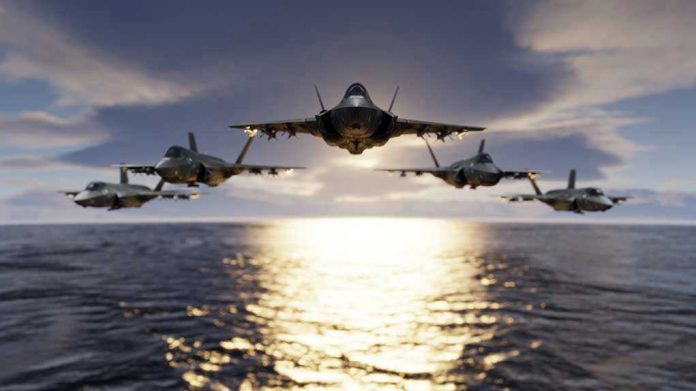
When a government sends fighter jets but draws a bright line against striking ground targets, it is making a precise claim about purpose: this is about shielding cities and infrastructure from airborne attack, not wading deeper into a war. The Royal Air Force’s Typhoon deployment to Saudi Arabia is exactly that—an air-defense mission with narrowly defined rules—rooted in a long, intricate UK–Saudi security relationship and a specific threat profile of drones and missiles launched by the Houthis.
At a Glance
- The UK Ministry of Defence ordered RAF Typhoons to fly defensive counter-air missions over Saudi Arabia.
- London’s mandate explicitly excludes offensive strikes against the Houthis.
- The task is to intercept airborne threats—drones and missiles—targeting Saudi cities and critical infrastructure.
- The move extends an existing UK defensive contribution, including air-to-air refueling support.
What the UK has committed—clearly, and by design
The UK Ministry of Defence set out the mission in plain terms: RAF Typhoon fighter jets will conduct defensive counter-air sorties to protect Saudi cities and critical national infrastructure from aerial attack. The statement is categorical about scope—these aircraft will not carry out offensive strikes against the Houthis. That operational distinction is not a semantic hedge; it governs where and how RAF crews can employ force, anchoring the deployment in air defense rather than strike warfare. Independent reporting the same day mirrored the government’s framing, identifying the intercept targets as inbound drones and missiles launched toward Saudi territory, not assets on or over Yemen. Together, those sources establish a tightly bounded mission, not a covert pathway to escalation.
London also cast the decision as an expansion of standing defensive support rather than a bolt-from-the-blue deployment. The RAF has already been contributing enablers—most notably air-to-air refueling—to help sustain defensive air operations. Extending that lattice to include RAF Typhoon defensive patrols folds neatly into the UK’s established Gulf posture while avoiding an offensive operational footprint. The Defence Secretary underscored the civilian-protection aim, linking the tasking to the defense of population centers and critical infrastructure—airports, energy nodes, and other nationally vital systems that drones and cruise missiles can threaten directly.
Mechanics of a defensive counter-air mission
Defensive counter-air (DCA) is the air force’s shield: detect, identify, and engage airborne threats before they impact defended assets. For the RAF Typhoon—an agile, multi-role fighter with a high-powered radar and a layered air-to-air weapons suite—that means orbiting in preplanned “combat air patrol” boxes, fusing radar and offboard tracks from allied sensors, and prosecuting engagements with beyond-visual-range missiles against cruise missiles or fast drones, or with shorter-range options and guns against slower one-way attack UAVs. In practice, the mission is a choreography of sensors and fuel. Tankers extend station time; ground-based radars and airborne early warning assets extend sightlines. The pilot’s job is to be at the right altitude and geometry to take shots in the narrow windows the threat allows.
DCA’s efficacy depends on the threat taxonomy. Slow, low-flying drones can be cued and killed by fighters, especially at standoff range; cruise missiles present a tougher, but still fighter-manageable, problem if the radar cross-section and flight profile yield timely detection. Ballistic missiles are a different species entirely—steep trajectories and high velocities usually place them in the remit of ground-based interceptors rather than fighters. The UK’s public guidance aligns with this reality: the Typhoon deployment is one layer in a broader air-defense architecture, complementing ground systems and Saudi assets to raise the probability that inbound threats are detected, sorted, and engaged before they reach a runway, refinery, or dense urban area.
Why this deployment now—and how it fits a longer arc
The proximate cause is a sustained pattern of Houthi-launched aerial attacks against Saudi territory, combining drones and missiles aimed at airports, energy facilities, and cities. Such attacks force a defending state into continuous readiness, where gaps in patrol coverage or sensor-fusion setbacks translate into risk for civilians and critical infrastructure. The RAF’s addition of Typhoon DCA sorties is intended to help close those gaps—by increasing the number of combat air patrols on the map, by adding an advanced radar/weapons combination to the intercept “stack,” and by plugging into existing Saudi and partner command-and-control arrangements. Public reports characterize the decision as an extension of UK aid already geared to defense, notably refueling support; that continuity matters because air defense is not solved by one-off sorties but by sustained, predictable coverage.
Strategically, none of this occurs in a vacuum. UK–Saudi defense ties run deep: from the Al Yamamah agreements of the 1980s to the Al Salam purchase of 72 Eurofighter Typhoons, the relationship has long married arms provision, training, and operational cooperation. Analysts have documented how those arrangements evolved into a broader security partnership—one that today encompasses industrial links and shared airpower know-how. A defensive RAF posture over Saudi territory therefore fits the pattern: a partner contributes capability in a way that reinforces an ally’s shield without reorienting its own force toward offensive action.
What we know—and what remains operationally unspecified
On the record, London has declared intent, role, and limits: defend Saudi skies, intercept inbound threats, no strikes into Yemen. Reporting corroborates that this is a DCA-led mission designed around drones and missiles. What the UK has not published, appropriately for an active air tasking order, are the finer force-management details—numbers of Typhoons, basing, sortie rates, rules of engagement beyond the defensive rubric. Those omissions do not change the mission’s character; they do mean that external observers cannot independently quantify defensive capacity or endurance from open sources alone. The Ministry’s framing, echoed by major outlets, is the reliable backbone for understanding scope and purpose.
Two other elements matter for practical outcomes. First, deconfliction and command-and-control: Saudi airspace during attack windows can be crowded with national fighters, ground-based air defenses, and coalition enablers. Effective DCA hinges on a mature air picture and disciplined positive control—who clears whom to shoot, with what, and when. Second, the threat mix: a defender’s coverage is only as good as its weakest seam. Typhoons add speed, reach, and precision to counter drones and cruise missiles; layered ground systems remain essential for ballistic tracks. The UK deployment makes the shield thicker. It does not, by itself, make it impenetrable.
Implications: protection, partnership, and limits
The immediate consequence of adding RAF Typhoons is an increase in the probability that airborne threats are intercepted before they can kill civilians or cripple infrastructure. That is the mission’s animating logic, and it is persuasive: more patrols, better sensors, and highly trained crews measurably raise a defender’s odds, particularly against drones and cruise missiles. The deployment also signals resolve within a longstanding security partnership—Saudi Arabia can count on UK defensive capability when its cities are under fire. Signaling matters in deterrence: adversaries watch not just hardware but political will.
Yet the UK’s own officials have paired this defensive surge with a clear-eyed assertion that the conflict’s end state will not be imposed by force. That is not a contradiction; it is an acknowledgment that air defense buys time and space—for diplomacy, for hardening critical infrastructure, for adaptation to the threat’s tactics and technology. In that sense, the RAF Typhoon mission is best understood as necessary mitigation in a contested environment: a bounded, defensive contribution whose purpose is to keep civilians and national systems out of the blast radius while political tracks try to close the chapter that produces the missiles and drones in the first place.
🚨 BREAKING!: UK DEPLOYS Fighter Jets to Defend Saudi Arabia
Britain announced Tuesday that RAF Typhoon fighter jets will conduct defensive missions over Saudi Arabia, protecting cities and critical infrastructure from escalating Houthi missile and drone attacks. pic.twitter.com/qDmxjprreV— SCION TV (@thesciontv) October 21, 2026
Bottom line
The RAF Typhoons over Saudi Arabia are there to do a specific job: defensive counter-air against Houthi-launched drones and missiles threatening cities and critical sites. London has set explicit limits—no offensive strikes—and embedded the mission within an existing lattice of defensive support. In capability terms, fighter-based air defense is a proven layer against UAVs and cruise missiles; ballistic intercept remains the province of ground-based systems. In political terms, the deployment reinforces a durable UK–Saudi partnership without redefining it. Defensive airpower rarely ends conflicts. It does, when properly integrated, save lives and keep vital infrastructure operating while states pursue outcomes only politics can deliver.
Sources:
theaviationist.com, gov.uk, euronews.com, edition.cnn.com, apnews.com, yahoo.com, forcesnews.com