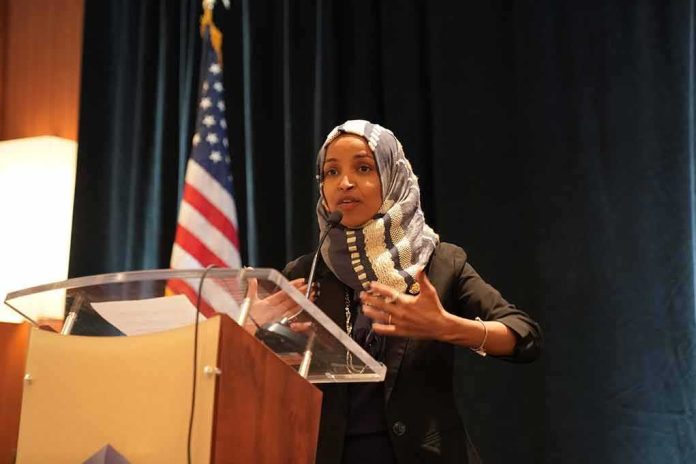
Denaturalization cases live at the narrow intersection of biography, paperwork, and exacting law; the Omar investigation matters because it tests whether decades-old immigration filings, if shown to contain a knowing and material falsehood, can unwind the citizenship of a sitting member of Congress — and because the government has unmistakably put real investigative muscle behind that question.
The Short Version
- Federal agents executed a judicially authorized search of Rep. Ilhan Omar’s Washington-area residence as part of an ongoing criminal investigation; DOJ confirmed the search’s existence and scope in general terms.
- According to major outlets, investigators are examining potential immigration fraud and false statements tied to whether Omar derived citizenship as a minor in 2000 and aspects of her late father’s immigration history.
- Agents reportedly seized devices and a passport, and a Minnesota grand jury issued subpoenas to relatives — signals of a serious, document-driven probe rather than mere political rhetoric.
- No charges have been filed; the legal bar to revoke citizenship is high and typically requires clear, convincing proof of a knowing and material misrepresentation that helped procure citizenship.
What investigators are actually probing
The Justice Department stated that Homeland Security Investigations executed a judicially authorized search warrant at Omar’s Washington-area home as part of an ongoing federal criminal investigation. That confirmation — sparse by design — establishes the core fact: this is not just a political food fight; federal agents obtained a judge’s approval to search for evidence of specific crimes. Subsequent reporting, sourced to people familiar with the matter, describes the warrant’s focus as conspiracy, false statements on immigration paperwork, and immigration fraud — categories directly relevant to how citizenship is obtained and documented.
The through-line tying these elements together is derivative citizenship: a minor can automatically derive U.S. citizenship upon a parent’s naturalization if statutory conditions are met. Several outlets report investigators are scrutinizing whether Omar’s documents reflected that she was 17 rather than 18 at the time of her father’s naturalization in 2000 — a detail that would be legally dispositive for derivative citizenship if proved false and willful. The same accounts say agents are reviewing her late father’s immigration history, including whether he concealed aspects of prior military service, an inquiry that could bear on the integrity of the family’s refugee and naturalization pathway.
Signals from the warrant, seizures, and subpoenas
Searches of a member of Congress’s residence are rare and require more than hunches; prosecutors must persuade a magistrate judge that there is probable cause to believe evidence of a crime will be found in the targeted locations. Reporting indicates agents seized Omar’s cellphone, computers, notebooks, and passport, and that a Minnesota grand jury has issued more than a dozen subpoenas, including to relatives, for testimony. If accurate, that inventory and the grand-jury activity point to a comprehensive records case aimed at reconstructing timelines, document histories, and who said what, when, and under oath or penalty of perjury.
Two caveats matter. First, a search warrant is not a finding of guilt; it signals that investigators convinced a judge there is reason to look — not that the government can carry the much heavier trial burden. Second, the warrant materials are reportedly sealed, so the public cannot yet assess the underlying affidavit, named witnesses, or documentary exhibits — a vacuum that inevitably invites partisan narratives to outrun the available facts.
The law that governs denaturalization — and why the bar is high
U.S. citizenship secured through naturalization or derivation can be revoked only under narrow statutory paths: if it was “illegally procured” or “procured by concealment of a material fact or by willful misrepresentation.” Over decades of Supreme Court decisions, courts have clarified two pillars. First, “material” means the falsehood had a natural tendency to influence — and, in practice, did influence — the decision to grant citizenship. Second, the government must prove its case with evidence that is clear, unequivocal, and convincing, a standard intentionally set above a normal civil preponderance to reflect the gravity of stripping citizenship.
That framework matters here. If the theory is that an age was misstated to qualify as a minor in 2000, investigators must marshal authenticated immigration records, corroboration from agency files, and testimony that demonstrates not merely an error in a public bio, but a knowing, material misrepresentation in the chain of applications that conferred citizenship. And if the inquiry extends to the father’s disclosures, prosecutors would need to show that any omission or concealment in his paperwork was legally required, willful, and material to his status in a way that, in turn, bears on Omar’s citizenship path — a more complex evidentiary bridge than the political talking points suggest.
What we know — and what we don’t
Three facts are durable. First, DOJ confirmed the search and active investigation; that is institutional, on-record, and independent of partisan spin. Second, major outlets report a focused scope: immigration fraud, false statements, and derivative citizenship timelines, along with a document-heavy evidence plan including devices, a passport, and grand-jury subpoenas. Third, there are no public charges, affidavits, or unsealed returns that lay out the government’s proof; until such filings exist, claims about specific false statements or intent rest on anonymous sourcing or inference rather than documentary exhibit numbers.
On the other side of the ledger, Omar has publicly denied wrongdoing and has offered an explanation for earlier biographical discrepancies — that an older 1981 date appearing in some public references was incorrect and later corrected to 1982. Independent fact-checking has likewise found that conflicting public biographical entries, including a Minnesota reference listing without underlying documentation, are not by themselves evidence of immigration fraud. Immigration practitioners quoted in coverage have emphasized both the government’s burden and the practical implausibility of hinging citizenship on an avoidable age misstatement when alternative legal paths existed at 18. These counterpoints do not refute the existence of an investigation; they go to its likelihood of success if the government ultimately files a case.
Mechanics and evidence: how cases like this are built
Denaturalization and related fraud cases turn on paper. Investigators reconstruct the original immigration file — refugee referrals, I-590s, asylum applications, Form N-400s, A-files, and State Department visa packets — and cross-compare dates, translations, signatures, and attestations. They pull school and medical records for independent age anchors, collect passport applications and renewals for sworn date-of-birth attestations, and subpoena relatives or caseworkers for context on who prepared which forms. In parallel, they obtain the parent’s files where derivative citizenship is asserted, looking for inconsistencies across interviews and security screenings. That is why the reported seizures and grand-jury subpoenas, if borne out, are significant: they are the raw material of any credible charge or civil complaint.
Defense teams, for their part, press two lines. First, they challenge materiality — arguing any discrepancy would not have changed the agency’s decision and thus cannot support denaturalization under Supreme Court precedent. Second, they contest intent — that a minor did not willfully misstate facts, that any parental omission was not knowing, and that subsequent government issuances (for example, a U.S. passport repeatedly renewed) reflect agency acceptance of the citizenship claim rather than fraud. Courts are accustomed to these debates; they demand specificity and provenance, not speculation.
𝐅𝐄𝐃𝐒 𝐒𝐄𝐈𝐙𝐄 𝐈𝐋𝐇𝐀𝐍 𝐎𝐌𝐀𝐑’𝐒 𝐏𝐀𝐒𝐒𝐏𝐎𝐑𝐓 — 𝐓𝐔𝐑𝐋𝐄𝐘 𝐒𝐀𝐘𝐒 𝐇𝐄𝐑 𝐎𝐖𝐍 𝐂𝐎𝐍𝐆𝐑𝐄𝐒𝐒𝐈𝐎𝐍𝐀𝐋 𝐅𝐈𝐋𝐈𝐍𝐆𝐒 𝐌𝐀𝐘 𝐑𝐄𝐏𝐄𝐀𝐓 𝐀 𝐊𝐍𝐎𝐖𝐍 𝐋𝐈𝐄
Federal agents didn’t just raid Rep. Ilhan Omar’s Washington home last week — they walked out with… pic.twitter.com/vXFoJOvWvC
— M.A. Rothman (@MichaelARothman) October 18, 2026
Politics at the edges, law at the center
There is no way to detach a high-profile federal search of a sitting lawmaker’s home from politics; the reported timing — within weeks of an election — and the broader enforcement push on denaturalization create fertile ground for claims of weaponization from one flank and impunity from the other. But in court, these atmospherics are irrelevant. What matters are authenticated records, sworn statements, and whether any misrepresentation was both knowing and material to citizenship. The government has, by multiple accounts, invested substantial investigative resources; Omar, for her part, has categorical denials and legal doctrines that set a high bar for revocation. Until the sealed record opens or charges are filed, that is the honest balance of the evidence: serious investigative steps on one side; no public proof of a willful, material falsehood on the other.
Sources:
facebook.com, nbcnews.com, npr.org, abcnews.com, wsj.com, washingtonexaminer.com, yahoo.com, constitution.congress.gov