

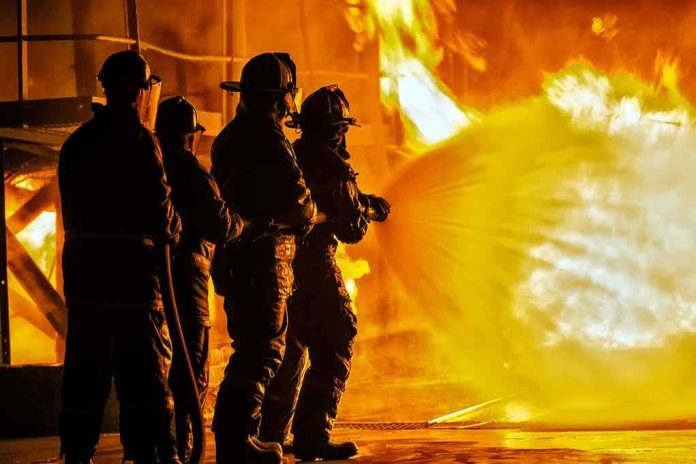
A mass-casualty fire on Canadian Forces Base Wainwright turned a routine afternoon into a national emergency: Ottawa confirmed both deaths and injuries, RCMP investigators were called in, and multiple fire and medical systems surged to contain a fast-moving blaze that crossed the base perimeter. This is what we know, how the response unfolded, and why the pattern of official disclosures looks the way it does in Canadian military incidents.
At a Glance
- Defence Minister David McGuinty confirmed fatalities and injuries after an incident at CFB Wainwright that triggered a major fire.
- The fire spread beyond the base’s training area in high winds, drawing multi-jurisdictional firefighting and medical responses.
- RCMP joined Defence officials in the investigation, underscoring the seriousness and formal nature of the inquiry.
- Hospitals and local authorities urged the public to avoid non-urgent care and keep access routes clear as casualties arrived.
What Happened: A confirmed deadly incident and a wind-driven fire
On an October afternoon, a serious incident on Canadian Forces Base Wainwright in eastern Alberta produced both fatalities and injuries, according to Defence Minister David McGuinty. He characterized the situation as very active and delicate while acknowledging that a large fire had broken out on the base and was being closely monitored by federal, provincial, and municipal partners. Multiple independent outlets reported the same core facts: the event occurred on CFB Wainwright, caused a major fire, and resulted in confirmed deaths and injuries. The precise casualty count and cause were not released during the initial ministerial briefing.
The fire did not remain confined to the range control area. Local authorities described flames crossing the base fence and moving rapidly under strong winds, an operational reality that complicated suppression efforts and triggered broader coordination across fire districts. The timeline placed the first emergency calls in the late afternoon, consistent with reports that responders faced deteriorating wind conditions as they established control lines and triage points.
Emergency response: How Canada mobilizes for base incidents
When a live-fire training base faces a fast-moving blaze on or near range areas, the playbook is well-rehearsed: base fire services and range control initiate incident command; municipal and provincial assets join under unified command; and medical transport—ground and air—is prioritized for the most critical patients. Reporting from the scene and from provincial hubs captured that rhythm, describing multi-jurisdictional firefighting and a surge of medical transports. The regional health system requested that residents avoid hospitals unless facing critical needs, preserving trauma capacity for incoming casualties. That request is a strong proxy for scale even when casualty numbers are not immediately public.
RCMP participation is a second telling marker. While base incidents often begin as safety events, RCMP involvement ensures criminality is ruled in or out and that scene preservation, chain-of-custody, and witness coordination meet evidentiary standards. McGuinty explicitly referenced RCMP engagement, aligning the response with Canada’s norm of parallel safety and law-enforcement inquiry in significant defence incidents.
What is known—and what was deliberately held
Ministerial confirmation centered on three load-bearing facts: there were deaths, there were injuries, and a substantial fire was burning at CFB Wainwright. The minister did not provide causal specifics—he declined to confirm whether weapons, ammunition, or other hazards were implicated—and he avoided releasing casualty counts while the situation was still being managed and next-of-kin processes were underway. This is not evasiveness by default; it reflects doctrine and law. Canadian Defence Administration Orders require prompt, accurate casualty reporting through internal channels while protecting personal information and preserving investigative integrity; the public release cadence often lags the internal CASREP cycle for those reasons.
The fire’s behavior was less ambiguous: contemporaneous local government updates stated that high winds helped carry flames beyond the base boundary. That account dovetails with responders’ reports that multiple jurisdictions were engaged and that the incident’s geography extended outside the initial training area. The operational picture—wide footprint, high winds, distributed response, and hospital surge—supports the minister’s description of an active and delicate situation.
Where Wainwright fits in Canada’s military-incident playbook
Base Wainwright is one of the Canadian Army’s principal live-fire training centers. When serious incidents occur on ranges, Canada typically activates a layered investigative architecture. Internally, the Department of National Defence and the Canadian Armed Forces document the event with formal incident logs and safety reviews; externally, or in parallel, police and coroners establish cause of death and consider criminal dimensions. The country has endured this choreography before: after the 1974 Valcartier cadet grenade explosion, authorities convened a military Board of Inquiry, coordinated with provincial police, and held a coroner’s inquest before finalizing findings and accountability—a process measured in months, not days.
While Valcartier is a different era and context, it illustrates a recurring pattern: initial public statements confirm consequences, not mechanisms; numbers and names follow next-of-kin notification; and only after technical reconstruction—origin point analysis, blast or burn pattern mapping, and records reconciliation—does Canada publish definitive causal narratives. Wainwright is tracking that pattern.
Mechanics of cause-finding: from scene to report
Determining how a range incident becomes a mass-casualty fire involves intersecting disciplines. Fire investigators establish origin and spread, often triangulating heat signatures, burn indicators, and wind data; ordnance and range-safety officers examine whether munitions, fuel, or training aids could have initiated or intensified the blaze; and police secure evidence to exclude sabotage or criminal negligence. In Alberta’s autumn wind regime, a spark that might be containable in still air can propagate across grassland and brush at speed; the technical question is what that initiating agent was and how it interacted with range materials, vehicles, or infrastructure. RCMP involvement alongside Defence signals that the final report will integrate both safety and law-enforcement findings.
The medical side also speaks to mechanism—patterns of injury can distinguish between blast, burn, smoke inhalation, and trauma sustained during egress. Hospitals’ decision to prioritize capacity for incoming casualties indicates they anticipated a mix of serious presentations consistent with a large fire incident.
FOUR CANADIAN SOLDIERS IDENTIFIED IN CFB WAINWRIGHT TRAGEDY — 39 INJURED, 19 IN CRITICAL CONDITION
BREAKING NEWS | OCTOBER 18, 2026 | ALBERTA, CANADA
WAINWRIGHT, ALBERTA — The Canadian Armed Forces have officially identified four soldiers killed in a devastating fire at… pic.twitter.com/pXeJy53Ynw
— CPRM Radyo 🇨🇦🇵🇭 (@cprm013113) October 18, 2026
What to expect next: timelines, disclosures, and accountability
In the near term, Canadians should expect three categories of updates. First, a formal casualty accounting—fatalities, injuries, and status—once next-of-kin processes are complete. Second, an operational chronology: when the incident began, how the fire moved, which agencies engaged, and how containment was achieved. Third, the causal analysis: whether the initiating event was mechanical, munitions-related, environmental, or a confluence of factors. Each tends to be released on a different timetable; the casualty list arrives first, the operational timeline next, and the technical cause last, after laboratory work and document reconciliation.
Why this matters: trust, training, and risk on Canada’s ranges
CFB Wainwright exists to train Canadian soldiers realistically, and realism brings managed risk. When that risk becomes real harm, the country asks two questions: were procedures and planning sound for the conditions on the day, and what must change to prevent recurrence? Clear, sequenced disclosures—anchored in evidence—are the only durable answer. In Wainwright, the facts already on the public record are consequential and uncontested: a deadly incident occurred, a high-wind fire spread beyond the range, the RCMP and Defence launched a formal investigation, and regional health systems treated incoming casualties. The rest will arrive the Canadian way—after investigators have finished their work and the families have been told first.
Sources:
thegatewaypundit.com, cbc.ca, nationalobserver.com, ctvnews.ca, lethbridgeherald.com, calgaryjournal.ca, cbsnews.com, canada.ca