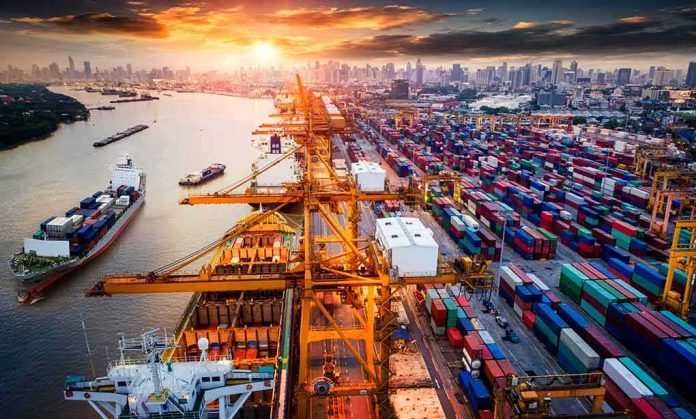
Tariffs change incentives; incentives change behavior. When Washington raises duty walls, the market does not wait for diplomats or think-tank panels to adjudicate legality — it reroutes. The line that matters is narrow but knowable: logistical transshipment is common and lawful, but disguising a product’s true economic origin to secure a better tariff is fraud. Congress is now tightening the system around that line because evidence shows years of evasion schemes exploiting it.
The Short Version
- Illegal transshipment is not a theory; U.S. agencies have issued formal evasion determinations and criminal cases documenting China-linked rerouting through third countries.
- Congress is moving to stiffen enforcement after years of origin fraud and duty evasion that grew with 2018–present tariff regimes.
- The White House estimates annual tariff losses in the tens of billions tied to transshipped China-origin goods, triggering a multi-agency crackdown.
- Beijing and some commentators contest the narrative, but their objections dispute characterization, not the specific U.S. case files and determinations.
What counts as illegal evasion — and what does not
Transshipment, properly defined, is the movement of goods through an intermediate hub on their way from origin to destination — as mundane as a Singapore feeder vessel or a bonded warehouse in Busan. It becomes illegal when that routing is paired with deception intended to change the declared country of origin: relabeling, repackaging, re-invoicing, or minimal processing that does not transform the good into a new article in tariff law. U.S. Customs and Border Protection (CBP) and the White House have been explicit on these distinctions in recent guidance and reporting; the enforcement target is the disguise, not the logistics itself.
In practice, adjudication turns on evidence: invoices that don’t match packaging slips, sudden surges of “local” exports from countries with no plausible industrial base in the product, or laboratory and supply-chain audits tying components back to a restricted origin. CBP makes these calls through the Enforce and Protect Act (EAPA) process and criminal investigations; both carry documentary records and, in the criminal context, convictions.
The record of evasion cases is specific, not speculative
Congress’s push did not emerge in a vacuum. A March 2025 letter from the House Select Committee on the CCP put agencies on notice about “numerous instances” of PRC-based actors violating U.S. trade laws by unlawfully transshipping through third countries to circumvent tariffs and duties — flagging false certificates of origin and other fraud mechanics as enforcement priorities. That political pressure intersects with a paper trail of agency actions. CBP’s EAPA determinations have found “substantial evidence” that importers routed Chinese-origin cast iron soil pipe and fittings through Malaysia to evade antidumping and countervailing duty orders — a textbook origin-fraud schema backed by investigative findings, not rhetoric.
The administrative record is reinforced by criminal and civil enforcement. CBP has publicized duty-evasion takedowns totaling hundreds of millions of dollars, including multi-country networks leveraging shell companies and third-country staging hubs to misdeclare origin on entry documents. Older but salient cases show the same pattern: goods shipped from China to the U.S., then shuttled to Mexico and reimported falsely as Mexican-origin to avoid duties — a closed loop that produced a conviction, not an allegation. Parallel industry analyses and law practices summarizing recent determinations underscore that falsified origin on China-made inputs routed via India or Indonesia has triggered EAPA findings and liability for AD/CVD and Section 301 duties.
Why the problem swelled — and why Congress is acting now
Economics explains the timing. When the tariff spread between two origins widens, so does the arbitrage opportunity. The 2018–present tariff structure on a wide array of China-origin goods created multibillion-dollar incentives to relabel or minimally process products in lower-tariff jurisdictions. The White House’s recent report put a number on the effect: an estimated $19–$26 billion in annual tariff revenue lost to goods, largely China-linked, routed through third countries to defeat U.S. import duties. Whether the upper or lower bound is closer to reality, the figure is large enough to command congressional attention and agency resources.
Accordingly, legislative proposals have aimed at both the front end and the back end of the pipeline. On the front end: more data, more targeting, and greater authority for CBP to suspend liquidation, require cash deposits, and pierce through shell importers quickly. On the back end: stiffer penalties, longer statutes of limitations, and task force structures to coordinate DOJ, DHS, and USTR — reflected in bipartisan bills framed around “fighting trade cheats” and “protecting American industry and labor” that specifically cite tariff evasion and transshipment fraud.
Competing views: criticism exists, but the decisive evidence sits in case files
Beijing’s response has been categorical: China’s Ministry of Commerce labeled the White House’s transshipment report a distortion that smears normal supply-chain diversification as a “scam”. Editorial voices sympathetic to that view warn against hyperbole and conflation of lawful supply-chain shifts with criminal fraud, cautioning that sweeping accusations can outpace proof and risk collateral friction with third countries. Those cautions deserve a hearing — logistics genuinely has diversified across Asia; not every detour is a disguise.
But objections in principle do not rebut specific determinations. EAPA findings hinge on documentary and investigative records — bills of materials, production records, site visits, and supply-chain tracing — that clear the evidentiary bar for “substantial evidence” under U.S. law. Where CBP has issued such determinations on Malaysia- or India-routed China-origin goods, those findings carry more weight than generalized diplomatic denials; the enforcement posture follows the files. Similarly, the revenue-loss estimate, while contestable at the margins, originates from the U.S. executive’s own cross-agency analysis and has been echoed in major outlets’ coverage; it sets the scale of the policy problem that Congress is addressing.
How enforcement is sharpening: mechanisms that matter
Three levers define the next phase. First, targeting: CBP’s analytics — from trade-flow anomalies to entity link analysis — now flag implausible origin shifts faster, with authority to impose interim measures under EAPA while investigations proceed. Recent agency statements describe networks spanning Indonesia, South Korea, and Vietnam tied to China-based exporters and U.S. shell importers, with hundreds of millions in underpaid duties identified — the sort of complex, multi-jurisdictional cases that benefit from data fusion and interagency work.
Second, legal architecture: clearer guidance on “substantial transformation” and de minimis processing helps both enforcers and compliant firms. The White House’s taxonomy of red flags — relabeling, repackaging, re-invoicing, and minor processing insufficient to change economic origin — gives trade practitioners a practical checklist to audit suppliers and avoid downstream liability. It also narrows disputes: is there a genuine manufacturing footprint in the alleged origin country, or just paperwork and light assembly?
Implications for importers, manufacturers, and allies
For importers, the message is simple: trust but verify — and document. Country-of-origin representations from brokers or suppliers are not shields if the underlying goods are China-origin and subject to AD/CVD or Section 301 rates. EAPA investigations can retroactively assess duties and impose penalties; civil and criminal exposure extends to those who “should have known” based on obvious risk signals like sudden supplier switches to low-tariff jurisdictions with no capacity to produce the product at declared volumes.
For manufacturers relocating legitimately, the burden is evidentiary, not ideological. Robust local production records, bills of materials, payrolls, and utility and capacity data help establish substantial transformation. Countries courting nearshoring should expect — and facilitate — verifiable transparency to avoid being treated as transshipment conduits by default.
The bottom line
The shape of the problem is cyclical: raise tariffs, and origin fraud attempts rise; improve enforcement, and schemes adapt or recede until the next spread emerges. What is different now is the scale — measured in tens of billions — and the maturity of the enforcement toolkit. Congress is aligning statutory teeth with that reality. The debate over tone and terminology will continue, but the decisive terrain is documentary: bills of lading, production records, and EAPA files. On that terrain, the case for a tougher U.S. stance is well-founded.
Sources:
redstate.com, uscc.gov, cleveland.com, hinson.house.gov, finance.yahoo.com, thehill.com, bbc.com, conference-board.org