

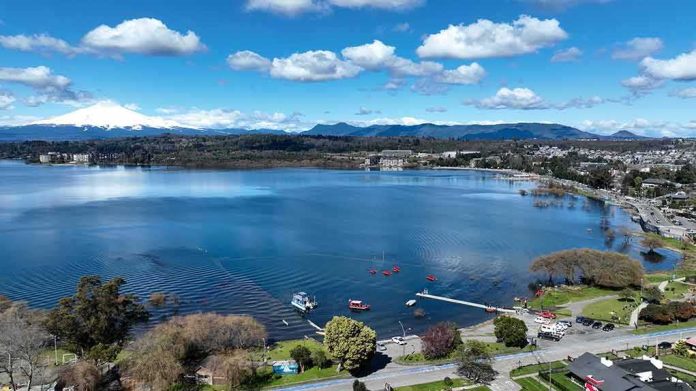
Federal place names are instruments of policy, not universal truth; President Trump’s directive to call Lake Ontario “Lake America” inside the U.S. government demonstrates how far presidential power reaches over federal nomenclature—and where it stops at the water’s edge.
At a Glance
- The executive order binds U.S. federal usage, not Canada, states, or private mapmakers.
- Implementation runs through the U.S. Board on Geographic Names and GNIS, the federal names database.
- Canada has rejected the rename outright and will continue using “Lake Ontario”.
- For transboundary features, dueling names are common; international standardization is rare and voluntary.
What the order actually does—and doesn’t do
President Trump signed an executive order instructing Interior and the U.S. Board on Geographic Names (BGN) to rename Lake Ontario as “Lake America” for federal purposes, to update the Geographic Names Information System (GNIS), and to scrub “Lake Ontario” from federal references going forward. The language is unmistakably an internal standardization directive—strong inside the federal government, irrelevant to non-federal actors unless they choose to follow it. Multiple outlets reported—and the administration framed—the scope as U.S. federal usage only, covering agency maps, databases, and communications, not international or Canadian usage. That is the constitutional lane: the president can steer executive-branch practice even when the rest of the world declines to come along.
Mechanically, GNIS is the linchpin. It is the canonical federal index of domestic place names maintained by USGS for the BGN; when GNIS changes, federal cartography, data products, and agency publications cascade to the new label over time. Past-practice guidance also keeps the superseded name as a “variant” in GNIS, which supports search and archival continuity even after a formal change. Within federal systems, then, “Lake America” will propagate—map tiles, datasets, procurement descriptions, and interagency correspondence—unless and until a later administration reverses course.
Why a president can dictate federal names
U.S. geographic names policy has been centralized—by design—since the 1890s. President Benjamin Harrison created the BGN by executive order to end inconsistent spellings and duplicative names across agencies; Theodore Roosevelt later expanded its remit to determining and changing domestic place names for federal use. Congress eventually codified the Board’s modern structure; today, its Domestic Names Committee (DNC) applies published procedures and maintains GNIS to standardize usage across the federal government. The critical boundary is jurisdictional: BGN decisions bind federal publications and systems. They do not dictate what states, private publishers, foreign governments, or international bodies must call a feature—least of all a transboundary one.
That boundary is the legal and practical hinge of the Lake Ontario episode. The executive order instructs Interior and the BGN on what to call the lake in federal products; it does not purport to rename the lake for Canada, the province of Ontario, the International Hydrographic Organization, or commercial map providers. The result is a clean, if narrow, exercise of executive control: sweeping inside the federal house; nonbinding everywhere else.
Canada’s response: history, language, and jurisdiction
Prime Minister Mark Carney rejected the U.S. rename immediately and categorically. He anchored Canada’s stance in the lake’s historical name—Ontari’io in Wendat usage—arguing both age and cultural continuity: “The name is more than 400 years old,” and Canadians will call it Lake Ontario “then, now and always”. Reuters, CBC, and other outlets captured the same through-line: Ottawa will stick with Lake Ontario, full stop. That response is not performative defiance; it reflects Canada’s own naming authorities and legal frameworks, in which the province of Ontario and federal Canadian bodies coordinate names for domestic and hydrographic products. There is no cross-border supremacy clause for toponyms.
For shared features, dual naming is the norm, not the exception. Countries routinely use different exonyms (a name used by outsiders) for the same physical feature; in some cases, neighboring states even formalize parallel names. U.S. federal policy acknowledges this reality: BGN standardization applies to federal publications and does not carry international effect. Canada declining to adopt “Lake America” is therefore not a diplomatic rupture so much as ordinary jurisdictional logic.
Transboundary naming is where cartography meets diplomacy
The Great Lakes are textbook transboundary features. When a feature crosses a line—political or maritime—the act of naming shades from technical cataloging into a signal of jurisdiction, history, and, in moments of friction, posture. Administrations reach for symbolic acts because they travel fast through bureaucracies: an internal name can change with a signature; a binational name requires years of coordination or a treaty-level understanding. That’s why the federal standardization tool is politically tempting and substantively limited at once. It guarantees uniform federal usage, but outside adoption is voluntary and often contested precisely when politics animate the change.
The administration’s stated rationale—that the deepest parts of the lake within U.S. territory and much of its volume lie on the American side—speaks to symbolic ownership more than to international law or hydrology. The order, as summarized in reporting, asserts a volume share and history of American exploration, settlement, commerce, and defense; the White House did not publish, with the order, a hydrometric or legal memorandum substantiating those claims. In any case, volume does not confer naming authority beyond federal usage; jurisdiction does, and only for one’s own house.
The implementation path and its limits
Expect the change to land first where federal systems are tightly managed: USGS basemaps, federal environmental datasets, NOAA and Interior web content, and new federal contracts referencing the feature. GNIS will record “Lake America” as the official federal name, with “Lake Ontario” retained as a variant for discoverability and historical continuity. Federal agencies will update gradually as map cycles, data releases, and content management systems refresh; some inertia is inevitable in large systems. None of this compels state GIS offices, Google or Apple Maps, the Canadian Hydrographic Service, or the Ontario Geographic Names Board to follow suit. For them, “Lake Ontario” remains canonical unless and until their own processes say otherwise.
This is why outside observers often read such moves as largely symbolic. Within the executive branch, the effects are real: standardization reduces ambiguity, improves search and data joins, and eliminates internal disputes. Beyond it, uptake depends on persuasion or alignment of interests. In contested, cross-border contexts, alignment is rare, and divergent labels often coexist for decades.
@RepMcCormick, how does “renaming” Lake Ontario Lake America give President Trump leverage? https://t.co/nGbk5RawmG
— Ulrik S. (@ulrik_s) August 28, 2026
How to judge durability
Federal place names set by order are only as durable as the institutions that maintain them. BGN procedures provide continuity across administrations, but a successor president can direct Interior to restore a prior name just as swiftly. By contrast, binational or international harmonization—when it happens—tends to persist because it arises from negotiated process, not unilateral fiat. If your interest is practical predictability on maps and in data, watch GNIS and major commercial basemaps. If your interest is diplomatic reality, watch whether any cross-border bodies or Canadian authorities so much as entertain “Lake America.” To date, Canada’s answer is no, and U.S. federal policy explicitly cannot convert that no into a yes.
Sources:
abcnews.com, whitehouse.gov, reuters.com, dallasexpress.com, cnbc.com, usatoday.com, cbc.ca, apnews.com, washingtonpost.com, ca.finance.yahoo.com, dailyhive.com, loc.gov