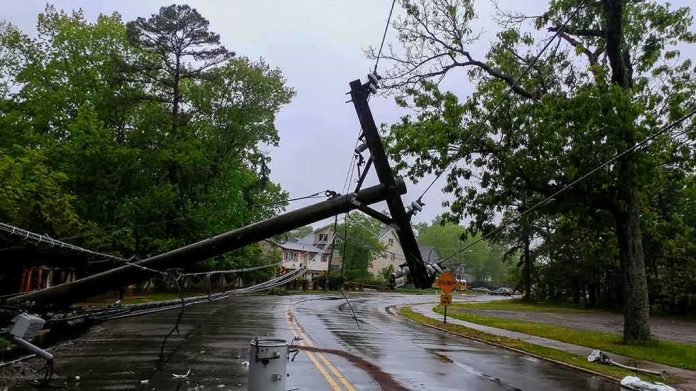
When power stays off for days or weeks, people understandably search for intent; but in prolonged urban blackouts like Gary, Indiana’s 2026 outage, the strongest evidence points to storm physics, restoration logistics, and years of underinvestment in vegetation and grid hardening—not a deliberate, race-based response—while still producing harsher consequences for Black and poorer neighborhoods.
At a Glance
- Officials and the utility tied Gary’s weeks-long outage to a severe August 2026 storm system—tornadoes, straight-line winds, flooding—that damaged distribution corridors across Northwest Indiana.
- Regulators and plaintiffs zeroed in on preventable factors: vegetation management and aging infrastructure that left the grid brittle, now the subject of a class-action lawsuit.
- NIPSCO publicly rejected claims of race-based prioritization, citing damage location and complexity; affluent areas were also dark.
- Independent research shows disadvantaged communities disproportionately endure longer outages after major storms—correlation and impact, not proof of intentional bias in a single event.
What actually failed: storm mechanics plus a brittle distribution system
The outage began with weather, not a dispatch choice. By the city’s account, the August system brought tornadoes, destructive winds, and heavy rain that felled trees and lines and flooded streets—the precise mix that shears distribution circuits, snaps poles, and isolates substations behind debris fields. The state’s emergency apparatus and FEMA treated it as a storm disaster, with President Trump approving an emergency declaration to speed federal support—language that specifies severe storms, straight-line winds, tornadoes, and flooding as the drivers. Those descriptors matter; they map to the failure modes utilities dread most: vegetation-on-wire contact, crossarms torn from poles, and feeder backbones blocked by downed trees.
Damage was not confined to one city block or one demographic. CBS and state reports pegged outages across Lake and Porter counties and well beyond, with tens of thousands still without power days later. That regional footprint constrains what any restoration leader can do: crews first “make safe,” then re-energize transmission and substations, then feeders with the highest customer counts and critical services—hospitals, water, and communications—before working down laterals and individual service drops. This triage is not ad hoc; it is codified in utility emergency operations playbooks and industry guidance for estimated time of restoration (ETR) and storm recovery.
Where accountability properly sits: maintenance, vegetation, and grid hardening
Storms expose the grid we have, not the one we wish we had. In Gary’s case, the legal and regulatory pressure landed on the right pressure points: whether vegetation was adequately managed, whether hazard trees were identified and removed, and whether investment flowed into the backbone in time to blunt the storm’s punch. Plaintiffs alleged NIPSCO failed to maintain safe clearances and inspect assets to industry standards; state leaders called for a review of tree clearing and the use of infrastructure funds promised in rate cases. These are not cosmetic issues. Vegetation is the dominant cause of storm-related distribution outages, and studies show enhanced clearances materially reduce vegetation-caused interruptions; the grid either earns resilience through year-round work or pays for its absence during the summer’s first major wind event.
A harder, less visible factor is regulatory sequencing. Utilities must win approval to allocate billions for “hardening”—stronger poles, covered conductor, sectionalizing, and targeted undergrounding—and to scale preventive vegetation programs. Denials or deferrals keep risk in the field. Industry analyses and trade reporting around the Gary event linked the restoration delays to exactly that infrastructure-vs.-regulatory tension, not to race-based decisions made during the outage itself. Accountability, in other words, lives upstream of the storm.
The claim of racial deprioritization vs. the public record
Residents’ anger was real and justified; two weeks off-grid is a humanitarian crisis. Some on camera ascribed the delays to Gary’s demographics and long experience with institutional neglect. Yet when we separate emotion from evidence, the on-record statements and contemporaneous reporting consistently attribute restoration order to damage patterns and operational triage. A NIPSCO spokesperson said the company had affluent areas out as well and denied any race-based prioritization; national coverage repeated the same explanation alongside restoration benchmarks (90 percent by Tuesday; full restoration by the following week).
City and state statements likewise framed the outage as storm-caused, while pressing the utility on performance and maintenance deficiencies. The through-line in formal documents, television reports, and regulatory actions is storm severity plus infrastructure fragility and vegetation exposure—not discriminatory dispatch. The class-action suit itself targets alleged negligence in tree trimming and asset management, not civil-rights violations. On the evidentiary scale—named officials, agency declarations, legal pleadings—the storm-and-maintenance explanation substantially outweighs claims of deliberate racial deprioritization.
Why disparities still show up—and how they are misunderstood
There is no contradiction between denying intentional discrimination in one outage and acknowledging that Black and lower-income communities bear longer outages, more often, across disasters. Multiple empirical studies—of Winter Storm Uri’s blackouts, of hurricane impacts across the Southeast, and of managed and hazard-induced outages—find that outage duration and severity correlate with socioeconomic vulnerability and minority concentration, even after accounting for storm intensity. Those patterns arise from infrastructure geography, housing stock, and the siting of critical facilities that influence restoration priority; fewer hospitals, fewer large customer clusters, and older overhead laterals translate into later turns in the restoration queue.
That distinction matters for solutions. If the problem is intent, the remedy is enforcement in the incident. If the problem is structure, the remedy is investment, planning, and metrics that force equity into the resilience baseline before the next storm. Equity in grid resilience is designed months and years in advance, not in the 72-hour sprint after landfall.
"We love Gary, we love this community." – WCK's Maureen
Our team is back at Lake Shore Common, alongside the Chicago Lunchbox food truck, serving Asian rice bowls to families in Gary, Indiana still without power. Residents from the building, all impacted by the ongoing outage… pic.twitter.com/7aAvpJnKTz— World Central Kitchen (@WCKitchen) August 25, 2026
What better looks like before the next storm
Four moves change outcomes. First, precision vegetation management—risk-based cycles, species-specific clearance standards, and hardening near top-percentile hazard spans—cuts storm outages at their root, quite literally. Second, sectionalizing and automation—more reclosers, smarter switches, and distributed fault indicators—shrink outage footprints from feeders to blocks, which compresses restoration times for everyone. Third, equity-weighted resilience planning bakes social vulnerability into capital planning and mutual-assistance staging, so crews don’t arrive last where household fragility is highest; many agencies now publish such guidance, and utilities can translate it into siting for community microgrids, critical load support, and priority feeder upgrades. Fourth, transparency: publish circuit-level vegetation backlogs, asset conditions, and post-storm restoration curves by census tract so communities can see, and regulators can verify, that restoration protocols perform as written.
Bottom line
In Gary’s long outage, the public record supports a storm-and-infrastructure failure narrative, not a deliberate race-based response. But the broader literature is unambiguous that disadvantaged communities too often sit in the dark longer after major hazards. Closing that gap is not a matter of rhetoric; it is vegetation budgets, grid hardening, restoration automation, and equity-weighted planning—executed before the sirens sound.
Sources:
gary.gov, cbsnews.com, tac-nrg.com, news.wttw.com, facebook.com, in.gov, theblaze.com, pmc.ncbi.nlm.nih.gov, hartman.byu.edu, wzy.ece.iastate.edu, par.nsf.gov, publications.jrc.ec.europa.eu