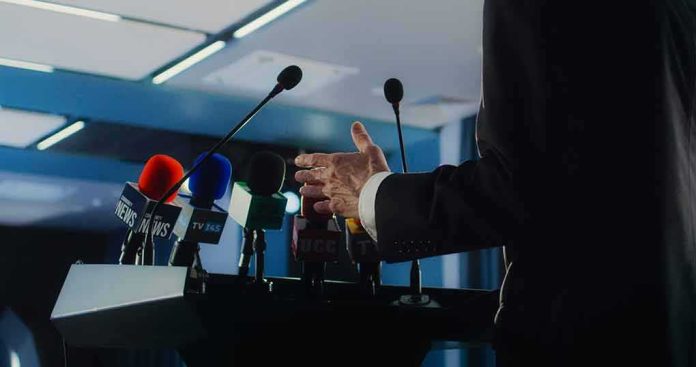
When a speech regulator reaches for its most coercive leverage against a news broadcaster years ahead of schedule, the real contest is not paperwork but power: whether the government may use licensing to discipline editorial judgment without crossing the First Amendment line.
At a Glance
- ABC has sued the FCC, alleging an unconstitutional, retaliatory campaign tied to the agency’s years-early call-in of eight ABC station license renewals.
- The FCC says the proceeding is a lawful public-interest inquiry linked to Disney’s DEI practices, not ABC’s content or viewpoints.
- Early renewal demands for a major broadcaster are extraordinarily rare, drawing alarm from former FCC officials and press-freedom advocates over chilling effects on news coverage.
- The legal fulcrum is viewpoint retaliation: if ABC shows the review was motivated by disapproval of speech, the inquiry itself can be unconstitutional—even absent a final sanction.
What ABC is alleging—and why the timing matters
ABC’s lawsuit squarely alleges that the Administration has “waged a retaliatory campaign” against its news and programming, using the FCC’s licensing process as the cudgel. The centerpiece is the Commission’s order requiring ABC to file years-early renewal applications for eight high-value stations, even though ordinary renewals are not due until 2028. ABC frames the move as unprecedented in modern practice and inseparable from on-the-record political ire directed at the network’s coverage and programming decisions. In litigation terms, this is a classic First Amendment retaliation theory: government action taken because of protected speech, where the process itself chills expression, can violate the Constitution even before any license is pulled or conditions imposed.
That theory resonates for a concrete reason: broadcast licenses are existential assets. When the regulator accelerates a review and signals that editorial choices are in the dock, the threat of hearing designation or adverse renewal is enough to alter newsroom behavior—a “chilling effect” courts take seriously. ABC has argued exactly that in filings and public commentary tied to the accelerated review.
The FCC’s stated rationale: public interest review and a DEI investigation
The Commission, led by Chair Brendan Carr, rejects the retaliation narrative. Carr has repeatedly asserted that broadcasters hold public licenses and must operate in the public interest—a statutory standard that, in the FCC’s telling, justifies calling in renewal applications when questions arise. The agency has linked the early review to concerns about Disney’s DEI policies and a long-running inquiry into potential discriminatory practices, not to ABC’s news judgment or political coverage. Carr has also emphasized that “all options remain on the table,” that the Commission will follow the facts, and that no decision has been made—signals meant to frame the process as neutral and open-minded rather than punitive.
On authority, the FCC points to its rules permitting earlier renewal filings when “essential to the proper conduct of an investigation.” That provision does exist; the real dispute is whether the investigation invoked here plausibly requires the extraordinary step of an early call-in for eight flagship stations, or whether the justification is pretext for pressure over speech. The answer to that question will likely decide the lawsuit’s core claim.
Why early call-ins are so rare—and why rarity is substantive
In modern broadcast practice, major-station license renewals are routine and track predictable cycles. Forcing an owner to apply early is vanishingly unusual; outside commentators and press-freedom groups have struggled to find a comparable major-broadcaster call-in in roughly half a century. Rarity matters for doctrine and for inference: the fewer neutral examples on the books, the harder it is to analogize this proceeding to “business as usual,” and the easier it is for challengers to argue the action is selective, targeted, and therefore suspect under the First Amendment when aimed at a critic’s newsroom.
That scarcity has drawn bipartisan concern from former FCC officials who warn that singling out a network through an accelerated license gauntlet sends a chilling message to the entire industry: editorial discretion is exercised at regulatory risk. Their public filing cast the review as a threat to speech masked as process—a characterization that, while not itself dispositive, underscores how far outside the norm the call-in appears to those steeped in agency precedent.
The legal stakes: retaliation, “jawboning,” and the public interest standard
The doctrinal hinge is motive. The First Amendment forbids the government from penalizing a speaker because of the viewpoints it expresses; that ban reaches not only direct censorship but also indirect pressure—what scholars and advocates call “jawboning,” where officials use regulatory sticks to coerce changes in content without a formal ban. In broadcasting, Congress reaffirms the same principle: the Communications Act’s Section 326 denies the Commission “the power of censorship,” even as it tasks the agency with ensuring licensees serve the public interest. The delta between those two mandates is where these fights live.
If a court credits ABC’s evidence that the early call-in was triggered by disapproval of ABC’s news and commentary, the action risks being unconstitutional regardless of the DEI framing; government may not launder viewpoint punishment through a neutral-sounding rubric. Conversely, if the FCC substantiates a bona fide, content-neutral investigation—germane to nondiscrimination or compliance—and demonstrates that early renewal is truly essential to conduct that probe, the action sits closer to ordinary oversight. The rarity of the tool, the congruence between investigative need and procedural burden, and any statements suggesting content-based animus will all loom large.
ABC SUES FCC, ALLEGING LICENSE REVIEW VIOLATES FIRST AMENDMENT
ABC sues FCC over challenge to its broadcast licenses, saying actions present 'existential threat'
ABC has filed a lawsuit against the Trump administration’s Federal Communications Commission, alleging violation of…— Worldwide News Network (@WorldwideNNX) August 18, 2026
Mechanism and consequence: how license leverage chills speech
Broadcast licenses are gateway permissions; without them, over-the-air stations cannot operate. Renewal proceedings expose licensees to petitions to deny, discovery-like scrutiny, and the specter of hearing designations that are costly and reputationally damaging. For a network group, compelling eight marquee stations into that posture years early multiplies risk and expense and invites adversarial filings keyed to recent coverage decisions. Even if no license is ultimately jeopardized, editors and executives can rationally moderate programming to avoid creating fresh fodder while the regulator is watching—precisely the chilling effect retaliation doctrine exists to prevent.
That is why former officials and civil society groups focus on process as punishment. The Commission’s most draconian remedies are rarely applied; the threat of deploying them, selectively and unusually, can be enough. Courts have treated such “credible threats” seriously when government power is near at hand and discretion is broad. The broadcast context, with its historical blend of content rules and a no-censorship command, is especially sensitive to that tension.
Where reasonable disagreement remains
There is a legitimate regulatory interest in ensuring that licensees comply with nondiscrimination law and operate in the public interest; the Communications Act means what it says on those obligations. The FCC’s rulebook does permit calling in early renewals to support an investigation. The question, however, is whether the factual record supports the necessity of invoking that tool here, and whether the surrounding rhetoric and sequence of events point to a content-based objective. On that evidentiary axis, ABC’s claim is materially bolstered by the sheer rarity of the mechanism and by the alignment of outside criticism from figures who once ran the agency’s processes themselves; the FCC’s defense rests on showing the DEI inquiry is both genuine and commensurate with the extraordinary procedural step it took.
A court will not accept conjecture. It will parse the administrative record, weigh public and internal statements for indicia of viewpoint animus, and ask whether less speech-burdening alternatives existed to pursue any legitimate compliance questions. If the answer is yes, the early call-in looks overbroad and retaliatory; if no, the agency’s process stands on firmer legal ground.
What it means for broadcasters and audiences
Whatever the outcome in court, the precedential signal is significant. If accelerated license reviews become a normal instrument for pressing culture-war grievances—on any side—broadcasters will adapt by avoiding edge cases in political coverage, candidate access, and live programming that might become regulatory tripwires. The result is safer television and a narrower public square. Conversely, if courts reassert bright lines against viewpoint-based use of licensing leverage, agencies will need to cabin their oversight to genuinely content-neutral compliance work and to tools proportionate to the investigative need. Either path clarifies the boundary between stewardship and censorship—an essential line in a system that still entrusts a speech regulator with renewing the presses of over-the-air news.
Sources:
twitchy.com, theguardian.com, npr.org, deadline.com, firstamendment.mtsu.edu, reuters.com, cnbc.com, usatoday.com, politico.com