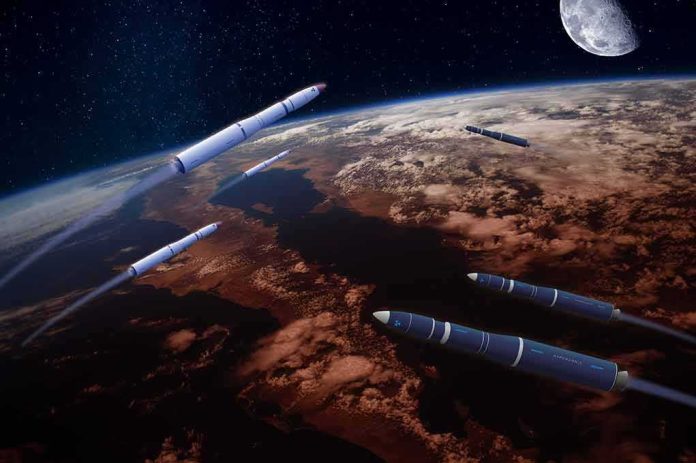
The impending impact of a spent SpaceX Falcon 9 upper stage on the Moon is not a portent of catastrophe but a precisely predicted, localized experiment in high-speed impact physics—one that says as much about how we track space junk as it does about the Moon itself.
At a Glance
- A derelict Falcon 9 upper stage (catalogued as 2025-010D) is forecast to hit the Moon near Einstein crater at about 06:35 UTC on August 5, 2026, at roughly 5,400 mph.
- The impact will excavate a new crater roughly a few tens of meters across and launch a plume of lunar dust and debris, but poses no danger to Earth or to people.
- The prediction, led by independent astronomer Bill Gray using Project Pluto orbital software, is accurate to seconds in time and kilometers in position, making this the best-characterized human-made lunar impact in history.
- Scientists plan to use Earth-based telescopes and lunar orbiters to study the flash, plume, and crater, turning an uncontrolled collision into a rare natural laboratory for impact science and space-debris policy.
A Spent Rocket on a One-Way Trajectory to the Moon
The object headed for the Moon is not an active spacecraft, but the inert upper stage of a SpaceX Falcon 9 that completed its job in January 2025. After delivering two private lunar landers on a trajectory toward the Moon, the roughly 12‑meter‑long, four‑ton stage was left in a highly elliptical Earth–Moon orbit with no fuel, power, or guidance remaining. From that point on, its path was governed entirely by gravity and solar radiation pressure—a piece of orbital flotsam gradually being nudged into a collision course.
Independent astronomer Bill Gray, best known in the professional community for his Project Pluto orbit-determination software, noticed something odd in 2025: disparate observations from ground-based telescopes, originally aimed at other targets, were all picking up the same faint, slow-moving object. By fitting those observations to orbital models, Gray reconstructed the trajectory and identified the hardware as a Falcon 9 upper stage left over from the January 15, 2025 lunar launch, now on track to intersect the Moon’s surface.
Gray’s latest published solution places the impact on 5 August 2026 at approximately 06:35 UTC, corresponding to 2:35 a.m. U.S. Eastern Time, with an impact point near latitude 19° N and longitude about 93° W, close to the lunar crater Einstein on the Moon’s western limb as seen from Earth. Other summaries quote 06:34–06:44 UTC and essentially the same coordinates, reflecting the fact that the prediction window has narrowed to a matter of seconds and a few kilometers, but is still expressed with sensible uncertainty.
What Happens When a Hollow Rocket Hits an Airless World?
The upper stage will strike at roughly 5,400 miles per hour—about 2.4 km/s, or seven times the speed of sound. That is considerably slower than the typical asteroid impact speed, which often exceeds 10–20 km/s, but still enough to release energy comparable to several tons of TNT. Because the Moon has essentially no atmosphere, there is nothing to slow, compress, or burn away the hardware during its final approach; the rocket stage will reach the surface largely intact, tumbling as it falls.
Impact-modeling work by planetary scientists, including teams led by Benjamin Fernando and others, suggests that the collision will excavate a new crater on the order of tens of meters across and several meters deep—roughly the size of a basketball court. Estimates gathered in media reporting cluster around about 20–30 meters in diameter and roughly 5 meters deep, though these are predictions from scaling laws, not yet measured values. The more important point is qualitative: this is a small, localized scar on an already heavily cratered lunar surface, not a landscape‑altering event.
When the stage hits, it will vaporize and fragment, coupling its kinetic energy into the upper few meters of the lunar regolith—the loose, dusty soil that blankets the Moon. That energy will blow out a plume of dust and excavated material that could rise tens of kilometers above the surface before falling back in a ballistic arc. Because the impact site is on the sunlit near side, any flash or plume will be superimposed on a bright lunar background, complicating detection from Earth.
Will anyone see it happen in real time? Here the record is genuinely mixed. Some astronomers and outlets suggest that large, fast cameras on big telescopes might catch a brief flash lasting less than a second. Others argue the flash will be too faint against the sunlit limb to be detectable at all, and that only the subsequent dust plume—if silhouetted against space beyond the limb—might be accessible to imaging for minutes after impact. The technical consensus is that it is worth trying: coordinated campaigns are planned to observe the event with narrow‑band filters tuned to specific emission lines and with high-speed detectors, but no one is promising fireworks visible in a backyard eyepiece.
Why This Impact Matters to Scientists
From a scientific standpoint, this crash is compelling precisely because it is uncontrolled but well characterized. Natural asteroid impacts on the Moon happen regularly, but the incoming objects are typically unknown in advance—astronomers do not know their mass, composition, or exact trajectory with precision. Here, by contrast, the impactor is a known piece of engineered hardware, built largely from aluminum-lithium alloys and composites, with a reasonably constrained mass between roughly 3.9 and 4.9 metric tons.
That combination of known impactor and predicted geometry allows researchers to treat the event as a calibration point for crater-scaling laws, ejecta plume dynamics, and impact-flash physics. Those laws underpin much of planetary science: they are used to estimate the ages of planetary surfaces from crater counts, to model how volatiles might be excavated from subsurface layers, and—crucially—to predict the consequences of potential asteroid impacts on Earth. Any real-world test of those models at known energy scales is valuable.
The 2026 impact also follows a puzzling precedent from March 2022, when a derelict rocket stage associated with China’s Chang’e 5‑T1 mission struck the Moon’s far side and produced an unexpected double crater—two overlapping depressions about 16 and 18 meters across. That morphology did not match the expectation for a single, hollow upper stage, and because the impact was on the far side, it could not be watched from Earth in real time. Lunar Reconnaissance Orbiter images revealed the double crater only after the event, leaving scientists to debate whether there were hidden masses on the rocket or gaps in their impact physics.
By contrast, the Falcon 9 upper stage is structurally and compositionally well documented, and its impact will occur on the near side in sunlit terrain. If it produces a single crater of the expected size, that outcome will strengthen the case that the 2022 double crater reflects peculiarities in that stage’s construction or undisclosed payloads. If, unexpectedly, a complex or multiple crater appears despite the simpler hardware, it would point to a deeper problem in how scientists model impacts of elongated, tumbling, hollow objects—an issue that would ripple outward into planetary defense and surface-age dating. In either case, follow-up imaging by NASA’s Lunar Reconnaissance Orbiter and other spacecraft will provide a definitive check.
Space Junk Beyond Earth Orbit: A Policy Blind Spot
Alongside the physics, this collision has become a case study in space-debris governance. The Falcon 9 stage is not violating any treaty by hitting the Moon; indeed, there is currently no binding international regime that addresses disposal of upper stages and mission hardware in cislunar space—the region between Earth and Moon—or beyond. Guidelines exist for lowering defunct satellites out of crowded low Earth orbit and for limiting long‑lived debris in geosynchronous orbit, but they say little about hardware sent toward the Moon or placed on escape trajectories towards the Sun.
Space agencies have demonstrated responsible disposal options in other contexts. Some lunar missions send their stages into heliocentric orbit—effectively out of the Earth–Moon system—to avoid long-term clutter. Others perform controlled impacts on the Moon as part of a planned experiment, as NASA’s LCROSS mission did in 2009 to search for water in a permanently shadowed crater. What distinguishes the 2026 impact is that it is unintentional: the stage simply ran out of fuel and was left in whatever orbit resulted from the mission design.
This is not, in itself, a scandal. A single four‑ton stage hitting the Moon once is a negligible addition to the lunar cratering record. But as commercial and national lunar activity accelerates—Artemis missions, private landers, proposed lunar communications constellations—the number of such stages and transfer vehicles will grow. Without clear norms and tracking obligations in cislunar space, more objects like 2025‑010D will wander through the Earth–Moon system unmonitored, occasionally colliding with the Moon or with future infrastructure.
The fact that the current event was discovered and characterized by an independent astronomer, working with open data and public software, underscores both the strength and the fragility of today’s tracking ecosystem. On one hand, it shows that skilled individuals, given access to enough observations, can provide impact predictions with precision surpassing many weather and seismic forecasts. On the other, it reveals that neither major space agencies nor military tracking networks were routinely cataloguing such debris in ways that would have flagged the impending collision for public discussion. As long as that gap persists, the narrative around cislunar debris will be driven by whoever notices something first—scientists, journalists, or, occasionally, sensationalist commentators.
How Visible—and How Dramatic—Will This Be for the Public?
For most people, this impact will be more significant as an idea than as a spectacle. The Moon will not split, wobble, or dim; tides on Earth will remain unchanged. The crater will be microscopic against the disk we see from our backyards, and even large observatories may struggle to register any transient signal above the bright limb. The best chance of catching something lies with carefully timed, narrow‑field observations from major telescopes, using high-speed imaging and tuned filters to pick out a brief flash or dust plume.
That subtle reality sits uneasily alongside the language of headlines and thumbnails about rockets “smashing,” “slamming,” or “crashing” into the Moon. The words are not wrong—this is indeed a high-speed impact—but they can imply drama on a human scale rather than on a geophysical one. For an object only five stories tall, striking an airless body that has weathered billions of years of asteroid bombardment, the effect is modest. The scientific community is interested not because the event is large, but because it is known, timed, and chemically distinctive.
Some observers worry that such coverage may blur distinctions between controlled and uncontrolled impacts, or between lunar and terrestrial hazard. There is a legitimate concern that the public might conflate a Moon‑impacting stage with the risk of rockets or debris falling on Earth, even though the basic orbital dynamics make that impossible in this case. The Moon is far outside the upper stage’s possible reentry corridor; the hardware is on a trajectory that either misses Earth entirely or, in this instance, intersects the lunar surface.
The more constructive way to frame the event is as a dress rehearsal for how we will observe, analyze, and discuss impacts in the increasingly busy Earth–Moon environment. Coordinated global observations, quick dissemination of impact solutions, and transparent follow-up imaging will all be part of how planetary scientists and space agencies build trust around their handling of debris and impact risks. In that sense, the small crater near Einstein will be less a scar and more a benchmark.
🚀A spent SpaceX Falcon 9 upper stage is expected to impact the Moon on the Earth facing side, Wed August 5 at about 01:35 AM CDT traveling at roughly 5,400 mph (8,700 km/h).
The collision will occur near the Einstein Crater.@RafStargazer @AJamesMcCarthy @SharpStarAstro… pic.twitter.com/40e4gXHsS0
— StarsAndScopes (@StarsAndScopes) August 2, 2026
Looking Ahead: From One Crater to a Debris-Conscious Moon
Once the dust settles—literally—the most enduring legacy of this impact will be the data it generates and the conversations it catalyzes. On the technical side, crater measurements and plume morphology will feed into models used well beyond the Moon. On the policy side, the event is already being cited in discussions of how to track and dispose of hardware in cislunar space, and how to ensure that commercial and national actors treat the Moon as more than a convenient dumping ground.
For the scientifically inclined observer, though, the heart of the story is simpler. Humanity has reached a point where a single astronomer, armed with a network of telescopes and sophisticated software, can say, “At 06:35 UTC, a specific human-made object will hit a specific spot on another world,” and be right to within seconds and meters. The upper stage, long inert, will have spent more than a year wandering through the Earth–Moon system; its final instant will be watched, modeled, and indeed learned from. That is not a catastrophe. It is, in a quiet way, a measure of how far our predictive grasp now extends—and a reminder that with that reach comes responsibility for what we leave behind.
Sources:
zerohedge.com, projectpluto.com, yahoo.com, abcnews.com, space.com, phys.org, usatoday.com, skyatnightmagazine.com, youtube.com, qz.com, forbes.com, reddit.com, instagram.com, facebook.com