

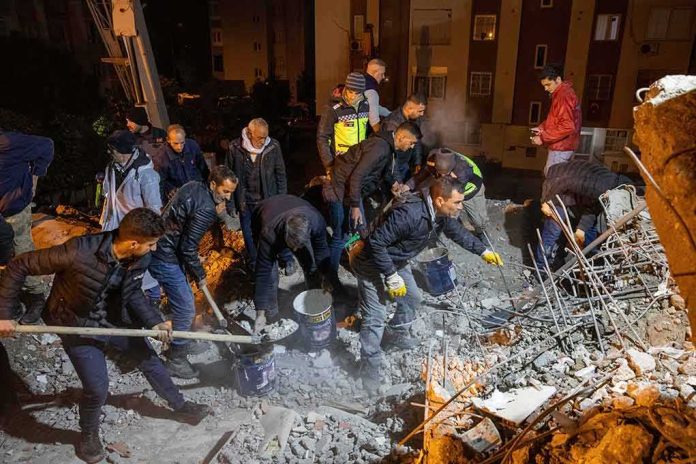
A crowded Japanese shopping mall turned into a deadly trap in seconds after a powerful earthquake and suspected gas explosion caused its second floor to collapse.
Story Snapshot
- A strong 7.1-magnitude earthquake hit southern Japan, damaging buildings and roads and injuring scores of people.
- The second floor of the Aeon Mall in Kashima Town collapsed after reports of an explosion, trapping many shoppers and workers inside.
- Local media and officials report multiple deaths and a “considerable number” of people feared buried in the rubble.
- Rescue crews are working through the night, searching for survivors as families wait for word on missing loved ones.
Powerful quake turns busy shopping day into disaster
Around late afternoon local time, a magnitude 7.1 earthquake struck Japan’s southern Kyushu island, shaking cities, toppling buildings, and cutting power in many areas. The Japan Meteorological Agency said the quake hit near Kumamoto, triggering a short-lived tsunami advisory for nearby seas before it was lifted. Bridges, roads, and homes suffered damage, and fires were reported in several spots as authorities rushed to understand the full impact. Officials say more than 100 people are injured so far, with that number likely to rise as reports come in.
Inside the Aeon Mall in Kashima Town, the quake was only the start of the nightmare. Police received reports of what sounded like an explosion at the shopping center shortly after the shaking, and witnesses saw smoke pouring from the building. Local broadcasters, citing fire officials, say the second floor of the mall collapsed during or just after the blast, leaving many people trapped under broken concrete, steel, and shattered glass. Customers and staff who could escape rushed to the outdoor parking lot as alarms blared and dust filled the air.
Rescuers race against time in collapsed mall
Japan’s Fire and Disaster Management Agency confirmed that the second floor of the Aeon Mall had collapsed while a large number of people were inside. Local fire departments reported “many people” trapped and began sending fleets of fire trucks, ambulances, and rescue teams to the site. Some early estimates from regional officials suggest about ten people are unaccounted for, while police earlier warned that between twenty and thirty mall employees could not be reached by phone. Rescue crews are working in dangerous conditions as aftershocks continue to shake the building.
Footage from the scene shows twisted beams, fallen ceilings, and storefronts ripped open, with rescuers clearing debris by hand and heavy equipment. Private broadcaster TBS quoted sources saying a “considerable number” of people are feared dead inside the mall, though police have not yet confirmed a final toll. Fuji TV and other outlets report multiple fatalities among those trapped in the building, and national broadcaster NHK says at least fifty people were taken to hospitals with injuries ranging from burns to broken bones. Doctors at one hospital described a steady stream of quake victims arriving with crush injuries and fractures.
Questions about safety, warnings, and everyday risk
While Japan is known for strong building codes and regular earthquake drills, this disaster shows how one failure can turn a normal place into a death trap. Early reports suggest the mall may have suffered a gas leak that led to the explosion, raising hard questions about inspection routines, maintenance, and who is watching out for ordinary shoppers. Many citizens in every country worry that big companies and government offices talk about safety but cut corners to save money, leaving regular people to pay the price when something goes wrong.
Live Updates
Rescuers race to find survivors in collapsed shopping mall after Japan earthquakehttps://t.co/mKc7gtyNZt— ninafromcanadaeh 💚🤍💜 (@ninafromcanada) July 28, 2026
For Americans watching from far away, the scene in Kumamoto feels painfully familiar: regular families caught in chaos while officials promise to “assess” and “coordinate.” People on both the left and the right in the United States often feel that elites manage risk for themselves, then expect everyone else to trust vague reassurances. This Japanese tragedy underscores a simple truth that crosses borders and party lines: when systems fail, it is workers, shoppers, and commuters who end up trapped in the rubble, hoping someone with real power still cares enough to act.
Sources:
insiderpaper.com, nytimes.com, turkiyetoday.com, france24.com, bbc.com, timesofisrael.com, youtube.com, tagesschau.de, vanguardngr.com