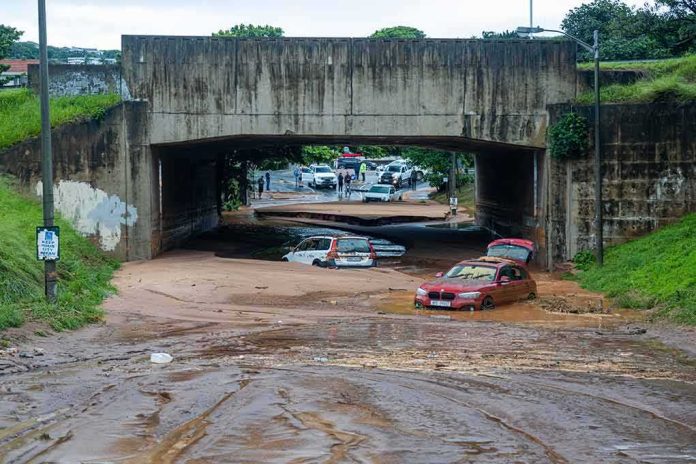
As deadly flash floods tear through West Virginia, the governor says some residents are still unaccounted for while search teams race to find them.
Story Snapshot
- Flash flooding in northern West Virginia has killed at least six people, with others still missing.
- Governor Patrick Morrisey has declared emergencies and says some residents remain unaccounted for as search-and-rescue operations continue.
- Hundreds of National Guard members and local crews are carrying out water rescues and door-to-door checks.
- Changing death and missing-person counts highlight how fragile life can be when government and infrastructure are tested by disaster.
Deadly Floods Leave Victims And Missing Residents
Over the weekend, intense rain in northern West Virginia turned quiet communities into disaster zones, killing at least six people and leaving others missing. Flash flooding hit Ohio County and nearby areas after about three to four inches of rain fell in under an hour, overwhelming streams, roads, and low-lying neighborhoods. A three-year-old child is among the dead, underscoring how quickly normal life can vanish when nature strikes faster than local systems can react.
Local officials first reported four deaths and four people unaccounted for, as crews tried to reach flooded homes and stranded cars. As recovery teams found more victims, the toll rose to six and then seven, while the number of missing shifted from four, to three, and then to at least two. These changing figures show what many Americans already suspect during crises: when the water is still rising, no one has a clear count, and families wait in fear for news.
Governor Says Some Are Unaccounted For As Search Efforts Expand
Governor Patrick Morrisey has told residents that state leaders are focused on finding the missing and supporting search crews on the ground. In one official update, he said there were seven confirmed fatalities and at least two people still missing as of 10:00 a.m. Tuesday, with state officials working alongside local emergency responders to locate those unaccounted for. In separate remarks, he said some residents were unaccounted for and that the state did not yet have an exact number.
To back up local responders, Morrisey declared states of emergency in Ohio County and Marion County, where flooding damaged roads, bridges, homes, and even caused an apartment building to partly collapse. He later expanded that step to a statewide emergency for all 55 counties as severe storms and flooding spread across West Virginia. Emergency declarations sound like paperwork, but they matter because they unlock money, equipment, and help from the National Guard and, eventually, the Federal Emergency Management Agency.
National Guard, First Responders And Neighbors Lead Rescues
As the water rose, first responders and neighbors did not wait for perfect plans; they went out in the dark to pull people from cars and flooded homes. Scanner traffic from north-central West Virginia described dozens of water rescues and life-threatening situations, with residents trapped by fast-moving water and cut-off roads. Reports from the hardest-hit counties say more than 100 people have been rescued, including elderly residents and shoppers stranded at a large store.
🚨 WEST VIRGINIA FLOODING DISASTER
Catastrophic flash flooding struck parts of West Virginia on Tuesday, July 21, after slow-moving thunderstorms dumped 5–7 inches (13–18 cm) of rain in just a few hours.
The flooding swept away vehicles, submerged homes and businesses, washed… pic.twitter.com/2twM9vEr1J
— ControversyMode (@controversymode) July 23, 2026
Governor Morrisey deployed hundreds of National Guard members to assist with swift-water rescues and damage checks in the worst-hit areas. State police teams began going door-to-door in impacted neighborhoods, checking on people who might have been unable to call for help when 911 centers and power systems were overwhelmed. Many residents describe scenes that look more like a war zone than a small American town, with washed-out bridges, broken gas lines, and piles of debris where streets used to be.
Changing Numbers And Wider Concerns About Government Readiness
News reports from this disaster show how death and missing-person counts shifted over several days, as bodies were found and some “unaccounted for” people turned up safe. One outlet cited three missing, another four, while later state updates spoke of at least two still unaccounted for. This is common in fast-moving disasters, but it feeds a deeper distrust many Americans already feel, on both the right and the left, about how clearly government tells the truth when lives are at stake.
Residents watching their roads, bridges, and 911 systems fail under pressure see more than one flood; they see proof that basic infrastructure and emergency planning have not kept up with real-world risks. Conservatives angry about waste and misplaced spending, and liberals worried about neglected communities and growing inequality, can both look at these floods and ask the same question: if leaders cannot keep people safe at home, what exactly are they doing with all that power and money?
Sources:
wvpublic.org, apnews.com, theepochtimes.com, governor.wv.gov, youtube.com, cbsnews.com