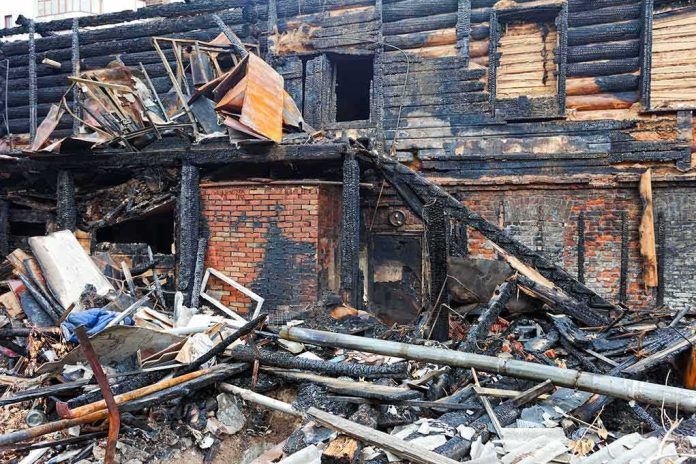
Fire investigators in Buffalo, New York, have ruled that a blaze which tore through the historic St. Ann’s Church complex was deliberately set, marking the second confirmed arson at the site within a year.
Quick Take
- Officials ruled a three-alarm fire at the former St. Ann’s Church in Buffalo an arson, four days after the blaze was contained.
- The site had already suffered a four-alarm fire at its school building six months earlier, also blamed on arson.
- Investigators found a makeshift bed near the rear entrance, suggesting someone may have been living inside the vacant structure.
- Buffalo Mayor Sean Ryan said the city will not spend an estimated $2 million to demolish the site.
- Online claims linking the fires to a proposed mosque conversion remain unconfirmed by any city record.
Arson Confirmed After Repeated Blazes at Historic Complex
Buffalo officials determined that a three-alarm fire at the former St. Ann’s Church on Broadway was arson, four days after crews contained the blaze. The fire struck the same site that had already been damaged by a four-alarm fire six months earlier, according to local station WIVB. That first blaze gutted the former St. Ann’s school building on Emslie Street in January 2026.
Fire crews responded to the school building around 11 p.m. on a Thursday night, and the small fire quickly grew to four alarms, engulfing the top floor and roof of the four-story structure. The building was left a roofless, frozen shell after the blaze, and repair estimates from the earlier fire alone topped $600,000.
Investigators Point to Human Activity Inside Vacant Building
Before officials called the July fire arson, investigators from WKBW said they found signs someone had been living in the abandoned structure. They described “a makeshift bed right at the entrance of that rear structure that the fire started”. Officials said “there is a human element involved,” though they stopped short of calling it arson until the investigation finished.
A local resident quoted by Reddit clarified that the July fire hit the school building next to the church, not the church itself, which stayed intact. That detail matters because St. Ann’s has stood as a landmark on Buffalo’s East Side for more than a century, and community members have watched the complex sit empty and increasingly damaged.
City Won’t Pay to Tear Down the Site
Buffalo Mayor Sean Ryan announced the city will not fund the roughly $2 million cost to demolish the fire-damaged complex. “If we demolish it, taxpayers will bear the cost,” Ryan said, pointing to the demolition price tag as too steep for city coffers. That decision leaves the scorched buildings standing, with no clear timeline for what happens next.
Online chatter has tied the fires to a disputed redevelopment plan for the property, including claims that part of the site could become a mosque. No city planning record or official statement confirms such a proposal, and reporting on the fires themselves has focused entirely on the arson findings and building conditions, not on any specific future use of the land.
A Pattern Seen Beyond Buffalo
Buffalo’s case fits a wider pattern seen in other cities where vacant, historic buildings catch fire under suspicious circumstances. In Toronto, investigators spent 18 months determining that a 2024 blaze which destroyed St. Anne’s Anglican Church was suspected arson, after early uncertainty about the cause. That fire destroyed priceless artwork, murals, and stained glass inside the century-old building.
Grok: "
Quote
📷
Eric Daugherty@EricLDaugh
·20h
Embedded video WTF?! 140-year-old St. Ann Church in Buffalo NY was just the victim of an ARSON attack as there is a push for the new owner to replace it with an Islamic Center This is now the second fire in one week. THIS… https://t.co/FGcatkUM0U
— KitSmithsonClinton (@smithson_kit) July 23, 2026
Fire officials nationwide generally treat empty, unsecured buildings as higher risk for intentional fires, since abandoned properties offer easy access and little oversight. Similar suspected-arson cases have hit vacant structures in Idaho and England in recent years. For Buffalo residents, the string of fires at St. Ann’s raises a simpler concern shared by neighbors on every side of the political spectrum: an empty, damaged landmark sitting unprotected in their community, with no clear answer yet on who set the fires or why.
Sources:
thegatewaypundit.com, wivb.com, youtube.com, facebook.com, wkbw.com, yahoo.com, audacy.com, cbc.ca