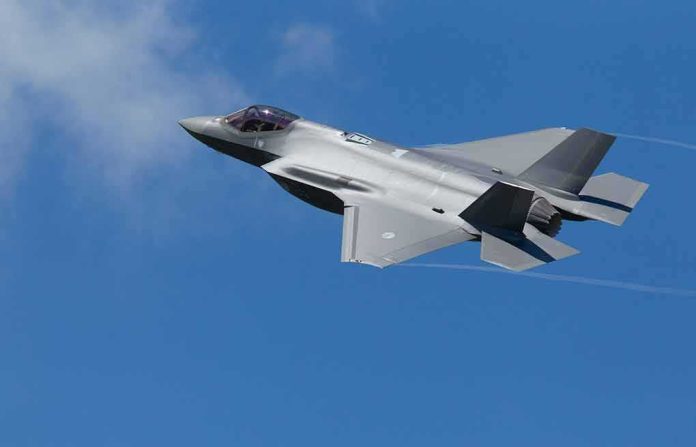
F-16 fighter jets were scrambled and flares were used after more than 10 civilian aircraft entered restricted airspace near the World Cup final in New Jersey.
Quick Take
- NORAD said more than 10 general aviation aircraft crossed into restricted airspace over Bedminster and East Rutherford.
- Three of those aircraft required intercepts by NORAD fighter jets.
- NORAD said flares were deployed during two intercepts to draw pilots’ attention.
- All of the intercepted aircraft were safely escorted out of the restricted zone.
NORAD Response Over New Jersey
The North American Aerospace Defense Command said it responded after civilian aircraft entered temporary flight restriction zones tied to the World Cup final and Trump’s presence in New Jersey. NORAD said more than 10 aircraft entered the restricted area, and three needed direct interception by F-16s. The command said all of the aircraft were safely escorted out after the violations.
NORAD also said the flares were used to pull the pilots’ attention back to the intercept. The command said the flares burn out quickly and do not pose danger to people on the ground. That detail matters because the visual of fighter jets releasing flares can sound more severe than the actual safety procedure described by the military.
Why the Airspace Breach Drew Attention
The incident landed in a setting already shaped by tight security and political tension. The World Cup final was treated as a major security event, with fighter jets and other security assets already part of the plan. Reuters and other reports on earlier Trump-related airspace incidents show that civilian aircraft near restricted zones have often been turned away rather than treated as hostile threats, which fits the pattern seen here.
That context explains why the story drew fast public reaction. Supporters of a hard security response see the intercepts as proof that restricted zones must be enforced quickly. Critics are more likely to see the episode as another sign of a government that often responds to airspace mistakes with dramatic force. The official record in this case supports the first fact and leaves the question of intent open.
What the Record Does and Does Not Show
What is clear is that NORAD confirmed the violations, the intercepts, and the flare use. What is not clear from the available reporting is whether any of the three intercepted pilots meant to enter the restricted zone. NORAD’s own language, as reported by multiple outlets, suggests many such violations are honest mistakes by pilots who did not check the latest restrictions.
🚨 THE SKYLINE SECURITY SCRAMBLE: NORAD F-16S DEPLOY FLARES OVER NEW JERSEY TO INTERCEPT INTRUDING AIRCRAFT DURING HIGH-STAKES 2026 WORLD CUP FINAL! 🚨
The high-density air defense perimeter over the tri-state area was forced into a dramatic, real-time military enforcement… pic.twitter.com/Mo2aUA4riT
— Boardroom Patriot (@nwmsound) July 21, 2026
That gap matters because the public debate often jumps from a breach to a motive. The evidence here supports a security response, but it does not prove a deliberate challenge to the restricted airspace. In practical terms, the episode shows how quickly routine aviation errors can trigger a high-profile military response when a president, a major sporting event, and a no-fly zone all sit in the same place.
Sources:
redstate.com, telegraph.co.uk, andhrajyothy.com, dotdotnews.com, dailybaku.az