
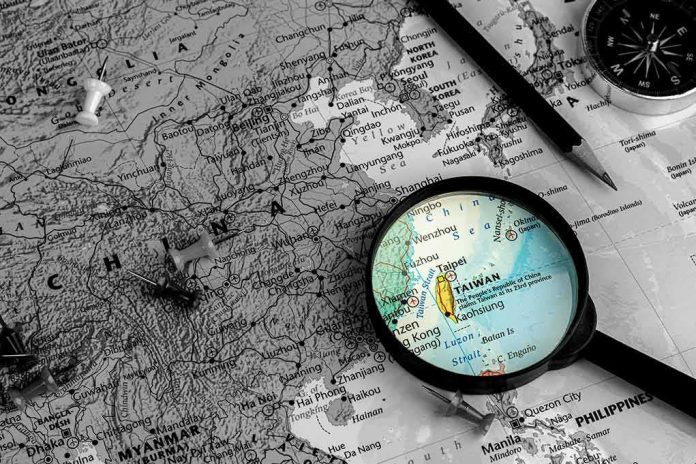
When Taiwan’s president warns of Beijing’s new “red terror” law reaching across borders, he is really asking if any free society is safe when distant elites claim the power to punish speech anywhere on earth.
Story Overview
- Taiwan’s President Lai Ching-te told his ruling party to unite against what he calls Beijing’s “red terror” and “legal warfare.”
- Lai says China’s new Ethnic Unity and Progress law could let Beijing target people outside China, including Taiwanese it labels “separatists.”
- He reaffirmed that Taiwan is a sovereign nation, the Republic of China, not subordinate to the People’s Republic of China.
- Beijing rejects this and insists Taiwan is part of China, deepening a clash that worries citizens who see unaccountable power on both sides.
Lai’s Warning: ‘Democratic Taiwan Must Not Become China’s Taiwan’
At his Democratic Progressive Party convention, President Lai Ching-te told members that democratic Taiwan must never be turned into “China’s Taiwan.” He urged the party and the public to “work together to protect our democracy” and resist what he called communist China’s “red terror.” Lai framed the dispute in simple terms: Taiwan is already an independent nation under the name Republic of China and “is not subordinate” to the People’s Republic of China. For many ordinary people, that sounds less like lofty theory and more like a basic fight over who gets to control their lives.
Lai’s language fits years of growing fear on the island about China’s use of pressure that never looks like open war but feels like constant intimidation. Taiwan faces near-daily military flights, cyber attacks, and economic moves that punish its choices. When Lai speaks of “red terror,” he is tapping into a wider worry seen in many countries today: powerful states and unelected party elites using tools of law, trade, and information to silence critics without ever firing a shot. For Americans who distrust their own deep state, this sounds uncomfortably familiar, even on the other side of the world.
China’s New Ethnic Unity Law and Fears of ‘Legal Warfare’
The spark for Lai’s latest warning is China’s new Law on Promoting Ethnic Unity and Progress, passed in March and in force since July 1. The full text puts ethnic policy directly under Chinese Communist Party control and orders schools, media, businesses, churches, families, and online platforms to promote one state-defined Chinese identity. One article tells officials to expand exchanges with Taiwan to “strengthen Taiwanese people’s sense of belonging” to a single Chinese nation. For people in Taiwan, that does not sound like friendly outreach; it sounds like a blueprint for quiet, slow absorption.
Most alarming to Lai and many legal experts is Article 63 of the same law. It says organizations and individuals outside China can be held legally responsible for actions that Beijing says “damage ethnic unity” or create “ethnic division.” The article does not clearly say what conduct counts or how China would enforce this abroad. Taiwan’s Foreign Ministry calls it an attempt to use domestic law for “long-arm jurisdiction” and transnational repression, warning that such vague language pushes people to censor themselves. When a foreign government claims the right to punish speech anywhere, it raises the same basic fear Americans have about unaccountable power at home: who decides what is “wrong,” and who stops them from abusing that label?
Competing Sovereignty Claims: Two Governments, One People?
Lai’s firm line on sovereignty is not new but has become sharper since he took office. In his inaugural address, he said clearly that “the Republic of China and the People’s Republic of China are not subordinate to each other.” He argues Taiwan is a sovereign state with its own constitution, elections, and military, and that only the people of Taiwan can decide their future. This matches a long trend under his party, which rejects Beijing’s “One China” claim and stresses that Taiwan already functions like an independent country in almost every way.
Beijing answers with equal certainty from the other side. Chinese leaders say Taiwan’s status as part of China “has never changed and will never change.” Official statements insist that “both sides of the Taiwan Strait belong to one and the same China and Taiwan is part of China’s territory.” Party documents tie “complete unification of the motherland” to national revival and treat any push for Taiwan independence as a threat that must be fought. For people on the ground, these clashing claims feel less like legal theory and more like two distant capitals arguing over who owns them, while everyday concerns about jobs, housing, and safety rarely come first.
What This Means for Ordinary Citizens and a Distrusted Global Elite
The fight over Taiwan touches deep frustration many Americans already feel about their own federal government. Lai warns that China uses “political warfare” and united front tactics to infiltrate societies and weaken their will to resist. Research shows Beijing mixes military pressure, economic leverage, and media influence to push its story that Taiwan must one day be absorbed. Citizens watching this from the United States see yet another example of powerful insiders writing rules that suit themselves, while regular people in Taiwan are left to carry the risk if things ever turn hot.
At the same time, some observers argue Lai’s sharper stance also raises the odds of crisis. His strong words about sovereignty anger Beijing and can give hawks there an excuse to push harder. For Americans tired of endless wars and foreign entanglements, this is a warning: when distant leaders on all sides chase their own agendas, common citizens end up squeezed between rival “solutions” they never truly chose. Lai’s call to resist “red terror” is not only about Taiwan. It is a reminder that wherever law is turned into a weapon by elites, the basic dream of building a better life through work and effort is the first thing placed in danger.
Sources:
zerohedge.com, nbcnews.com, reuters.com, english.president.gov.tw, theepochtimes.com, english.news.cn, mfa.gov.cn, us.china-embassy.gov.cn, chrissmith.house.gov, taiwanpolitics.org