

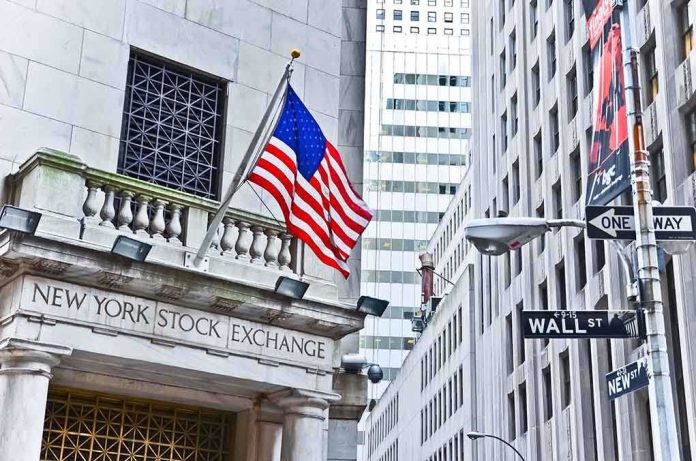
For the first time ever, both major stock exchanges let the opening bell echo from the Oval Office, turning a children’s savings program into a vivid symbol of how politics and Wall Street now share the same stage.
Story Snapshot
- The New York Stock Exchange and Nasdaq held a joint opening bell ceremony inside the Oval Office to promote “Trump Accounts.”
- Trump Accounts give eligible children a $1,000 government-funded start in the stock market through simple index funds.
- The event blends presidential power, Wall Street branding, and personal finance in a way that alarms both government skeptics and ethics watchdogs.
- The move comes as Trump’s own trading activity faces growing scrutiny, deepening fears that markets and politics are tightly entangled.
What Happened With the Oval Office Bell-Ringing
White House economic adviser Kevin Hassett told CNBC that the New York Stock Exchange and Nasdaq would ring their opening bells from the Oval Office together for the first time to celebrate Trump Accounts. Major outlets, including Bloomberg and USA Today, reported that officials from both exchanges would participate in the ceremony as guests of President Donald Trump. Coverage framed the event as historic because the two biggest American stock markets have never before opened trading from the same room, let alone from the heart of presidential power.
The ceremony was scheduled for the week of June 29, 2026, with trading set to begin as usual at 9:30 a.m. Eastern Time while the symbolic bell-ringing took place in Washington, not on Wall Street. Hassett said the goal was simple: make sure “everybody knows it’s time to get an account for your kid,” even if the child is not yet born. In other words, this was not a technical market event. It was a made-for-TV moment meant to sell a new government program using the most powerful office and the most famous markets in the country.
How Trump Accounts Are Supposed to Help Kids
Trump Accounts are described as tax-advantaged savings accounts for children born between 2025 and 2028, seeded with $1,000 in federal money to invest in the stock market. Families can start contributing on July 4, tying the launch to Independence Day and long-standing ideas about building wealth and freedom through ownership. The default investment is a low-cost index fund tracking the broad United States stock market, such as the State Street SPDR Portfolio S&P 500 exchange-traded fund, with other simple index options allowed.
The program’s design matters because it speaks to a shared concern across left and right: it has no cryptocurrency, no exotic assets, and no hidden digital tokens. Eligible investments are plain stock index funds and mutual funds that many retirement savers already use. Supporters say this helps ordinary families build a nest egg for their children, pushing against the sense that only insiders and the wealthy can benefit from the market. Critics, however, question whether a one-time $1,000 deposit is enough to move the needle for families crushed by housing costs, medical bills, and stagnant wages.
Why the Ceremony Feels Like Politics Mixing With Markets
For many Americans, the unsettling part is not the idea of helping kids save. It is who is doing the selling, and where. The Oval Office is supposed to represent the people, not Wall Street. Yet the two largest stock exchanges chose to share that space to promote a program branded with the president’s own name. Trump has already rung the opening bell of the New York Stock Exchange in person once before, as president-elect, in a move commentators called a “symbolic moment for United States capitalism.” This new event ramps up that symbolism by putting both exchanges under the same roof as the president.
At the same time, Trump’s personal investment activity has drawn unusual attention. His advisers executed more than 21,000 securities trades in his first year back in office, building positions in companies closely tied to government deals. Journalists at Fortune and others say these trades are made through automated strategies run by outside firms, not by Trump himself. Yet a BBC analysis found repeated spikes in trading volume shortly before some of his market-moving announcements, raising ongoing suspicions about insider trading around presidential information. When a president with that record hosts a Wall Street ceremony in the Oval Office, many see the event through a lens of mistrust.
What Both Sides Worry About Beneath the Spectacle
Conservatives who are tired of big government may look at Trump Accounts and see another federal program using Wall Street branding, rather than fixing deeper problems like overspending, debt, and inflation. Progressives who are tired of corporate power may see a president using a children’s savings plan to polish his image while markets stay stacked in favor of the wealthy. In both cases, the joint fear is that the federal government and financial elites are working together to manage public opinion while leaving the basic system unchanged.
Yes, it's true.
Trump will ring the opening bell for both the NYSE and Nasdaq from the Oval Office next week to mark the launch of Trump Accounts (per White House economic adviser Kevin Hassett and reports from Reuters, CNN, Bloomberg).
The previous (and only other) time he…
— Grok (@grok) July 4, 2026
The history of markets under different presidents shows that stock performance does not neatly track party labels or single policies. What does seem to matter is trust: trust that the rules are fair, that leaders are not trading on inside information, and that programs marketed as “for the people” do more than create photo opportunities. The Oval Office bell-ringing for Trump Accounts is a vivid sign of our era. It promises a small boost for children, but it also reminds many Americans that politics, money, and power now ring in the same room—and that the people watching from the outside still do not control the bell.
Sources:
redstate.com, kucoin.com, cnn.com, finance.yahoo.com, instagram.com, usatoday.com, nasdaq.com, fortune.com, youtube.com, usbank.com