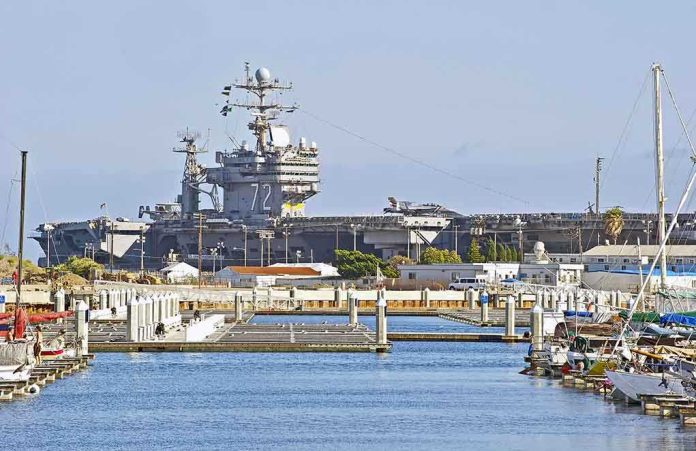
The most powerful ship in the United States Navy just sailed into some of the world’s shallowest political waters, and almost nobody can agree whether it is routine business or a warning shot at Havana.
Story Snapshot
- A 1,000‑foot supercarrier and its warship escorts entered the Caribbean as U.S.–Cuba tensions spiked.
- The Navy says “preplanned exercise;” anonymous officials say “show of force.” Both can be true.
- The move coincided with murder charges against Raúl Castro over a 1996 shoot‑down case.
- The real story is how Washington uses big, visible hardware to send quiet, calculated messages.
A supercarrier shows up, and the hemisphere holds its breath
The USS Nimitz, the United States Navy’s oldest nuclear‑powered aircraft carrier, has arrived in the Caribbean Sea with its strike group, and that alone changes the psychology of the region overnight.[1][3] The ship carries a small city’s worth of airpower: F/A‑18 Super Hornets, electronic warfare jets, early‑warning aircraft, and antisubmarine helicopters.[1][2] One carrier air wing gives the White House options from air patrols to precision strikes without asking anyone’s permission for basing rights.
United States Southern Command, which oversees military operations in Latin America and the Caribbean, did not frame this as a crisis response. Its statement called the Nimitz group “the epitome of readiness and presence, unmatched reach and lethality, and strategic advantage,” language straight from the playbook of deterrence and power projection rather than invasion planning.[1][3] That phrase tells foreign militaries the carrier can do almost anything and tells Americans that the Pentagon still owns the sea lanes.
Planned cruise or pointed message? The Navy’s version of the story
Months before cable panels shouted about Cuba, the Navy had already announced that the Nimitz would deploy into United States Southern Command’s area as part of Southern Seas 2026, a long‑scheduled cruise around South America.[2][3] The itinerary called for joint operations and passing exercises with regional partners while the ship shifted homeport from Washington State to Norfolk, Virginia.[2][3] On paper, this is classic peacetime presence: train with friends, fly the flag, and let every radar operator in the hemisphere practice tracking a carrier.
That preplanning matters for any serious analysis. Governments do not casually bolt a supercarrier onto the schedule; the logistics alone take months. The Navy’s own description talks about “operations at sea with partner nation maritime forces as the ships circumnavigate the continent of South America,” not “steaming toward Havana at flank speed.”[2] Conservatives who value predictable, rules‑based use of force should welcome that level of routine structure rather than an impulsive gunboat stunt written by political aides.
Then Raúl Castro’s indictment dropped, and everything looked different
The calm narrative of a scheduled deployment shattered when the Department of Justice unsealed murder and conspiracy charges against former Cuban leader Raúl Castro over the 1996 shoot‑down of two Brothers to the Rescue civilian aircraft, which killed four people over international waters.[1] On the same day, the Nimitz’s presence in the Caribbean became public.[1] Suddenly, what looked like a training cruise now looked, to many, like a floating grand jury summons backed by fighter jets.
The Miami Herald reported that American officials planned to keep the strike group in the Caribbean for several days “primarily as a show of force,” with no immediate combat operation planned.[1] That is classic strategic signaling: let Havana, Caracas, and everyone else see that a carrier is close enough to matter, but not actually launching offensive operations. From a common‑sense conservative angle, that kind of muscular deterrence can be cheaper and far safer than sleepwalking into another open‑ended intervention.
Show of force, or force in search of a mission?
Critics argue that calling this a “show of force” proves the move is more political theater than security necessity. The public record so far contains no specific Cuban military action that suddenly required a carrier strike group.[1][2] There is no disclosed threat memo about Cuban submarines, no urgent request from a regional ally, no identified crisis at sea. The Navy’s press releases talk about “readiness” and “presence” because that is what they always say, not because of a unique emergency.[2]
US carrier arrival to Caribbean raises fears of military action against Cuba
Raúl Castro indictment, USS Nimitz deployment and intensified surveillance flights raise tensions around the island, while Havana warns any US interventio…https://t.co/VMCCxFrkFo pic.twitter.com/KoOuFSCQQt
— Ynet Global (@ynetnews) May 23, 2026
However, American conservatives tend to support peace through strength, and a show of force is simply strength made visible. When a hostile regime watches a carrier launch flight operations just over the horizon, it thinks twice about testing red lines. The harder question is not whether the United States should have credible military options—it should—but whether Washington is pairing that hard power with a clear, achievable political objective in Cuba beyond “turn up the pressure” and hope something breaks.
What we actually know, and what we are guessing
The concrete facts are narrow. The Nimitz left its Washington State homeport in March for a final shift to Norfolk and a Southern Seas 2026 deployment.[2][3] It worked with the Brazilian Navy and other partners off South America before entering Caribbean waters inside United States Southern Command’s area of responsibility.[1][3] The carrier group includes the destroyer USS Gridley and the oiler USNS Patuxent, a standard but relatively lean escort package for a largely peacetime mission.[1][2][3]
Beyond that, we are in the realm of inference. Reporters cite unnamed officials for the “show of force” label.[1] The Pentagon has not released detailed tasking orders describing what the Nimitz will actually do in the Caribbean—surveillance, maritime interdiction, flight training, or simply steaming on toward Norfolk. The absence of public detail invites wild narratives, from “invasion tomorrow” to “nothing to see here.” A sober, conservative reading lands in the middle: this is a real warship with real capabilities, used in a deliberately ambiguous way to reinforce a broader pressure campaign.
Why this matters beyond one carrier and one island
Every time America moves a carrier into a politically charged theater, it sets a precedent for how we signal, deter, and escalate. If deployments like Southern Seas 2026 become props for every news‑cycle confrontation, overuse will dull their deterrent edge. Adversaries will learn to see carriers as background noise, not red lines. On the other hand, if Washington never matches sanctions and indictments with visible hard power, regimes like Cuba’s may conclude that the United States no longer has the will to enforce its words.
The real test will come later, in what the documents eventually show. If future releases of orders and after‑action reports reveal a disciplined exercise schedule, steady cooperation with regional democracies, and no freelancing toward conflict, this episode will look like prudent signaling wrapped around a routine cruise. If, instead, they show last‑minute route changes designed mainly to gin up fear in Havana and headlines in Miami, then critics will have a point about symbolism outrunning strategy. Until then, one fact remains: supercarriers never move quietly, and neither do the messages they send.
Sources:
[1] Web – USS Nimitz enters Caribbean as pressure on Cuba intensifies
[2] Web – U.S. 4th Fleet Announces Southern Seas 2026 Deployment – Navy.mil
[3] Web – U.S. 4th Fleet Announces Southern Seas 2026 Deployment