When political commentary fuses apocalyptic theology, ethnic identity, and personal grievance, the argument is no longer just about one remark; it becomes a test case for how modern media handles truth, accusation, and the weaponization of “racism” in public life.
Key Points
- Tucker Carlson did, on tape, ask whether Donald Trump could be the Antichrist, and later flatly denied using those words despite readily available recordings.
- Carlson insists his critique is about moral arrogance and “mocking the gods of his ancestors,” not about ethnicity, yet his language inevitably invokes ancestral and religious identity.
- Mainstream outlets and many critics read his pattern of rhetoric—especially his fabricated description of Kamala Harris’s ethnicity—as racist or bigoted, reinforcing a hostile frame around the Antichrist discussion.
- Neither side brings serious legal, theological, or scholarly evidence to the narrower claim that “celebrating immigrant success based on ethnicity” is inherently racist; that part of the debate is largely rhetorical.
- This fight fits a broader pattern in which religiously charged political commentary triggers claims of bigotry and defamation, raising stakes not just for reputations but for how public discourse polices itself.
The Core Dispute: What Carlson Said, and What He Denies
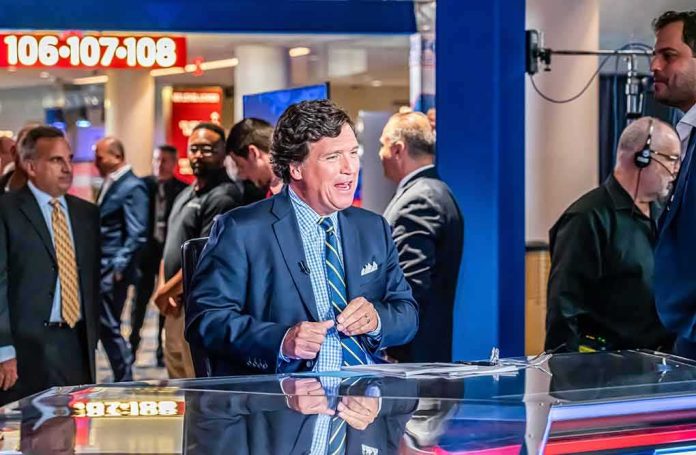
The starting point for this controversy is not what critics say about Tucker Carlson; it is what Carlson said about Donald Trump, on his own program, and what he later denied having said. In an April 15, 2026 podcast episode, Carlson discussed Trump’s use of AI-generated imagery of Jesus and broader conduct he viewed as religious mockery. In that segment, he described a leader “mocking the gods of his ancestors, mocking the God of gods, and exalting himself above them” and then posed to his audience: “Could this be the Antichrist? Well, who knows?”[4] The phrasing matters. Carlson framed the notion as a question rather than a declaration, but the language unmistakably links Trump’s behavior to the biblical figure of the Antichrist. Multiple video clips from that episode circulate on YouTube and Instagram, preserving the exact question he asked.[3][9]
Yet when New York Times reporter Lulu Garcia-Navarro later confronted Carlson about these remarks, he denied ever saying, “Could this be the Antichrist?” and claimed, “Those words never left my lips,” even casting doubt on whether he truly understands what “Antichrist” means if there is only one.[1][2] The problem for Carlson is that the recordings are plain. This is not a nuanced dispute over interpretation; it is a factual contradiction between a recorded question and a subsequent denial that the question was ever asked. Grassroots commentary has seized on precisely this point: social posts ridicule the denial as emblematic of a broader phenomenon in which public figures deny statements even when video evidence exists.[2][13]
That tension—between the tape and the denial—is the most solid piece of evidence in the entire debate. On the narrow question of whether Carlson asked if Trump could be the Antichrist, the recordings are decisive. His later insistence that he never used those words conflicts directly with primary-source audio and video.[3][4][8][9]
Religious Critique, Ethnicity, and “Mocking the Gods of His Ancestors”
Once you acknowledge that Carlson did raise the Antichrist question, the next issue is how to understand the target and content of his critique. Carlson presents himself as uninterested in ethnicity and focused instead on morality—on whether a leader elevates himself above God and desecrates sacred traditions. In the podcast segment and related commentary, he emphasizes that “putting oneself above God” is inherently problematic regardless of ethnicity and frames Trump’s behavior as a universal moral offense rather than an ethnic one.[1][4]
Yet his language about “mocking the gods of his ancestors” is not morally neutral; it explicitly anchors Trump’s conduct in ancestral religious heritage. That kind of phrasing inevitably draws on notions of lineage, tradition, and—by extension—ethnic or religious identity. Critics argue that by tying Trump’s alleged blasphemy to his ancestral gods and then invoking Antichrist imagery, Carlson is not merely condemning a single act of hubris but making a coded attack on a particular heritage.[2][7] This is why many outlets interpret the remarks as not only extreme but potentially anti-Semitic or racially charged, especially against the backdrop of long-standing conspiratorial tropes about elites, blasphemy, and apocalyptic judgment.[1][4][6]
Here, the evidence is more interpretive than the tape of the Antichrist question; we are in the realm of implication rather than direct statement. Carlson insists the critique is universal, about “good people” versus bad behavior, and expresses a general disinterest in ethnicity as such.[1][2][5] The counter-argument is that his chosen vocabulary—ancestral gods, exaltation above the “God of gods,” Antichrist—cannot easily be stripped of its ethnic and religious associations in a culture where those associations have been weaponized for generations. Both sides have a coherent story, but they are arguing at different levels: Carlson at the level of declared intent, critics at the level of rhetorical effect.
Pattern Evidence: Kamala Harris and Fabricated Ethnicity
To move beyond the single episode, critics point to a pattern in Carlson’s rhetoric, particularly his comments about Vice President Kamala Harris. At Trump’s Madison Square Garden rally in October 2024, Carlson described Harris using a fabricated string of identifiers—“Samoan, Malaysian, low-IQ”—despite her actual Indian and Jamaican heritage.[1][4][6] Coverage from CBC and the New York Times documents this description as “crude, false and racist,” noting both the invention of an ethnicity and the coupling of that invention with an insult about intelligence.[1][6]
That episode is harder to reconcile with Carlson’s claim that he “does not care about ethnicity” and only cares about whether people are “good.” Here, ethnicity is not incidental; it is the vehicle for derision. By assigning Harris a bogus ancestry and stapling it to a slur, Carlson used ethnic categories as a punchline. This is why multiple outlets described the rally rhetoric, including Carlson’s contribution, as “racist and vulgar.”[4][5][10] The argument that he is consistently post-ethnic—focused solely on conduct rather than identity—does not survive this recorded incident well.
From an evidentiary perspective, this pattern matters because it undercuts Carlson’s broad self-description and gives critics a concrete, documented example of ethnicity being used as a tool of attack in his commentary. When they look at his Antichrist question about Trump and hear him talk about “gods of his ancestors,” they do so in light of that earlier conduct. The history does not prove that every later remark is racist, but it makes claims of pure post-ethnic moral concern significantly less credible.
Is Ethnic Celebration Inherently Racist? The Missing Legal and Scholarly Case
One strand of Carlson’s defense, and more broadly of certain conservative critiques of identity politics, is the assertion that “celebrating immigrant success based on ethnicity” is itself racist—that any focus on ethnicity in politics is inherently problematic. This is a conceptual claim with possible legal implications, but the research assembled here shows almost no serious evidentiary support for it.
Neither Carlson’s defenders nor his critics offer court rulings, academic studies, or named expert testimony that treat ethnic celebration per se as discriminatory conduct under the law. Side A—the defense—explicitly acknowledges this gap: there is no primary-source document, court filing, or deposition that backs the notion that highlighting immigrant success by ethnicity violates anti-discrimination norms.[Primary Side A #6, #10–#12] Side B—critics—likewise fails to provide such evidence and instead relies on consensus language from news coverage and advocacy commentary.[Counter Side B #5, #9–#11]
In other words, the debate over whether ethnic celebration is “inherently racist” is almost entirely rhetorical at this stage. It is driven by moral intuitions and political commitments rather than by legal precedent or robust social science. That does not make the claim meaningless, but it does mean that attaching the weighty label “racism” to every instance of ethnic pride or recognition is not grounded in the institutional evidence available here.
Media Framing, Social Amplification, and the Charge of Racism
The way this controversy has played out illustrates how media ecosystems shape reputational outcomes long before factual disputes are fully sorted. Mainstream outlets such as the New York Times, HuffPost, Media Matters, Yahoo, NBC, and PBS framed Carlson’s Antichrist remarks in headlines and coverage as either implying Trump could be the Antichrist or as part of a broader “racist and vulgar” rally culture.[1][2][4][5][6][16][20] These frames foreground accusations of racism and bigotry; they rarely engage with Carlson’s own explanation that he was raising a question about religious mockery and moral arrogance rather than ethnicity.
On social platforms, the dynamic is even more compressed. Short clips of Carlson asking “Could this be the Antichrist?” circulate without the broader context of his moral argument, accompanied by captions that take the question as a settled declaration and then read it through the lens of racism or anti-Semitism.[3][7][8][13] Other clips feature Carlson loudly denying he ever asked the question, which in turn provoke derision and further accusations of dishonesty.[8][13] The net effect is a feedback loop: mainstream framing primes audiences to see the remarks as racist, viral snippets confirm the apocalyptic language, and Carlson’s denial appears not as nuance but as evasion.
There is also notable cross-pressuring from within conservative media itself. Figures like Pete Hegseth and other right-leaning commentators have criticized or distanced themselves from Carlson’s Antichrist comparison, calling it “fake” or problematic and reinforcing skepticism from both sides of the political aisle.[Primary Side A #16; Counter Side B #15] In such an environment, Carlson’s attempt to reposition himself as morally serious but non-racist faces an uphill battle; he is not merely fighting mainstream coverage but also factional disputes within his own audience.
Defamation, Weaponized Theology, and the Risks of Apocalyptic Rhetoric
However one judges Carlson personally, this episode fits a broader pattern in which religiously charged political commentary can escalate into defamation disputes and high-stakes reputational risk. Since 2020, defamation suits over election claims, moral character attacks, and religious insinuations have proliferated, with conservative outlets like Newsmax paying tens of millions of dollars to settle cases involving false assertions about voting technology and election fraud.[21][24] Legal filings against various media figures have increasingly treated apocalyptic or quasi-theological allegations—claims of treason, moral evil, conspiratorial control—as actionable when tied to specific factual misrepresentations.[22][23][25]
Calling a president “vile on every level” or suggesting he may be the Antichrist straddles a line between opinion and theology on one side and inference from concrete behavior on the other.[3][4] As long as the claims remain clearly framed as opinion or religious speculation, they are unlikely to trigger successful defamation actions. But when such language is fused with demonstrably false factual assertions—such as fabricated ethnic identities or invented conduct—the legal risk increases. The same environment that has produced multi-million-dollar settlements over election lies can, over time, draw more religiously inflected attacks into formal dispute when they serve as vehicles for false factual narratives.
Theologically, Carlson’s use of Antichrist imagery and talk of ancestral gods taps into a reservoir of symbolism that has been weaponized repeatedly in modern politics. Commentators who embrace that register may believe they are merely importing biblical vocabulary into contemporary critique, but in practice they are playing with loaded concepts that carry long histories of associating specific peoples and faiths with cosmic evil. When those concepts are directed at identifiable individuals or communities, accusations of racism or anti-Semitism are not a surprise; they are a predictable consequence of deploying apocalyptic theology in a pluralistic society.
Judging the Evidence: Where the Case Stands
Stepping back, the evidence supports several firm judgments. First, Carlson did ask whether Trump could be the Antichrist; the recordings are clear, and his later denial is contradicted by primary-source video and audio.[3][4][8][9] On this point, critics are on solid ground and Carlson’s defense is not credible. Second, his claim to be indifferent to ethnicity is undermined by documented instances—especially the Kamala Harris episode—where he used fabricated ethnic descriptors and tied them to insults.[1][4][6] That pattern makes accusations of racially inflected rhetoric understandable and substantially supported.
Third, the specific claim that “celebrating immigrant success based on ethnicity” is inherently racist lacks legal and scholarly backing in the material presented; it is a moral and political assertion, not an evidentiary conclusion. Critics who rely solely on consensus and outrage to brand such celebration as discriminatory are not relying on strong institutional support, and Carlson’s defenders who treat that claim as self-evident are likewise operating in a purely rhetorical mode.
Finally, this dispute illustrates how quickly a mix of theology, ethnicity, and political anger can harden into charges of racism and bigotry, with media framing and social amplification doing much of the work. For readers trying to make sense of Carlson’s position, the most responsible approach is to separate what is recorded from what is claimed, to distinguish intent from effect, and to recognize that in an environment primed for defamation and moral condemnation, apocalyptic language is not just colorful rhetoric—it is a high-risk choice.
Sources:
[1] YouTube – Journalist Calls Tucker Racist (Instant Regret)
[2] Web – NYT Corners Tucker Carlson On Trump ‘Antichrist’ Remarks
[3] Web – NYT Corners Tucker Carlson On Trump ‘Antichrist’ Remarks – HuffPost
[4] YouTube – Tucker Carlson Compares Trump To Antichrist As Pete …
[5] Web – Tucker Carlson on Donald Trump: “Could this be the Antichrist? Well …
[6] Web – Tucker Carlson Turning Point USA – Rev
[7] Web – NYT Corners Tucker Carlson On Trump ‘Antichrist’ Remarks – AOL.com
[8] Web – On Monday, conservative commentator Tucker Carlson took aim at …
[9] Web – Tucker Carlson denies suggesting US President Donald Trump …
[10] YouTube – Tucker Carlson on Whether Trump Is the Antichrist
[13] YouTube – Tucker Carlson GOES NUCLEAR on ‘ANTICHRIST’ Trump
[16] Web – Trump rally overshadowed by comedian’s racist remarks and …
[20] Web – Donald Trump and cable news host-turned-MAGA – Facebook
[21] Web – Trump faces major backlash for New York rally rife with racist … – …
[22] Web – Newsmax to pay $67M in defamation case over false 2020 election …
[23] Web – [PDF] in the circuit court of st. louis city, missouri – Yale Law …
[24] Web – Behind the Star-Studded Rise and Expanding Scope of Defamation …
[25] Web – Defamation cases related to the 2020 election could help stop future …