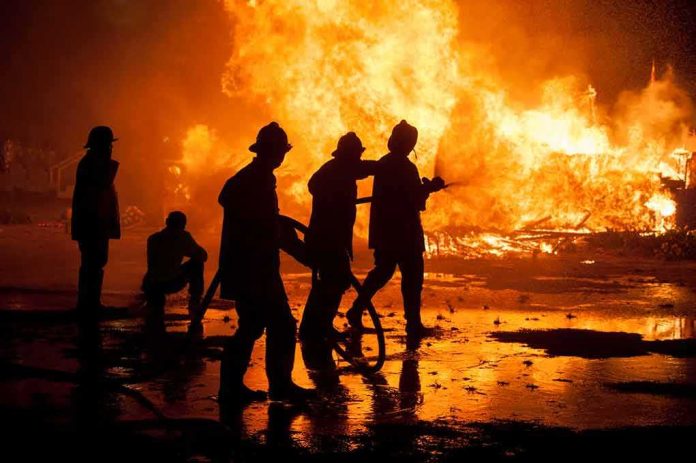
The central fact in this case is not only the loss of three firefighters; it is the way a fast-moving wildland entrapment can turn a regional fire campaign into a matter of operational safety, public accountability, and institutional memory in a single afternoon. The evidence now available supports the official account that the deaths occurred during response to the Knowles and Gore fires on the Colorado-Utah border, while the larger Snyder Fire complex continued to expand around them.[1][2][7]
Intro Header
- Three firefighters were killed and two were injured while responding to wildfire activity on the Colorado-Utah border.
- The official narrative points to a burnover or entrapment during interagency operations, but the public record is still thin on forensic detail.
- The Snyder Fire began in eastern Utah as the Snyder Mesa Fire before merging with other fires and growing to roughly 28,000 acres.[1]
- The broader context is extreme fire weather: strong winds, rugged terrain, and multiple simultaneous fires across Utah and Colorado.[2][8]
What the Official Record Establishes
The strongest verified facts are straightforward. The U.S. Wildland Fire Service said three firefighters died and two others were injured on Saturday while battling fires on the Colorado-Utah border, and multiple outlets reported the crew had been part of an interagency response to the Knowles and Gore fires.[1][2][7] Colorado Governor Jared Polis declared a disaster emergency and authorized the National Guard to support the response, underscoring that this was not an isolated incident but part of a broader wildfire emergency across the region.[1][8]
The fire geography matters. Reporting places the Snyder Fire at more than 28,000 acres, originating as the Snyder Mesa Fire in eastern Utah’s Grand County before spreading and combining with other fires.[1] That detail is not cosmetic; merger events complicate command structure, resource allocation, and the public’s ability to track which fire is which as incident names change faster than the news cycle can stabilize them.[1][7]
Why Wildland Fire Entrapments Turn Deadly So Quickly
Wildland firefighting is uniquely vulnerable to entrapment because the threat does not arrive as a single blast; it arrives as a failure of margin. In the wildland lexicon, burnover or entrapment describes a situation in which firefighters are overtaken after escape routes or safety zones become compromised by fast-changing fire behavior.[15][16] The fatal mechanism can be wind shift, terrain channeling, spotting, or simply a bad tactical position that collapses under conditions the crew can no longer outrun.
That is why investigators care so much about the exact minute-by-minute weather log, terrain profile, and crew movement record. Standard entrapment investigations are built to preserve evidence quickly, document burn patterns, and reconstruct the scene before critical information is lost.[14][16] The public statements released so far do not provide that level of forensic detail, so any precise reconstruction of wind speed, escape options, or tactical error would go beyond the record currently available.[14][16]
The Real Meaning of the Conflicting Fire Names
One source of confusion is nomenclature. Reports variously reference the Snyder Fire, the Snyder Mesa Fire, and the Knowles and Gore fires.[1][2][7][8] That is common in rapidly evolving wildfire incidents, where separate starts merge, local names persist, and incident communication lags the fire’s actual footprint. It does not undermine the core facts; it does, however, show how quickly public understanding becomes fragmented when multiple fires are burning at once and the incident itself is being reorganized in real time.[1][7]
The important distinction is that the fatalities were reported in connection with the Knowles and Gore response, while the larger Snyder fire complex was also active and expanding.[1][2] In wildfire reporting, those distinctions matter because they determine which command post, which operational period, and which tactical decisions belong to the chain of events that must later be reviewed.[14][16]
🚨 BREAKING: Three firefighters are dead after battling a wildfire along the Utah-Colorado border.
Officials say three wildland firefighters were killed while fighting the rapidly growing #SnyderFire. Two other firefighters were seriously injured and transported to the hospital… pic.twitter.com/Sdz47r50Lg
— Chase Thomason (@ChaseThomason) June 28, 2026
What Can Be Said About Cause, and What Cannot
The public record supports the classification of the deaths as an entrapment or burnover event, but not a detailed forensic explanation of how it unfolded.[1][2][16] That distinction is important. A burnover label tells you the category of tragedy; it does not, by itself, tell you whether the crew was overtaken by a sudden wind-driven run, boxed in by terrain, cut off from an escape route, or operating under a planning failure that will later be revealed in an incident review.[14][16]
Because no public counter-narrative has emerged, the official account is presently unrebutted at the primary-source level.[1][2][7] But unrebutted is not the same as fully explained. The responsible reading of the evidence is that the deaths occurred during an officially recognized wildfire entrapment, that the event happened amid severe fire conditions, and that the specific tactical and meteorological chain leading to the fatalities remains unpublished.[1][2][14]
Why This Incident Fits a Familiar Pattern
This tragedy fits a recurring pattern in western wildland fire: a sudden entrapment, immediate institutional tribute, and only later a granular reconstruction of what happened. The investigative manuals for entrapments are explicit because the stakes are so high: preserve the scene, gather weather and terrain data, document routes and equipment, and interview survivors once they are medically and psychologically able.[14][16] That process exists because the first public story is rarely the full story.
The broader lesson is structural. Wildland firefighting is still a profession in which the difference between a managed retreat and a fatal burnover can be measured in minutes and meters, not hours and miles.[15][18] When multiple fires are active, winds are strong, and terrain is broken by canyons and ridges, the system depends on disciplined situational awareness; when that system fails, the human cost is immediate and often irreversible.[2][8][15]
What the Public Should Expect Next
At minimum, a fuller accounting should eventually answer three questions: who the firefighters were, what the exact incident sequence was, and which tactical conditions made escape impossible.[1][2][14] That information typically comes later, after family notification, medical updates, and formal safety review. Until then, the story should be understood in two layers: the immediate human loss, which is confirmed, and the operational explanation, which is still incomplete.[1][2][14]
For now, the evidence supports a sober conclusion. Three firefighters died, two were injured, and the incident occurred inside a broader wildfire emergency marked by intense weather, multiple fire complexes, and an official response that has already escalated to state-level emergency action.[1][2][8] The tragedy is real; the final technical account is not yet public.
Sources:
[1] Web – 3 firefighters killed, 2 injured while tackling wildfires on the …
[2] Web – Three Firefighters Killed, 2 Injured in Snyder Wildfire on Utah …
[7] Web – South Canyon Fire Entrapment Fatalities 1994
[8] Web – Three firefighters killed on Colorado-Utah border as wildfires …
[14] Web – Three firefighters killed while tackling major wildfires along …
[15] Web – [PDF] Investigating Wildland Fire Entrapments
[16] Web – [PDF] Wildland firefighter entrapment avoidance: modelling evacuation …
[18] Web – Predicting Firefighter Injury and Entrapment in Urban … – PMC – NIH