
The Supreme Court just told America’s Catholic bishops they must face a fraud lawsuit over Peter’s Pence in open court, and that choice could quietly redraw the line between religious freedom and basic honesty in fundraising.
Story Snapshot
- The Supreme Court declined to hear the bishops’ appeal, leaving a fraud class action over Peter’s Pence donations alive.
- Plaintiffs say U.S. bishops sold Peter’s Pence as emergency aid for the poor while money allegedly went to Vatican expenses and investments.
- The bishops argue religious liberty and church autonomy shield how they talk about and spend offerings.
- The real fight is whether churches must meet the same truth-in-advertising standards as everyone else.
Supreme Court lets the fraud lawsuit move forward
The United States Supreme Court declined to take the case United States Conference of Catholic Bishops v. O’Connell, leaving in place a lower court ruling that refused to dismiss a fraud class action over the Peter’s Pence collection.[3][4] The justices did not issue an opinion or explanation; they simply denied review, which means the litigation now returns to the trial court for discovery, evidence, and, potentially, a jury.[3][4] That quiet “no” is loud in its consequences.
The U.S. Court of Appeals for the District of Columbia Circuit had previously held that the bishops could not use a church-autonomy theory to short-circuit the case at the threshold.[3][4] The court emphasized that religious organizations are not automatically immune from secular fraud claims when the dispute centers on allegedly misleading fundraising appeals rather than doctrine.[3] By declining review, the Supreme Court allowed that reasoning to stand nationwide as a powerful signal to lower courts and religious nonprofits.
What Peter’s Pence donors say they were promised
Rhode Island parishioner David O’Connell filed the lawsuit in 2020 after years of hearing parish appeals for Peter’s Pence framed as direct help for the poor, disaster victims, and urgent papal charities.[2][3] The complaint claims the bishops, through printed materials and pulpit messages, led ordinary Catholics to believe their envelopes would fund emergency relief and suffering people, not financial engineering or bureaucratic overhead.[1] O’Connell says he would not have donated had he known the broader, more institutional uses of the money.[1]
The lawsuit alleges that, in reality, significant portions of Peter’s Pence were used for Vatican administrative costs and even investments, while only a fraction went to direct charitable aid. Media reports and Vatican financial scandals over the past decade fueled these concerns, including revelations that charitable contributions were mixed with funds used in controversial real estate deals. Plaintiffs argue that, whatever the Vatican’s internal rules, the key question for U.S. law is straightforward: were American donors told the truth or sold a comforting story.
How the bishops defend Peter’s Pence and religious autonomy
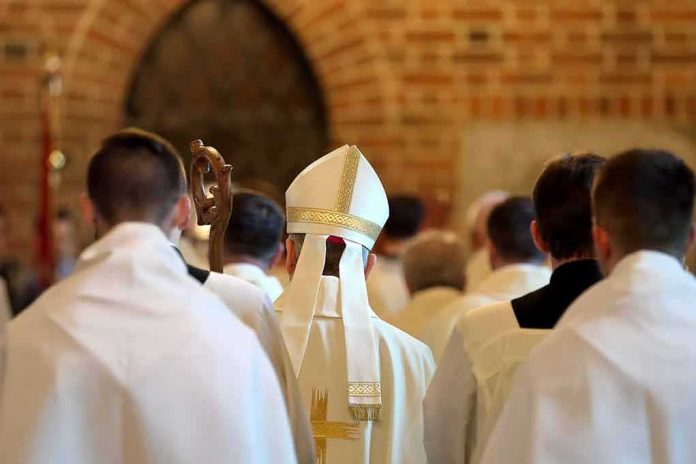
The United States Conference of Catholic Bishops responds that it neither collects Peter’s Pence funds nor controls how the Vatican ultimately spends them.[4] According to its legal defense, the bishops’ conference merely helps dioceses communicate about a centuries-old papal collection that is governed by canon law and administered by the Holy See.[4] The bishops insist the offering has always had a dual purpose: supporting the pope’s charitable works and the needs of the Holy See itself.[4]
The bishops’ legal team frames the case as a religious liberty problem, not a consumer dispute.[4] They argue that allowing civil courts to interrogate sermons, homilies, and internal communications about offerings would entangle judges and juries in the heart of church governance and preaching.[4] From that angle, the threat is broader than Peter’s Pence: every religious collection, from mission drives to building campaigns, could be second-guessed by secular authorities whenever someone later dislikes how the money was spent.[4] That concern resonates with many conservatives wary of state intrusion into churches.
Fraud or free exercise: what is really at stake
The lower courts have drawn a sharper distinction. They have not ruled that the bishops committed fraud; they have only said the case can proceed under ordinary rules that apply to any charity or nonprofit.[1][3][4] Judges have focused on whether the dispute can be framed as a secular question about advertising claims and donor expectations, without probing theology or papal decision-making.[1][3] If a jury someday decides liability, it will likely hinge on brochures and parish scripts, not encyclicals.
From a common-sense, conservative perspective, two principles must be held together. On one hand, the First Amendment should robustly protect churches from government control over doctrine, worship, and internal discipline. On the other hand, religious institutions that step into the public square to raise money ought to tell the truth with the same clarity we expect from a hospital, school, or veterans’ charity. Honesty in solicitation is not hostility to faith; it is basic respect for the donor’s conscience and hard-earned dollars.
Why this case matters for every donor and every church
This lawsuit also rides the wave of broader mistrust after repeated financial scandals in both religious and secular institutions. When donors learn that only a sliver of their gift funded what the brochure showed—a starving child, a flooded town, a persecuted believer—confidence erodes, and giving dries up. That hurts the very poor and vulnerable these institutions claim to serve. Transparent accounting and plain-language appeals are the best antidote, and they cost less than one more lawsuit.
For faithful Catholics and non-Catholics alike, the Supreme Court’s refusal to intervene sends a bracing message: pious language does not immunize fundraising from scrutiny.[3][4] The bishops now face the same question any nonprofit faces when challenged—did they match their promises with their practices. If they did, discovery will clear them. If they did not, a jury of ordinary citizens may be the ones to say so. Either way, the decision will echo far beyond one Vatican collection.
Sources:
[1] Web – Supreme Court declines to intervene in Peter’s Pence fraud lawsuit …
[2] Web – O’Connell v. United States Conference of Catholic Bishops, No. 23 …
[3] Web – United States Conference of Catholic Bishops v. O’Connell – Becket
[4] Web – O’Connell v. U.S. Conference of Catholic Bishops – Americans United