

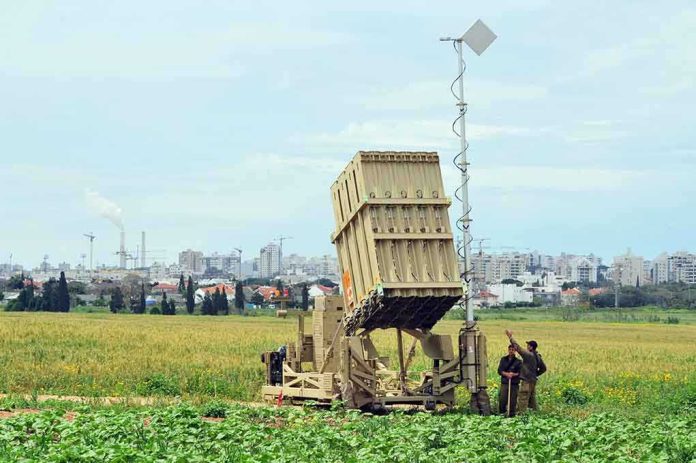
Europe’s scramble to harden its skies against Putin’s hypersonic and cruise missiles exposes a sobering truth: even NATO admits the shield is still being built while the threat is already here.
Story Highlights
- NATO calls integrated air and missile defense a core mission but acknowledges ongoing build-out and integration work [4][5].
- European leaders push new production and programs as supplies of U.S.-made interceptors prove insufficient alone [2][8].
- European Sky Shield timelines stretch into the next decade, leaving near-term coverage gaps [9][10].
- Brussels promotes big-ticket initiatives while analysts warn results hinge on real factories, stockpiles, and training [2][6][7].
NATO’s Mission Meets a Compressed Timeline
North Atlantic Treaty Organization (NATO) doctrine sets integrated air and missile defense as a core alliance task to deter and reduce the effectiveness of air and missile threats, tying together round‑the‑clock air policing and ballistic missile defense under a single mission set [4]. NATO materials also describe a missile defense architecture under construction across member states, underscoring that the system remains a work in progress rather than a finished shield with comprehensive coverage today [5]. That gap matters when Russian salvos test European and Ukrainian defenses in real time.
King’s College London’s analysis concludes allies increased air and missile defenses after 2014 and accelerated after the 2022 invasion, but also points to lingering shortfalls in integration and protection of critical infrastructure across alliance territory as of 2023 [3]. Those findings track with on-the-ground experience: improving sensors, interceptors, and command networks helps, yet layered defense must be scaled and synchronized to counter mixed raids that blend ballistic missiles, cruise missiles, and one‑way attack drones.
Industrial Bottlenecks and Europe’s Push for Self‑Sufficiency
The Center for Strategic and International Studies urges a crash program to expand European-made interceptors because Russia’s output of missiles and drones strains current stocks and procurement cycles [2]. European Commission messaging markets “Readiness 2030” with flagship projects like an Eastern Flank Watch and a European Air Shield to channel funding and focus, but those ambitions will only matter if they convert into signed contracts, new lines, and delivered rounds at scale and speed [6]. Debt-financed proposals add urgency, yet taxpayers deserve proof of timely, measurable capacity growth [7].
European officials have openly warned that the continent cannot rely on the United States alone for sufficient quantities of air defense missiles, pushing capitals to grow indigenous production and diversify suppliers [8]. That stance does not break transatlantic ties; it acknowledges a basic logistics truth: air defense burns interceptors fast, and replenishment must keep pace with Russian launch rates. Common sense demands stockpiles sized for sustained campaigns, not peacetime drills or one‑off intercepts.
Programs on Paper, Gaps in Practice
The European Sky Shield Initiative aims to assemble a multi‑layered ground‑based defense with participation from dozens of states, but published materials show staggered timelines and a long runway to full operational capability into the next decade [9][10]. Meanwhile, NATO’s broader missile defense framework continues to evolve across multiple host nations and platforms, reflecting incremental construction rather than instant theater coverage [5]. The result is progress—yet not a continent‑wide umbrella that can promise to stop every missile in the near term.
Germany’s work on systems like IRIS‑T variants illustrates how Europeans are adding medium‑range layers designed to counter aircraft, cruise missiles, and drones, with ongoing upgrades to improve performance envelopes [1][4]. Still, even capable systems must be fielded in numbers, integrated with allied radars and command nodes, and sustained with predictable resupply. Without that triad—quantity, integration, sustainment—defenses risk winning tactical intercepts while losing the logistical war.
What Conservatives Should Watch Next
Policy papers and alliance pledges are not interceptors on a launcher. Voters should press leaders for verifiable production targets, delivery schedules, and training pipelines that match expected Russian launch rates, not political speeches [2][7]. Transparent milestones—batteries emplaced, crews certified, missiles delivered—are the accountability tools taxpayers deserve, especially as Brussels touts expansive initiatives and assumes new financial burdens to underwrite defense industry growth [6][7].
#Gravitas | Kyiv's air defences faces their toughest test
Europe, America turn deaf ear as defenceless Ukraine begs for weapons against missiles
Moscow vows systematic missile strikes as Ukrainian cities burn @MollyGambhir brings you more on this pic.twitter.com/wCYGRjYTrO
— WION (@WIONews) June 3, 2026
For Americans, the takeaway is twofold. First, U.S. leadership under President Trump is pushing allies to carry more of the load, and Europe’s own officials now concede they must expand local production rather than lean on Washington for endless resupply [8]. Second, a stronger European magazine and tighter integration inside NATO ultimately protect U.S. forces and taxpayers by reducing emergency backfills. Deterrence works best when promises become hardware—and when every layer, from sensors to shooters, is in place and stocked [4][5].
Sources:
[1] Web – Europe to ramp up defence against Putin’s hypersonic missiles after …
[2] YouTube – Better Than Patriot?” Germany Unveils New 80 KM IRIS-T SLX Air …
[3] Web – Europe Needs an ASAP Program for Air Defense – CSIS
[4] Web – [PDF] European Integrated Air and Missile Defence in NATO
[5] Web – NATO Integrated Air and Missile Defence
[6] Web – NATO missile defense system – Wikipedia
[7] Web – White paper for European defence – Readiness 2030
[8] Web – European Union debt to boost European air defence – Bruegel
[9] Web – Europe can’t rely on US for air-defense missiles, top EU official says
[10] Web – European Sky Shield Initiative – Wikipedia