

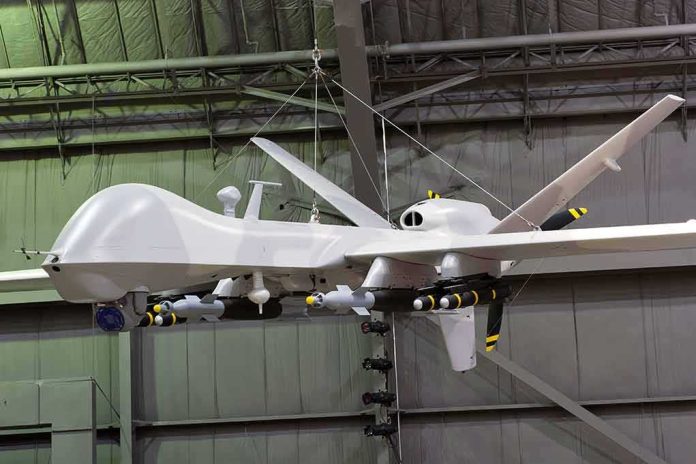
American small-drone warfare has quietly stopped being a Silicon Valley story and become, once again, an Oklahoma story — because the warheads that will arm a new generation of attack drones are being built inside a bomb plant that has been loading American ordnance since the Roosevelt administration.
Key Points
- The McAlester Army Ammunition Plant (MCAAP) in southeastern Oklahoma has entered a formal production partnership with Perennial Autonomy, a drone company backed by former Google CEO Eric Schmidt.
- Under the arrangement, MCAAP will manufacture, load, and deliver warheads for Perennial’s drone fleet, while Perennial supplies the airframes, guidance, and autonomy software.
- Perennial’s product line includes the Merops interceptor, the Bumblebee quadrotor series, and the Hornet fixed-wing strike drone, aimed at countering Shahed-type threats and striking battlefield targets.
- The deal fits a broader Army Materiel Command push to retrofit legacy ammunition plants for the drone era, treating small unmanned systems increasingly like expendable munitions rather than exotic aircraft.
What the Partnership Actually Covers
The Army confirmed the arrangement at a ribbon-cutting ceremony in early October, describing it as a “transformative defense production partnership” between MCAAP and Perennial Autonomy, a firm the Army itself characterizes as a developer of “specialized drones for the battlefield”. The division of labor is straightforward and, by defense-industrial standards, unremarkable in structure: McAlester handles the dangerous, heavily regulated work of building, loading, and delivering explosive payloads, while Perennial contributes the platforms and the guidance systems that turn a warhead into a weapon. It is, in effect, the drone-age version of a relationship the Army has run with private contractors for generations — government owns the ordnance infrastructure, industry brings the airframe and the software.
What makes the story land differently is the identity of the private partner. Eric Schmidt, who ran Google for a decade and helped popularize the company’s famous internal maxim about avoiding evil, now backs a company whose drones are destined to carry warheads assembled at one of the nation’s primary bomb-making facilities. That juxtaposition — a Silicon Valley technologist’s firm supplying strike drones loaded with Army-made explosives — is the genuinely new wrinkle in an otherwise conventional government-industry production deal.
The airframe came from a 2023 startup. The warhead comes from Oklahoma.
McAlester will load payloads for Perennial's drones. The plant already has the chemists and the load-assemble-pack crews, and the Army says partnerships like this one help pay for its infrastructure…
— Tate Williams (@Tate_Williams86) October 6, 2026
Who Is Perennial Autonomy, and Why McAlester
Perennial Autonomy’s publicly described catalog spans three distinct roles. The Merops is an interceptor, priced around 15,000 dollars per unit, built specifically to run down and destroy incoming Shahed-type attack drones of the kind Russia has used en masse against Ukraine; it is reported to have logged more than 4,000 intercepts in that conflict. The Bumblebee is a quadrotor series suited to close-range reconnaissance and strike, and the Hornet is a fixed-wing platform intended