

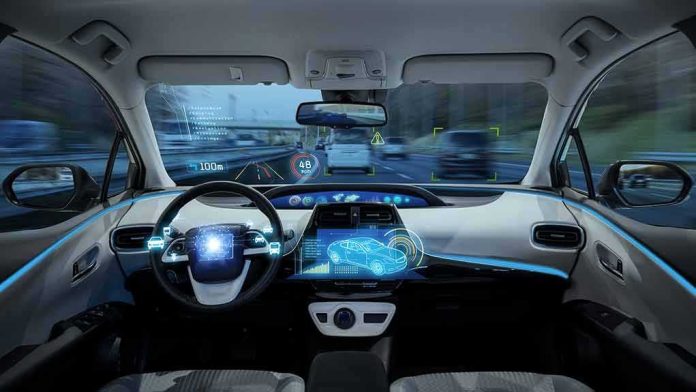
Europe just turned every new car into a rolling eye-tracker, and the real fight now is whether that camera is a lifesaver or a snitch.
Story Snapshot
- From July 7, 2026, every new car and van in the European Union must have a driver-facing camera watching your eyes and head.
- The system aims to cut crashes from distraction and fatigue by warning drivers who look away too long from the road.
- Rules say no facial recognition, no biometric ID, and no sending footage out of the car, but penalties and audits are vague.
- Past data-selling scandals and “dystopian surveillance” headlines make many drivers doubt those promises and see a privacy threat.
Europe’s cars now come with a built‑in watcher
Starting July 7, 2026, every newly registered passenger car and van in the European Union must carry an Advanced Driver Distraction Warning system with a camera pointed at the driver’s face. Lawmakers pushed this through as the final phase of the General Safety Regulation, which now makes several advanced safety systems mandatory on all new vehicles. The goal sounds simple: watch the driver’s attention, warn them before a mistake becomes a crash, and save lives.
The system does not just sit there. It tracks where the driver’s eyes look, how the head moves, and signs of drooping or drowsiness. At speeds between about 20 and 50 kilometers per hour, if the driver looks away from the road longer than six seconds, the car must trigger a warning. At higher speeds above 50 kilometers per hour, the limit tightens to about 3.5 seconds before an alert kicks in. The warning must escalate until the driver looks back toward the road.
What the rules say about privacy and limits
The European Union knows how this sounds, so the official rules stress privacy protections. Technical requirements state that Advanced Driver Distraction Warning systems must work without using biometric information or facial recognition for any occupants. In plain terms, the camera is supposed to answer “where are the eyes pointing?” not “who is this person?” That aligns with conservative values that reject mass identification by default and expect clear limits on government and corporate power.
Regulators also say image data must stay inside the vehicle in a closed loop and be processed in real time, not stored or sent to outside servers. The system is designed to analyze frames as they come in, trigger an alert if needed, then delete the data right after processing. Authorities insist nothing should go to law enforcement, insurance companies, or marketing databases during normal operation. On paper, that is a strong line: no surveillance state dashboard and no corporate profile built from your every blink.
The holes that make people nervous
Critics point out that the regulation uses fuzzy language about “immediate deletion” without a hard time limit, leaving room for different interpretations. There is also no clear, independent European Union audit system built into the rule to check that every carmaker really keeps data local and avoids biometrics. Legal commentary notes that while the rules forbid sending data or using facial recognition, they do not spell out exact penalties if a company breaks those promises.
For Americans with a conservative mindset, these gaps matter. Trusting large companies that already got caught selling driving data to insurance brokers feels naive. Without strong enforcement, “closed loop” can sound like “trust us” dressed up in technical jargon. Critics warn that once hardware and software are in place, future rule changes or quiet firmware updates could expand what the camera does and where the data goes. The hardware is permanent; the policy can shift with the next committee vote.
Safety case versus surveillance fear
European officials argue that driver distraction and drowsiness play a major role in serious road accidents and that preventive technology can lower deaths and injuries. They follow a long pattern: seat belt reminders, speed assistance, and event data recorders all started as “creepy” or “nanny state” tools before becoming normal features. The logic is consistent with a government that sees fewer fatalities as justification for tighter rules, even at the cost of personal privacy and choice.
As of July 7, 2026, every new car and van registered in the EU must have an interior, driver‑facing camera as part of an Advanced Driver Distraction Warning (ADDW) system—the vehicle will be carefully watching the driver's every move.
— Ella Proud Refusenik✨ 🕊💕🎶💫 (@EleftheriaElpis) July 16, 2026
Opponents counter that past safety gains do not excuse turning the inside of every car into a monitored space by default. Social media posts and outlets describe the mandate as “dystopian” and “anti-freedom,” framing the camera as a symbol of elite control from unelected bureaucrats rather than a neutral safety tool. This hits a nerve among drivers who already feel squeezed by rising costs, complex car tech, and broader government reach into daily life. For them, the line between safety feature and surveillance device is thin.
What comes next and what to watch
Right now, there is no forensic proof that European Union‑mandated systems are secretly sending driver images or doing facial recognition behind the scenes. The core dispute turns on trust, not yet on exposed code or leaked contracts. The big tests will come later: independent audits of how data flows, accident statistics showing whether distraction warnings actually cut crashes, and any whistleblower reports on hidden data deals. If regulators stay vague and industry stays opaque, privacy fears will only grow.
For drivers in America, this matters because European rules often cross the ocean through global car platforms. Carmakers like using one tech stack for many markets. Once eye‑tracking hardware is standard in every European model, it becomes cheaper to ship the same cameras in United States versions, then flip features on or off by software. The real question is not whether the camera exists; it is who controls it, what limits the law sets, and whether citizens demand those limits before the “safety upgrade” quietly becomes a permanent watcher in every family car.
Sources:
reason.com, modernity.news, forbes.com, repairerdrivennews.com, faq.com.tw, newsbreak.com, neonode.com, thenextweb.com, youtube.com, cryptopolitan.com, autonocion.com, facebook.com, cybernews.com, reddit.com, thedrive.com