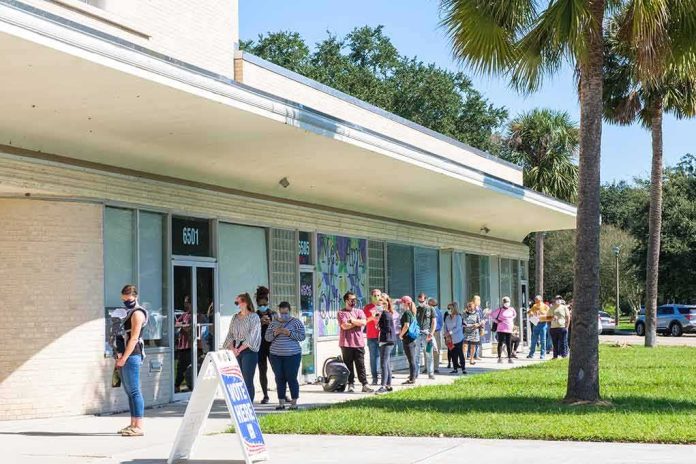
In Michigan’s 2026 Democratic Senate primary, the “whack jobs on the ballot” frame mostly reflects how volatile the party’s internal fight over electability and change has become—not that the candidates themselves are fringe or unserious.
At a Glance
- The Michigan Senate primary is a high-stakes clash between an establishment-backed moderate, Haley Stevens, and a progressive insurgent, Abdul El-Sayed, in a pivotal swing state.
- Stevens embodies the traditional electability case: prior success flipping a Republican seat, deep institutional endorsements, and a message centered on affordability and pragmatic governance.
- El-Sayed leads late polling and prediction markets, drawing strong support from younger voters and independents, and running on Medicare for All, anti-corporate money, and a sharper critique of U.S. policy toward Israel.
- National media and party elites have turned the race into a proxy war over the Democratic Party’s future, amplifying ideological conflict while offering limited hard evidence about who is truly stronger against Republican Mike Rogers in November.
Michigan’s Senate Primary as a Proxy Fight for the Democratic Party
The Michigan Senate primary is not just a local contest; it sits at the junction of two competing theories about what the Democratic Party should be in the late 2020s. On one side is Haley Stevens, a centrist U.S. representative who flipped a Republican House seat in 2018 and built a reputation as a governable, institutionally grounded Democrat. On the other is Abdul El-Sayed, a former public health official and progressive standard-bearer whose campaign is explicitly designed to test whether movement politics can carry a statewide race in a battleground.
Major outlets from the Associated Press to Bloomberg, the New York Times, and CNN have framed this contest as a clash between “progressives and moderates” or “old-guard Democrats” and a “rising coalition,” effectively elevating a single state primary into a referendum on the party’s future. That framing is not incidental. Michigan is a must-win Senate seat for Democrats seeking to reclaim or defend narrow control of the chamber, and the winner will face Republican Mike Rogers in a general election both parties treat as pivotal to the national map.
Haley Stevens: The Establishment Electability Argument
Stevens is the kind of Democrat party strategists traditionally point to when they talk about electability in the Midwest. She won her House seat in 2018 by defeating Republican Lena Epstein in Michigan’s 11th District, flipping the seat from GOP to Democratic control. That victory in a swing-area district gives her more than a narrative—there is actual electoral proof that she can compete and win where Republicans had previously held ground.
In the Senate primary, Stevens is consistently described as the establishment-backed moderate: she has the explicit support of retiring Senator Gary Peters, Governor Gretchen Whitmer, and Senate Democratic leader Chuck Schumer. Those endorsements signal not just ideological alignment but also access to donor networks, experienced staff, and the broader infrastructure of the party’s campaign committees. Reporting on the race notes that outside groups such as the United Democracy Project, aligned with AIPAC, have spent tens of millions of dollars to support Stevens and oppose El-Sayed, underscoring how heavily national institutions are invested in her nomination.
Stevens’ pitch to voters is grounded in practical economic issues and a clear general-election frame. She talks about healthcare costs, grocery prices, and support for small businesses—classic kitchen-table themes in a state whose politics are shaped by manufacturing, union households, and suburban cost-of-living pressures. In one widely covered appearance, she framed her primary vote in terms of defeating Mike Rogers in November, insisting that he is not talking about those affordability issues at all. The message is straightforward: she is the candidate focused on governing, not symbolic fights.
Polling snapshots earlier in the cycle backed up the idea that Stevens was a serious contender with real statewide appeal. A Detroit News survey in early July reportedly showed her leading El-Sayed by seven percentage points, reinforcing the perception that an establishment-backed moderate could still hold her own in a Democratic electorate that is restless but not yet fully realigned. That said, these were early numbers; they reflect a moment in time, not necessarily the settled will of primary voters.
Abdul El-Sayed: Movement Politics Meets Swing-State Reality
El-Sayed enters the race as a known quantity to Michigan progressives. He previously ran for governor in 2018 and has positioned himself as a public health expert turned movement politician, with a platform anchored in Medicare for All, aggressive climate action, and a deep critique of corporate influence in politics. In this Senate primary, he has attracted endorsements from Bernie Sanders and Alexandria Ocasio-Cortez, making clear that he is the candidate of the national left, not just a local progressive curiosity.
Where Stevens leans on institutional support and proven electability, El-Sayed makes the argument that the party must change or risk losing the next generation of voters. Emerson College polling captured that dynamic: in one survey, El-Sayed led Stevens 54 percent to 39 percent among likely Democratic primary voters, with a striking 42-point advantage among voters under 50 and a 27-point lead among independents. Those numbers suggest that his coalition is not limited to activist enclaves; it reaches into demographics that Democrats worry about losing to apathy or third parties.
El-Sayed’s substantive contrast with Stevens runs along three main axes. First is healthcare. He argues for Medicare for All, framing it as a moral and economic necessity rather than a long-term aspiration. Second is corporate money. He has repeatedly criticized the volume of outside spending backing Stevens and the broader role of corporate PACs and allied super PACs in Democratic primaries, going so far as to claim that needing tens of millions of dollars in outside support is evidence a candidate is “foundationally unelectable on their own terms.” Third is foreign policy—specifically Israel and Gaza. El-Sayed opposes unconditional U.S. military aid to Israel and ties his critique to a broader argument about human rights and the need for the party to realign its foreign policy with progressive values.
That last contrast is not just ideological; it interacts directly with the institutional backing Stevens receives. AIPAC-aligned spending on Stevens’ behalf has become a centerpiece of El-Sayed’s critique, allowing him to connect concerns about money in politics to a high-salience foreign policy issue. In an era when Democratic voters are sharply divided over Israel, this is a potent wedge—one that mobilizes younger, more online voters and puts establishment candidates on the defensive.
Polling, Prediction Markets, and the Illusion of Inevitability
As Election Day approached, public polling and prediction markets moved decisively toward El-Sayed. A New York Times briefing cited recent surveys showing him ahead of Stevens by margins between 10 and 19 points, while prediction platforms like Kalshi and Polymarket gave him odds in the mid-90s to near-certainty range. Emerson’s late poll, with El-Sayed at 54 percent to Stevens’ 39 percent, reinforced the narrative of momentum on the insurgent side.
These data points matter because they shape how donors, activists, and even casual voters interpret the race. When markets price a candidate as a near lock and polls show double-digit leads, the temptation is to treat the outcome as preordained and to read any remaining institutional backing for the underdog as stubbornness or denial. However, polling and markets are probabilistic, not dispositive; they capture expectations based on available information, not certified votes.
More importantly, neither the Stevens nor El-Sayed camp can point to robust, head-to-head general-election evidence proving that one would outperform the other against Mike Rogers. The public record is heavy on primary polls and light on tested models for November, particularly in terms of favorability, turnout behavior, and cross-pressured voters who might swing between parties or stay home. That leaves both electability narratives partly speculative, even as media coverage implies sharper conclusions than the data can actually sustain.
Electability Versus Change: Where the Real Disagreement Lies
The core dispute in Michigan is not about whether one candidate is a “whack job”; it is about which theory of politics Democrats should trust in a swing state. For Stevens’ supporters, electability is defined by demonstrated ability to win in Republican territory, maintain relationships with key party leaders, and talk in practical terms about affordability and governance. They worry that El-Sayed’s Medicare for All and foreign policy positions, however principled, could alienate moderates and hand the seat to the GOP.
For El-Sayed’s backers, electability is inseparable from enthusiasm and authenticity. They argue that a party facing a disaffected base and rising generational cynicism cannot afford to run candidates defined primarily by institutional comfort. Emerson’s finding that voters under 50 favor El-Sayed by an enormous margin, and that independents break toward him as well, feeds a broader claim: that only a candidate offering systemic change rather than incremental adjustments can build the kind of coalition needed to win and govern in the long term.
The broader electorate is conflicted. CNN’s reporting notes that a majority of Democratic-leaning voters now say the party needs major changes—57 percent, up from 33 percent in 2022. That sentiment is a structural tailwind for insurgent campaigns, but it does not automatically translate into trust in specific progressive candidates or policies. Many voters simultaneously want change and fear that going too far left will jeopardize hard-won gains; Michigan’s primary is where that ambivalence is being tested in real time.
Money, Israel, and the Risks of an “Extremely Online” Campaign
This race is unusually shaped by money and media. Outside spending backing Stevens is enormous by primary standards, with AIPAC-aligned groups alone reported at around $25 million. That kind of expenditure can buy saturation-level name recognition and framing, but it also creates reputational risk in a political environment where high-dollar influence is suspect. El-Sayed has turned Stevens’ fundraising advantages into a liability, arguing that they prove she is captive to corporate and pro-Israel donor interests rather than to grassroots constituencies.
Politico and other outlets describe the contest as “extremely online,” meaning that social-media ecosystems, viral debate clips, and rapid-response commentary play outsized roles in shaping perceptions. In that environment, sharp ideological contrasts—on Israel, money, and identity—travel faster than nuanced discussions of manufacturing policy or committee work. This dynamic benefits insurgent campaigns, which thrive on energy and distinctiveness, but it can also distort public understanding, flattening real policy differences into caricatures of “radical” versus “corporate.”
Israel and Gaza, in particular, have become flashpoints. El-Sayed’s criticism of unconditional military aid resonates with segments of the Democratic electorate, especially younger and more progressive voters, while causing concern among moderates and some party leaders who fear it could complicate national security messaging or alienate pro-Israel swing voters. The resulting debate is not merely about one race; it touches a broader reorientation of Democratic foreign policy, making Michigan a symbolic stage for disputes that run through the party’s national coalition.
DDHQ Race Update (est. 3% in): Michigan US Senate Democratic Primary
Abdul El-Sayed (D): 30,736 (62.1%)
Haley Stevens (D): 16,934 (34.2%)
Mallory McMorrow (D): 1,821 (3.7%)Follow more results here:https://t.co/dd0OEey5Er pic.twitter.com/4MYJwakjfc
— Decision Desk HQ (@DecisionDeskHQ) August 5, 2026
What Michigan’s Choice Will Signal Going Forward
Regardless of who wins, the Michigan Senate primary will be cited for years as evidence of where the Democratic Party stands on electability and change. If Stevens prevails despite late polling and market skepticism, party leaders will point to her victory as proof that institutional candidates can withstand insurgent pressure when stakes are high and that outside money, however controversial, still moves votes in a swing state. They will argue that flipping Republican areas and holding a broad but not necessarily enthusiastic coalition remains the safest path to governing.
If El-Sayed wins, the race will be read as confirmation that the center of gravity inside the Democratic electorate has shifted left enough to elevate movement candidates in top-of-ticket contests. Analysts will emphasize his strength among younger voters and independents, the ability of a critique centered on corporate money and foreign policy to resonate beyond activist circles, and the limits of institutional endorsements when the base is hungry for change. At the same time, a progressive nominee in a must-win seat will pose its own test: whether such a candidate can translate primary energy into general-election durability against a Republican opponent explicitly targeting moderates uneasy with ideological experimentation.
The rhetoric about “whack jobs on the ballot” misses this deeper story. What Michigan is really deciding is which risk Democrats are more willing to take: the risk that a familiar, establishment-centered model no longer fits the electorate, or the risk that a more ambitious progressive agenda will stumble in November. The evidence on each side is serious and grounded, even if incomplete. The voters’ verdict will not end the debate, but it will provide the clearest data point yet on how much the party has changed—and how far it is prepared to go—in a state where the margin for error is small.
Sources:
townhall.com, nbcnews.com, nytimes.com, cnn.com, bloomberg.com, ballotpedia.org, usatoday.com, en.wikipedia.org, politico.com, kalshi.com, theguardian.com, michigan.gov