

Kyiv’s overnight strike reporting is not just a tally of explosions; it is a recurring portrait of how modern air war reaches deep into a city, overwhelms civilian space, and forces residents to describe catastrophe in fragments — “five minutes later, a second one followed” is the kind of witness language that captures the rhythm of such attacks better than any official communiqué.
Key Points
- Residents in Kyiv reported multiple explosions during an overnight Russian attack, consistent with a larger pattern of repeated drone-and-missile strikes on the capital.
- Ukrainian officials said the assault caused major civilian casualties and damage across the city, with the worst destruction concentrated in residential areas.
- Reporting from the scene describes emergency crews searching rubble, damaged apartment blocks, and neighborhoods hit in several districts.
- The strike fits a broader escalation in Russia’s aerial campaign, in which Kyiv has faced sustained pressure from missiles and drones over many months.
What residents experienced overnight
The core fact is straightforward: people in Kyiv heard and felt a coordinated nighttime attack, with explosions arriving in waves rather than as a single blast. Ukrainian reporting described multiple detonations across and around the capital, while air defenses engaged incoming drones and missiles. That layered pattern matters because it is what turns a strike into a citywide event: alarms begin the sequence, interceptors crack overhead, then the impacts land, often in more than one district and at different intervals through the night.
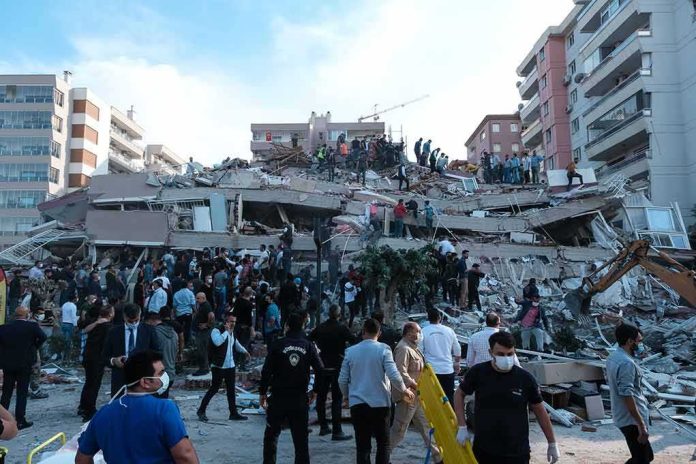
What made this particular assault so brutal was not only the sound of the attack, but the concentration of damage in ordinary residential fabric. ABC News reported that damage was recorded at more than 20 sites, most of them residential buildings, while rescue teams searched for people believed trapped under rubble. In Kyiv, the geography of injury is often the story itself: apartment blocks, garages, storage areas, and neighborhood streets become the front line. That is why residents’ accounts so often focus on the interval between explosions, the collapse of walls, and the sudden silence that follows the sirens.
The scale of the damage and the casualty count
The casualty figures were large and, as is common in the hours after a major strike, they moved as rescuers worked. One report cited at least 27 dead and more than 100 injured in Kyiv, while other updates placed the death toll lower or described it as still rising. Those differences are not unusual in an ongoing rescue operation; they reflect the practical reality that people can remain under debris for many hours, and that official counts tend to harden only after search teams finish the most dangerous phases.
What does not change across the reporting is the character of the damage. In one heavily affected district, a nine-story building was reportedly destroyed from the ninth floor down to the fifth, with people still believed to be under the rubble. Another account described a partial collapse between the fifth and ninth floors in a residential building in Podilskyi district, again with rescue work underway. These are not cosmetic hits or peripheral blast effects. They are structural failures in inhabited buildings, which is why the civilian toll is so high even when air defenses intercept much of the incoming fire.
Why the strike hit so hard
The military context helps explain the scale. Ukraine’s air force said Russia launched 351 drones and 68 missiles overnight, with Kyiv as the main target, and reported that all 29 ballistic missiles reached their targets. That combination is significant. Drones saturate defenses and force responders to cover broad areas; ballistic missiles arrive fast, are harder to intercept, and can produce catastrophic damage when they get through. The result is not a single point of failure but a layered stress test on the city’s air defenses and emergency services.
In that sense, the overnight strike belongs to a recognizable pattern rather than an isolated event. Kyiv has endured repeated Russian aerial attacks since the full-scale war began, and the capital has become a proving ground for Moscow’s evolving mix of drones, cruise missiles, and ballistic systems. The July attacks reported here fit that escalation: larger salvos, more frequent alarms, and more strikes landing in residential zones. CSIS has documented the scale of Russia’s broader missile campaign against Ukraine, underscoring how sustained and industrialized the air war has become.
❗️Russia launched more than 120 drones and 12 missiles during the overnight attack, half of them ballistic, President Volodymyr Zelenskyy said in response to the latest strikes.
“Our defenders managed to shoot down most of the targets, but not the ballistic missiles.
Eleven… pic.twitter.com/edFQd6PzlJ
— GMan | GMan’s Chronicle (@FAB87F) July 11, 2026
The civilian geography of modern strikes
What distinguishes these attacks from battlefield combat is their target environment. The reporting repeatedly points to homes, apartment blocks, ambulances, research facilities, hotels, storage areas, and other civilian infrastructure. That breadth matters because it tells you how urban strike warfare works in practice: the objective is not only destruction, but disruption — of sleep, mobility, emergency response, and the feeling that any room in the city is safe. Residents do not experience that as strategy; they experience it as shock, dust, broken glass, and the search for neighbors in a collapsed stairwell.
The city’s own officials framed the event as a major civilian assault. Kyiv City Military Administration and other Ukrainian authorities reported deaths and injuries that climbed as the rescue effort unfolded, and the Ukrainian president said the damage extended across many sites in the city. The exact death toll varied across updates, but the direction of the evidence never did: the attack hit civilians hard, and it did so at scale. In the face of that, the most reliable witness accounts are often the simplest ones — the sound of one blast, then another, then the knowledge that the night is not finished.
Why this matters beyond one night in Kyiv
Every large strike on Kyiv carries two meanings at once. On the ground, it is a rescue and casualty event; strategically, it is a message about endurance, air-defense saturation, and the vulnerability of a capital city under prolonged pressure. That is why these reports recur with such grim regularity, and why the language of residents remains essential. Official counts establish the scale, but lived testimony reveals the cadence of the attack — the pauses, the second wave, the building that still trembles after the sirens stop.
For readers trying to understand the war a year from now, the point is not merely that Kyiv was struck again. It is that the capital continues to absorb mass attacks in which civilian housing is repeatedly exposed to military force, and that the city’s residents have learned to narrate catastrophe in real time. That is not a sign of normalization. It is evidence of a sustained aerial campaign that has made overnight explosions part of Kyiv’s civic vocabulary.
Sources:
youtube.com, washingtonpost.com, abcnews.com, dw.com, instagram.com, vpm.org