

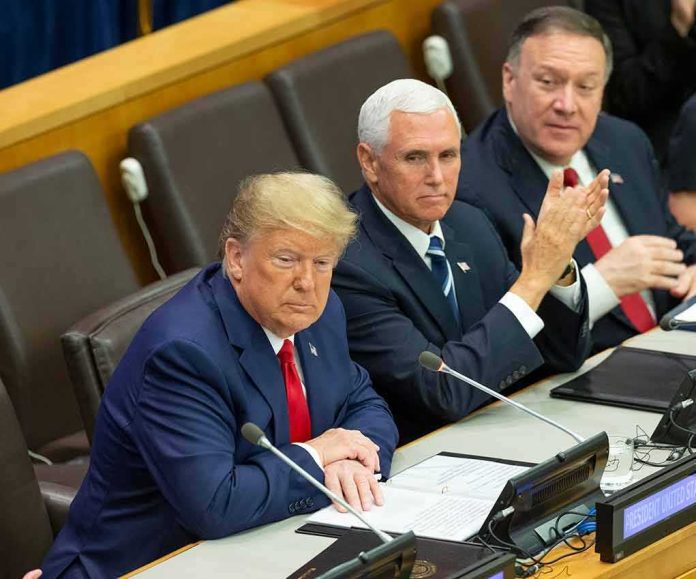
For Iran’s leadership, the defining change under President Trump is not a single speech or strike, but the fusion of sustained “maximum pressure” with an open-ended willingness to use force while still keeping a diplomatic off-ramp on the table.
At a Glance
- Trump’s Iran posture marries economic “maximum pressure” with active military operations, going well beyond prior U.S. sanction campaigns.
- Secretary of State Marco Rubio frames this as unprecedented leverage: Iran is “the weakest it has ever been” and “has never had to deal with a president like Trump.”
- Despite hard-edged rhetoric, the administration has repeatedly paired pressure with negotiations and draft agreements, not a pressure-only strategy.
- The core dispute is whether this coercive mix produces durable nuclear and regional constraints on Iran, or merely shifts goals without securing a stable end-state.
Rubio’s Claim: A President Iran Has “Never Faced”
When Marco Rubio says the Iranian regime has “never had to deal with a president like President Trump,” he is distilling a broader argument he has made across briefings, interviews, and cabinet meetings: that Trump’s approach to Iran combines an unusually high tolerance for risk, an expansive concept of leverage, and a readiness to escalate in ways prior presidents avoided. In Rubio’s telling, this is not a stylistic difference; it is a structural break in U.S. Iran policy. He contrasts four decades of what he portrays as warnings without decisive action with Trump’s decision to move from sanctions and covert pressure to overt strikes designed to “destroy Iran’s navy,” missile launchers, and production facilities as explicit war aims. This, he argues, puts Tehran under a kind of compounded pressure—military, economic, and political—that its leadership has not experienced before, even in earlier phases of confrontation with the United States.
Rubio’s public remarks repeatedly tie this claim to a storyline of Iranian weakness. At a Trump cabinet meeting he declared, “This is the weakest Iran has ever been,” claiming that U.S. and allied operations had significantly degraded Iran’s missile infrastructure, naval assets, and defense industry. In multiple venues, from Fox News interviews to State Department press briefings, he has asserted that every day the conflict continues, U.S. leverage grows, while Iran’s position erodes under a tightening blockade and sanctions that target its energy exports and broader economy. The premise is clear: Trump’s willingness to sustain high-intensity pressure, rather than seek rapid de-escalation, is what makes him unprecedented from Tehran’s perspective.
There is a domestic dimension to Rubio’s argument as well. He frequently contrasts Trump’s approach with critics in Washington who worry about costs, escalation, or alliance frictions, framing their caution as precisely the pattern Iran has learned to exploit. Iran, he warns, “won’t be able to leverage U.S. politics into forcing a bad deal” on Trump, a line meant to assure both foreign and domestic audiences that political headwinds—oil prices, protest fatigue, election cycles—will not easily pry Washington off its pressure track. In Rubio’s rhetoric, this resistance to political leverage is part of what makes Trump “unlike” previous presidents, and therefore more difficult for Iran’s leaders to predict or manipulate.
Maximum Pressure: How Trump’s Strategy Works
To understand what Rubio is pointing to, you have to look beyond the sound bites at the architecture of Trump’s Iran policy. In his first administration, Trump withdrew from the 2015 nuclear agreement (JCPOA) and launched a “maximum pressure” campaign built primarily around sanctions—over 1,500 individual measures that squeezed Iran’s oil exports, banking, and shipping. Upon returning to office, he formally reinstated that campaign, signing a memorandum in February 2025 that again aimed to drive Iran’s oil exports “to zero” and to snap back multilateral sanctions. A White House fact sheet described this as reaffirming the national emergency with respect to Iran and authorizing tariff penalties on countries that purchase Iranian goods or services, effectively widening the coercive net to third parties whose trade helps keep Iran’s economy afloat.
On paper, this approach is framed as a comprehensive strategy. Official documents list objectives that include denying Iran “all paths to a nuclear weapon,” constraining its funding of regional proxies, countering ballistic missile threats, and rallying allies against human rights abuses and hostage-taking. In practice, however, Trump has layered military objectives on top of the economic ones. As the current war unfolded, administration statements and outside analyses converged on four battlefield aims: further degrading Iran’s nuclear program, dismantling its navy, destroying its missile and drone capabilities, and reducing its ability to arm proxy forces such as Hezbollah and the Houthis. Rubio’s own briefings echo this, emphasizing operations to eliminate “short-range ballistic missiles” and naval threats that endanger U.S. and allied assets.
The result is a two-track pressure system. Economic sanctions and secondary tariffs crowd Tehran’s revenue streams and complicate its trade, while strikes dismantle physical capabilities and signal that attempts at nuclear or conventional build-up will be met with force, not only diplomatic censure. Where previous administrations often treated sanctions as leverage for negotiations, Trump has more openly treated force itself as a tool to irreversibly damage Iran’s ability to act—in Rubio’s words, “destroy the factory so they couldn’t make more missiles and more drones.” That shift in emphasis is central to the claim that Iran is facing something qualitatively new.
Coercion Plus Diplomacy: The Administration’s Own Mixed Record
Yet the public record undercuts any simple story about a pressure-only strategy. Even as Rubio talks about unrelenting leverage, he and Trump have repeatedly acknowledged ongoing negotiations with Iran. In Senate testimony and media interviews, Rubio has said “we are in negotiations,” describing talks carried out through intermediaries rather than direct, trust-based diplomacy. He has emphasized that Washington “remained open to a diplomatic solution” and that military pressure and negotiations can proceed in parallel—a classic coercive diplomacy model, not pure punishment.
Trump’s own actions reinforce that pattern. Reporting from CNN and Axios shows the president asking for edits to ceasefire and Strait of Hormuz reopening proposals negotiated by his envoys, pressing for stronger language on Iran’s nuclear obligations and commitments tied to maritime security. He has alternately signaled the war could end in “two or three days” or drag on for “four to five weeks or far longer,” a variability that reflects both changing military assessments and the unpredictable impact of diplomatic back-and-forth. A BBC analysis captures the essence: Trump is pursuing “two off-ramps at once,” keeping a negotiated end-state in view while simultaneously preserving the option—and rhetoric—of escalation.
Even sanctions are framed in conditional terms. Rubio told lawmakers that no offer had been made to trade sanctions relief simply for reopening the Strait of Hormuz; instead, any easing would be contingent on Iran abandoning its nuclear weapons ambitions and adhering to resulting agreements. That is still bargaining, just with a harder edge. The administration’s messaging oscillates between triumphal claims of Iran’s weakness and reminders that the U.S. “prefers diplomacy” and will “give it every chance to succeed,” as Rubio put it during a Camp David meeting. The underlying reality is not a clean break from the engage‑and‑pressure pattern of prior decades, but a more militarized version of the same dual-track approach.
Shifting Objectives and Messaging: Where Critics Push Back
The strongest critique of Rubio’s “never faced a president like Trump” line is not that it misstates the existence of pressure—that is clear enough—but that it glosses over how often the administration has changed its story about what pressure is supposed to achieve. Over the course of the conflict, Trump’s stated objectives have shifted from regime change and “freedom for the people” to more modest aims: degrading Iran’s military, protecting allies, ensuring rapid retaliation against any renewed nuclear push. NPR, the Guardian, and other outlets have documented these transitions, noting that initial talk of replacing Iran’s leadership gave way to talk of simply being “very close” to meeting narrower goals, then to focusing primarily on curbing support for regional proxies.
Rubio has sometimes been caught in the gap between early and revised rationales. CBS coverage of his Operation Epic Fury briefing shows him first tying U.S. action to an imminent Israeli strike and an “absolutely imminent threat” from Iran’s ballistic missiles, then walking back the explanation after Trump said the U.S. would have struck regardless. That kind of inconsistency does not prove the pressure campaign is ineffective on its own terms, but it does erode confidence that the campaign is anchored to a stable end-state. When goals move—from regime change to degradation to proxy containment—it becomes harder to judge whether Iran is actually closer to or further from the conditions Washington says it wants.
Critics also point to the mixed record of maximum pressure during Trump’s first term. Sanctions did substantial economic damage, yet Iran responded by stepping away from JCPOA limits on uranium and heavy water stockpiles, rather than by accepting expanded nuclear and regional constraints. That historical experience raises a fair question: does piling on more pressure in a second Trump administration, now backed by overt force, produce different behavior, or does it simply deepen mutual hostility while Iran adapts around new constraints? Rubio’s rhetoric about Iran “begging” for relief and “paying a very heavy price” captures one side of that argument; sceptics highlight the lack of a publicly documented compliance trail showing verifiable, durable concessions on the core disputes—enrichment, missiles, proxies—that can be clearly attributed to pressure.
Has Iran Truly “Never Faced” a President Like This?
Measured against the broader history of U.S.–Iran relations, Rubio’s claim is partially right and partially rhetorical. It is accurate to say that Trump has taken steps no predecessor did: reinstating and expanding maximum-pressure sanctions, ordering joint U.S.–Israeli strikes with an initial regime-change goal, and publicly linking economic campaigns to active, large-scale military operations inside Iran. From Tehran’s vantage point, facing a U.S. president who explicitly declares an intent to “destroy” pivotal military infrastructure and who pairs sanctions with kinetic attacks is indeed a different environment than navigating sanctions backed mainly by covert action or diplomatic isolation.
At the same time, the underlying logic—use pressure to gain leverage, and use leverage to shape negotiations—is familiar. Administrations from both parties have used sanctions, military signaling, and alliance politics to influence Iranian decision‑making, and have toggled between confrontation and engagement as circumstances changed. Trump’s approach amplifies that pattern, sometimes past the point of strategic clarity, but it does not escape it. The presence of intermediated talks, draft deals, and conditional sanctions relief shows that Iran is still, in essence, dealing with a U.S. president who wants concessions he can claim as a win, not simply punishment for punishment’s sake.
For a 40‑plus audience looking for signal rather than noise, the key takeaway is this: what is genuinely new in the Trump–Rubio Iran policy is the degree of integration between economic strangulation and direct use of force—and the political willingness to sustain both despite casualties and allied friction. Whether that combination yields a more stable region or a more brittle stalemate remains unresolved. Iran’s leaders have faced hostile presidents before; what they have not faced, until now, is a president who treats ongoing war as just another instrument in a familiar game of destroy and deal.
Secretary of State Marco Rubio said Iran can no longer expect negotiations without consequences, arguing President Donald Trump is taking a tougher approach than previous administrations while urging Tehran to return to meaningful talks. pic.twitter.com/KyVsqUYn7g
— All Time Entertainment (@AllTimeEnt) August 1, 2026
What This Means Going Forward
Looking ahead, three questions will determine whether Rubio’s confident line ages as insight or as bravado. First, does the pressure‑plus‑force model produce verifiable caps on Iran’s nuclear and missile programs that survive beyond Trump’s tenure? That requires inspection regimes, documented dismantlement, and enforcement mechanisms—not just rhetorical claims of weakness. Second, does sustained coercion change Iran’s regional behavior, or does it push Tehran toward deeper reliance on proxies and unconventional warfare? Analysts already warn that sanctions alone have historically strengthened hardliners and encouraged asymmetric tactics. Third, can the administration articulate and stick to a clear political end-state—short of regime change—that is acceptable to Congress, allies, and, ultimately, the American public?
Rubio’s assertion that Iran has never faced a president like Trump captures a genuine shift in how Washington is willing to use power. But power without disciplined strategy is simply pressure in search of a purpose. Whether this presidency is unprecedented in Tehran’s experience or merely louder than its predecessors will be decided by outcomes: the durability of any deal struck, the stability of oil routes like the Strait of Hormuz, and the long-term trajectory of Iran’s nuclear and regional ambitions. Until those results are clear, “never faced a president like this” is less a verdict than a warning—to allies, adversaries, and Americans—that the familiar U.S.–Iran confrontation has entered a more dangerous, and more ambiguous, phase.
Sources:
facebook.com, cnbc.com, thehill.com, youtube.com, theguardian.com, republicworld.com, nytimes.com, reuters.com, whitehouse.gov, washingtonpost.com, state.gov, iranintl.com, foxnews.com, nbcnews.com