

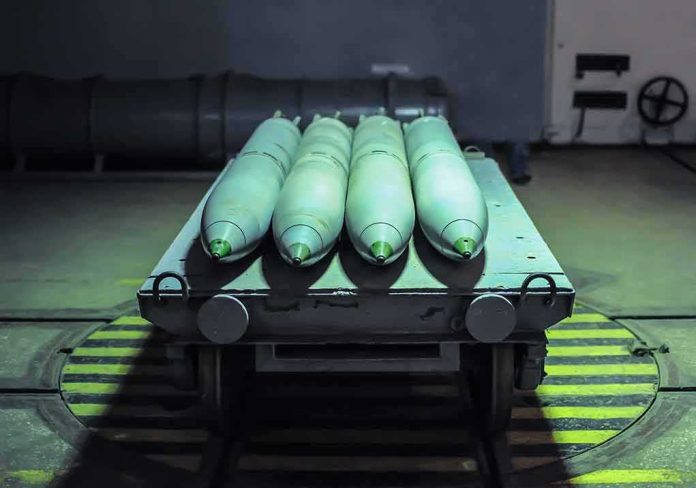
When hazardous waste becomes an explosive hazard, governance shifts from paperwork to command. Iowa’s disaster proclamation ahead of the Army’s planned detonation of 68 drums of lead azide was not symbolic; it activated the state’s emergency machinery to align local, state, and federal actions around a single, time-sensitive risk: preventing an uncontrolled explosion while managing the consequences of a controlled one.
At a Glance
- Iowa activated its disaster response framework for three counties in anticipation of a federal explosive-hazard operation at the Iowa Army Ammunition Plant.
- The EPA issued an emergency permit identifying the stockpile as both reactive and toxic; the Army’s plan called for treating 68 drums of lead azide on-site.
- The operation sat inside active federal litigation and a temporary permit stay, underscoring the need for coordinated public communication and readiness.
- This episode illustrates a recurring tension in hazardous-materials governance: the risk of keeping an unstable explosive versus the risk of dispersing toxic material during controlled disposal.
What the proclamation actually did
Iowa’s proclamation triggered the disaster response and recovery provisions of the Iowa Emergency Response Plan and applicable county plans. In plain terms, that moved the state from monitoring to operational posture: activating the state emergency operations center, synchronizing health and environmental messaging, and clearing the way for logistics, mutual aid, and public-information functions that counties rely on in time-compressed events. Iowa Homeland Security and Emergency Management described the activation explicitly, tying it to the planned detonation window at the Iowa Army Ammunition Plant in Middletown.
That activation matters because explosive-response timelines are dictated by physics, not meeting schedules. The decision space narrows quickly when an energetic material shows increasing sensitivity; a state’s formal activation ensures county public health, emergency management, and law enforcement know who speaks when, who moves what, and which thresholds trigger sheltering, road controls, or sampling operations.
Why the Army planned a detonation at all
EPA issued an emergency hazardous-waste permit authorizing the Army to store and treat lead azide at the Middletown site, labeling the material both reactive (prone to detonation) and toxic (lead) and citing imminent and substantial endangerment standards. The authorization encompassed intentional detonation—an extraordinary but recognized treatment method in explosives safety when handling, transport, or conventional neutralization would increase the risk envelope. The Eighth Circuit’s opinion, addressing challenges to that permit, identifies a specific inventory—68 drums—and the intended on-site treatment at the Iowa Army Ammunition Plant.
Lead azide is a primary explosive; even small crystals are sensitive to friction and impact. According to the litigation record and EPA materials, changes in storage conditions contributed to recrystallization and elevated sensitivity, eroding the safety margin for indefinite storage. Under those conditions, risk managers face a binary: continue to store material whose hazard curve is trending upward, or reduce the source term through a controlled operation engineered to contain blast effects and capture particulate to the maximum extent practicable.
The legal crosscurrents—and what they changed
Environmental groups sought review of the emergency permit; the Eighth Circuit issued a temporary stay that paused the EPA authorization even as officials discussed other potential legal authorities. The Associated Press reported the stay and the state’s activation of its emergency operations center while Iowa coordinated with federal counterparts and kept residents informed. In practice, the litigation and stay did not erase the underlying hazard; they altered the procedural path and timeline. For state authorities, that is precisely when a proclamation earns its keep: aligning communications, sustaining readiness during uncertainty, and ensuring rapid pivot capacity if schedules or authorizations shift.
It is important to separate functions here. The EPA permit conferred federal authority to treat hazardous waste emergently; the Army controlled the technical operation; Iowa’s proclamation mobilized state and county capabilities to protect the public around whatever federal action proceeded. These are complementary roles. The proclamation did not adjudicate the court dispute; it prepared the state to manage consequences under either scenario—action or delay.
Mechanics of risk: explosive safety versus toxic exposure
This case is a study in competing precautions. One camp sees the dominant risk in the growing instability of the stored explosive; the other sees the dominant risk in potential airborne lead from a detonation. Both are rational frames. EPA’s emergency action reflected the former—an explosive hazard that could not be left to ripen; the opponents emphasized environmental and health pathways if the operation released lead particulate. The documentary record confirms the Army’s intent to detonate 68 drums on-site and the EPA’s finding of imminent endangerment, while the legal challenge focused on the adequacy and lawfulness of using an emergency permit route for such a treatment step.
From an operations perspective, the mitigation tool kit is well-understood: engineer down the blast, arrest ejecta, knock down and capture dust, and design the plume with meteorology and timing. None of those steps nullifies toxicity; they reduce exposure probability and magnitude. That is why state activation around public guidance—sheltering advisories, agricultural precautions, and post-operation sampling—complements the Army’s on-site controls. The proclamation stitched those pieces together quickly for Des Moines, Lee, and Van Buren counties.
Iowa Governor Kim Reynolds Issues Disaster Emergency Proclamation for Three Counties as U.S. Army Prepares to Detonate 68 Barrels of Volatile Lead Azide Ahead of Thanksgiving https://t.co/64xOvQupTD #gatewaypundit via @gatewaypundit
— Jo-Ann (@ljcb12) November 25, 2026
What this episode teaches about hazardous-waste governance
Three patterns recur in events like Middletown. First, technical permitting frameworks are built for steady-state hazards; when chemistry or physics compresses timelines, emergency authorities take the lead. EPA’s emergency permit and the Army’s explosives doctrine reflected that shift, while Iowa’s proclamation mirrored it at the state level. Second, legal challenge windows overlap with operational clocks; even when a court pauses an authorization, governments must manage public risk communication and readiness. Iowa’s activation during the litigation stay exemplifies that posture. Third, accountability fragments when roles are multilayered—federal permitter, federal operator, state and county protectors. The public experiences a single event; the institutions do not. Proactive, centralized messaging is the antidote to that fragmentation.
How to judge the state action, fairly
The proclamation did what such instruments are designed to do: it readied the state to manage protective actions and consequence management around a federally led explosive-hazard operation tied to a specific, unstable stockpile at a known site. The record supports the core facts with named authorities—the EPA emergency permit, the Eighth Circuit opinion identifying 68 drums at the Iowa Army Ammunition Plant, and Iowa’s own activation notice. The litigation and stay underscore that risk management here involved both technical and legal judgment calls; they do not negate the value of pre-positioned state coordination when an operation may move on short notice.
Sources:
thegatewaypundit.com, epa.gov, ecf.ca8.uscourts.gov, kwqc.com