

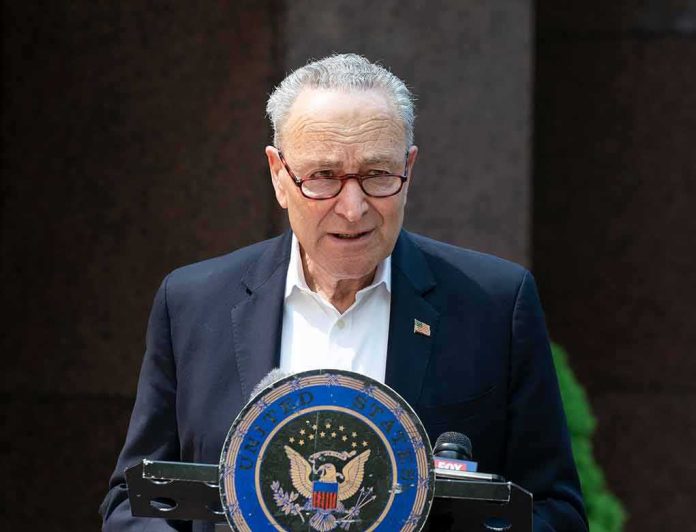
The real fault line in the Senate Democrats’ leadership fight is not age or personality; it is a choice between a centralized, leader-driven chamber and a recommitment to committee power, bipartisan craftsmanship, and regular order.
At a Glance
- Van Hollen’s case rests on institutional reform: empowering committees and elevating bipartisan committee work over leader-centric dealmaking.
- Schumer’s case rests on performance and relationships: fundraising prowess, coalition management, and a record his allies say helped deliver a dominant Senate majority.
- Endorsements split the caucus’s instincts: change to fix process versus continuity to bank recent electoral and legislative gains.
- Political science is clear: incumbents in leadership contests start with structural advantages, and reform agendas rarely prevail without broad, cross-faction buy-in.
The choice in front of Senate Democrats is structural, not generational
Strip away the headlines and one argument defines this contest. Chris Van Hollen’s supporters frame leadership as the gateway to process reform: move power down from the leader’s office, let committees write, vet, and surface bills, and create incentives to privilege bipartisan committee outputs on the floor. Chuck Schumer’s supporters answer with results and reliability: in a polarized era, centralized control is the only way to protect a fragile governing coalition, coordinate message and money, and steer big packages to the president’s desk. That is the trade. Voters rarely see it, but senators live inside it every day.
Van Hollen has put his procedural cards on the table. He aligned with a bipartisan rules package associated with Jeff Merkley and Steve Daines to strengthen committees and channel more Senate time to bills that emerge from real, recorded committee work—an explicit attempt to curb the modern habit of leader-crafted omnibus legislating and crisis-driven “ping-pong” with the House. Whether one loves or hates the outcome of recent mega-bills, the mechanism is familiar: leaders write, rank-and-file react, and committees retrofit oversight after the fact. Van Hollen promises to reverse those incentives.
How Schumer’s side argues continuity delivers
Schumer’s allies prosecute a straightforward case: when the Senate majority expanded, fundraising pipelines strengthened, vulnerable incumbents felt protected, and the caucus kept its policy center of gravity intact, one constant was Schumer’s leadership. They cite his decades of donor cultivation, his “always-on” phone diplomacy with nearly every Democrat, and his role in knitting colleagues together against President Trump’s priorities as evidence that centralized stewardship has paid off. In a caucus that, they argue, now holds 56 seats, swapping out the architect of that success looks like needless risk; John Fetterman has given that sentiment its bluntest form, crediting Schumer for recruiting “a great class” and dismissing Van Hollen as lacking a record commensurate with the top job.
On the numbers and networks, their claims have traction. Leadership jobs today are as much about engineering resources and sequence as about floor speeches. The leader decides what ripens for debate, what waits, and how much airtime any intraparty fissure receives. A caucus this large contains senators who would never back each other’s signature bills; the leader’s office smooths those contradictions by sequencing wins, bundling tradeoffs, and absorbing blame for the inevitable disappointments. That is hard to replace quickly, and Schumer’s long-running relationships give him leverage no rule can manufacture overnight.
Does reforming the process actually change outcomes?
Reformers are right about one thing: the Senate’s committee system has atrophied. Hearings still happen, but the center of gravity for real legislating migrated to the leader’s suite and task forces years ago. The Merkley–Daines model Van Hollen backs would push more vetted, bipartisan materials to the floor and give committee chairs—who are closer to policy detail than to daily message thermals—greater gatekeeping power. Historically, reforms that democratize agenda control have come in waves and have required both procedural change and cultural buy-in to stick; changing the rulebook without changing member behavior yields symbolism, not throughput.
The empirical literature on congressional leadership elections underscores why this is hard. Incumbents possess dense advantages: information flow, member services, staff patronage, and fundraising ties. Challenges do arise, but they are uncommon and often fail unless would-be reformers assemble a coalition broad enough to convince members that new rules will not strand their individual priorities on the rocks of “regular order” delay. That is the strategic hurdle Van Hollen must clear: persuading appropriators, authorizers, and swing-state senators that more committee power will produce more governable compromises, not more hostage points for the minority or intra-party bottlenecks.
What the endorsements actually signal
The public endorsements tell a more nuanced story than a left-versus-center morality play. Van Hollen has drawn support from progressives who have long pushed for regular order, but also from moderates who view committee empowerment as a way to discipline messaging bills and build credible bipartisan coalitions—Elissa Slotkin’s backing was read precisely in that light. That cross-ideological pairing suggests his pitch is institutional, not merely ideological. By contrast, Schumer’s bloc features members who prioritize predictability in floor time, incumbency protection, and the integrated campaign-and-governing machine a modern leader runs; for them, continuity is a risk hedge as much as a reward.
In private, senators run a practical calculus. Will my priorities make the floor? Will vulnerable colleagues get the votes they need without forcing mine? Will the fundraising and outside-group choreography remain synchronized? Continuity answers those with known quantities. Reform answers with different risks: potentially fewer midnight mega-packages, more bipartisan markups, and—if it works—more durable policy. But fewer leader-driven packages also means less ability to bundle tough votes into one take-it-or-leave-it moment that protects individual members. That is why institutional reformers often find their coalition thinning as vote day approaches.
🔥🚨💥 DEMOCRATIC CIVIL WAR ERUPTS 💥🚨🔥
Bernie Sanders just STABBED Chuck Schumer in the back and publicly backed Chris Van Hollen to steal the Senate Democratic Leader job!
SANDERS on MS NOW: “Chris is a strong advocate for real change, for listening to the people.”
“I’ve… pic.twitter.com/oKg68yAfof— CONSTITUTION X 🇺🇸 (@ConstitustionX) November 23, 2026
The sober read: both theories can succeed, but the burden is on the reformer
There is no iron law that centralized leadership always outperforms committee-led legislating, nor vice versa. In periods of intense polarization and narrow margins, leaders have amassed power because it is the shortest path to a floor outcome. When margins grow or the center of the chamber thickens, committees can again become productive engines—if leaders allow it and members invest. Schumer’s defense is built on recent performance and the promise of continued cohesion. Van Hollen offers a plausible mechanism to improve deliberation and legitimacy: invert the incentive structure so bills earn floor time by clearing bipartisan committees, then let the leader orchestrate, not originate, most of the content.
Political science and congressional history suggest challenges like this succeed only when three conditions align: a widely shared sense that the current workflow has failed; a credible, specific reform blueprint; and enough relationships across factions to guarantee near-term stability during the transition. Van Hollen clearly has condition two. Schumer’s allies argue, persuasively to many colleagues, that conditions one and three still favor continuity—and they point to electoral gains and caucus harmony as proof. The decision, then, is not about who gives the better speech; it is about which workflow Democratic senators want to inhabit for the next two years, and which risks they are willing to own.
Sources:
reason.com, wjla.com, jewishinsider.com, politico.com, washingtonsun.com, news.bloomberglaw.com, washingtonexaminer.com, nytimes.com, dailypost.ng, realclearpolitics.com