Warnings about election-period pressure rarely hinge on clairvoyance; they flow from how power actually operates under stress—rhetoric hardens into administrative signals, those signals can chill participation at the margins, and close races are decided precisely at those margins.
At a Glance
- Hillary Clinton publicly predicted that President Trump would become “even more out of control” if Democrats captured both chambers of Congress, framing institutional leverage as the necessary counterweight.
- Contemporaneous reporting documented live concerns about potential federal presence near polling places, even as homeland security officials said ICE would not target polling locations.
- Structural election frictions—polling-place reductions, long lines, and administrative confusion—amplify the intimidation risk without any single order to interfere.
- The likeliest flashpoints follow a familiar sequence: rhetoric, administrative pressure, litigation, and—less commonly—contests over certification; each stage deserves separate scrutiny and safeguards.
What Clinton Actually Said—and Why It Matters
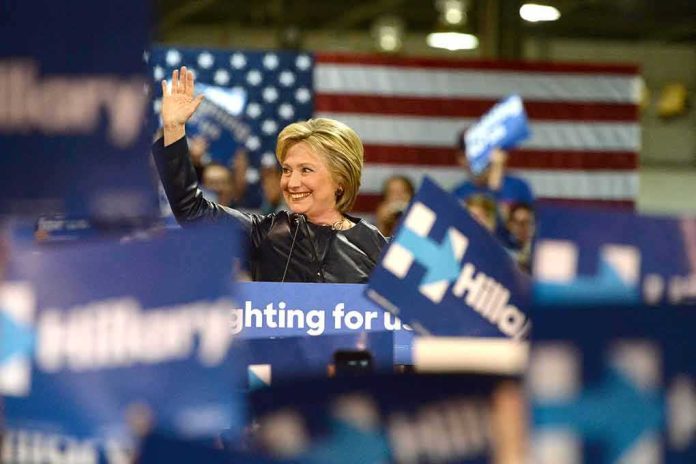
On national television, Hillary Clinton argued that if Democrats won the House and Senate, Trump would feel “cornered,” lash out, and refuse cooperation with Congress. She paired that diagnosis with a remedy: institutional leverage through congressional oversight. The core claim is not metaphysical; it is about incentives in divided government. An executive facing adverse majorities has two broad paths—accommodation through negotiation or confrontation through unilateralism and information resistance. Clinton forecast the latter and urged voters to supply the countervailing branch needed to check it.
Her warning came alongside a more concrete anxiety: signals from federal agencies around Election Day operations. Concern about a visible federal footprint near polling sites is not novel—both law and best practice treat it as a potential source of voter intimidation. Clinton’s emphasis placed these risks in the same frame as executive-congressional conflict: the moments when power meets constraint are when corners are most likely to be cut.
The Mechanism: How Rhetoric Translates into Election-Side Pressure
Election conflict in the United States tends to move through predictable stages. First comes political rhetoric that reframes normal administration as suspect or disloyal. Next are administrative nudges—public safety justifications, enforcement postures, or “presence” decisions by federal or state actors—that signal scrutiny at or around voting activity. Litigation often follows, aimed at rules governing access, counting, or timelines. Only rarely does the conflict escalate to certification standoffs. Treating this as a single monolith obscures what experience shows: each stage can be managed with clear legal boundaries and rapid accountability, and none by itself proves the next.
Within that sequence, a visible federal presence at or near polls sits in a legally sensitive zone. Federal law, including 18 U.S.C. § 592 and 52 U.S.C. § 20511, restricts armed federal officials at polling places and criminalizes intimidation or attempted intimidation of voters. The point is less theoretical than operational: the mere possibility of immigration or law-enforcement activity proximate to voting can chill turnout among eligible voters in mixed-status families or communities. That is why guidance, preclearance of deployments, and bright-line rules matter.
What Was Known About Federal Posture Near the Polls
As the midterms approached, investigative reporting highlighted the absence of an explicit, categorical disavowal of federal agent presence at polling locations or extraordinary custodial actions involving ballots or machines. A Department of Homeland Security spokesperson stated that ICE was not planning operations targeting polling sites while reserving authority for bona fide safety threats. The combination—assurances paired with exceptions—left practitioners focused on execution: who decides what constitutes a threat, and how are those decisions communicated to local officials and the public in real time?
Those questions are not idle. Election administration is fragmented across thousands of local jurisdictions, which means a small number of ambiguous signals can produce large-scale confusion. When lines are already long and sites have been consolidated, as documented in parts of Texas where Tarrant County cut polling locations by roughly a third, any added uncertainty can alter who persists through a two-hour wait and who turns back after twenty minutes.
Where the Guardrails Are—And How They Work
Legal backstops exist and, when invoked early, work. Statutes restricting armed federal presence at the polls are clear; civil-rights laws supply remedies for intimidation; and federal courts are practiced in issuing rapid, targeted injunctions. These tools are effective only if facts are surfaced quickly enough to meet the moment. That is why detailed advance planning—jurisdictional playbooks, hotline escalation pathways, and pre-negotiated interagency protocols—matters as much as courtroom victories secured after the doors close.
Congressional leverage, which Clinton invoked, is a different guardrail with a longer fuse. Oversight powers—hearings, subpoenas, appropriations riders—shape executive behavior not only after a controversy but in anticipation of it. Executive privilege and accommodation norms complicate that dance, yet the mere prospect of sustained oversight can deter edge-case tactics. In divided government, the durability of that leverage is a function of procedural competence and public clarity about what is at stake.
Hillary Clinton made an ominous warning about what Trump may do if Republicans lose big in the midterm election.https://t.co/F9qR7scGo2 pic.twitter.com/s1NTpPosxL
— The Daily Beast (@thedailybeast) November 3, 2026
What Is Speculation—and What Is Evidence
Clinton’s temperament assessment of Trump—“more unhinged,” “out of control”—is a political judgment. The parts of her warning that merit policy attention are the ones tethered to identifiable mechanisms: how federal enforcement presence is signaled, how polling access is structured, and how a newly empowered Congress would conduct oversight. On those fronts, the record contained concrete, contemporaneous elements: a DHS statement declining targeted polling-site operations while reserving threat-response authority, and reporting on site reductions and the resulting line-and-confusion risk in key jurisdictions.
None of this requires assuming a master plan to subvert the vote. It does require acknowledging that ambiguous enforcement postures and stressed local infrastructure change behavior at the margins. In tight contests, the margins decide outcomes. The prudent posture is therefore less about forecasting a single dramatic breach and more about crowding out gray zones where routine administrative choices become de facto suppression.
Practical Implications for Voters, Officials, and Institutions
For voters, the advice is straightforward: confirm your polling location early, budget time for lines, and use official channels—county election offices or state portals—to resolve inconsistencies. For local officials, clarity beats creativity on Election Day: publish site lists that are locked 72 hours in advance, coordinate with state and federal partners on a single public point of contact for safety concerns, and document any law-enforcement activity near sites in real time, including who initiated it and why.
For federal agencies, the burden is to collapse ambiguity. Codify a bright-line posture that bars non-emergency enforcement near polling locations during voting hours; require high-level signoff and immediate public notice for any exception; and pre-brief state election directors on thresholds and communication protocols. For Congress, assuming a mandate, the work is anticipatory: secure data preservation across relevant agencies, schedule early oversight hearings focused on Election Day operations, and legislate default rules that remove discretion from the most distortion-prone windows of time.
Why This Frame Endures Beyond a Single Cycle
The architecture of American elections—decentralized, time-compressed, and legitimacy-dependent—guarantees that small procedural choices carry outsize democratic consequences. The pattern Clinton invoked will recur: heated rhetoric, administrative signals, litigation, and, sometimes, certification drama. We cannot abolish political conflict. We can narrow the lanes in which it can distort participation or outcomes, by hardening legal rules at the point of contact between voters and the state and by insisting that competing branches do their jobs with discipline when stakes are highest.
Sources:
themirror.com, ew.com, news.meaww.com, comingsoon.net, tvinsider.com, propublica.org