
In modern air combat, the decisive edge is not the airplane but the missile it carries; the United States’ AIM-260 Joint Advanced Tactical Missile (JATM) exists for one reason—restore and extend U.S. beyond-visual-range reach against adversaries fielding longer-legged weapons such as China’s PL-15.
The Short Version
- The U.S. began AIM-260 specifically to counter the PL-15 and surpass AIM-120 AMRAAM’s reach, according to an Air Force weapons chief’s on-record explanation.
- Photographs from May 2026 show an AIM-260 test article carried by a U.S. Navy F/A-18F, confirming flight-test progression.
- Budget documents and reporting describe a major program with multibillion-dollar procurement planned through 2031.
- Exact range, speed, and seeker performance remain classified; what is confirmed is the design intent: longer range in a package compatible with front-line U.S. fighters.
Why the AIM-260 Exists: Out-ranging a growing threat
The AIM-260 JATM is not a speculative science project; it is a deliberate response to a concrete operational problem. In June 2019, the Air Force’s program executive for weapons, Brig. Gen. Anthony Genatempo, publicly tied the missile’s inception to the emergence of China’s PL-15, describing JATM as the next air-dominance air-to-air weapon with longer range than AIM-120 AMRAAM. That framing matters because it defines the requirement the missile must meet: enable U.S. and allied fighters to hold first shot, first kill advantage at ranges where the PL-15 would otherwise dictate terms of engagement.
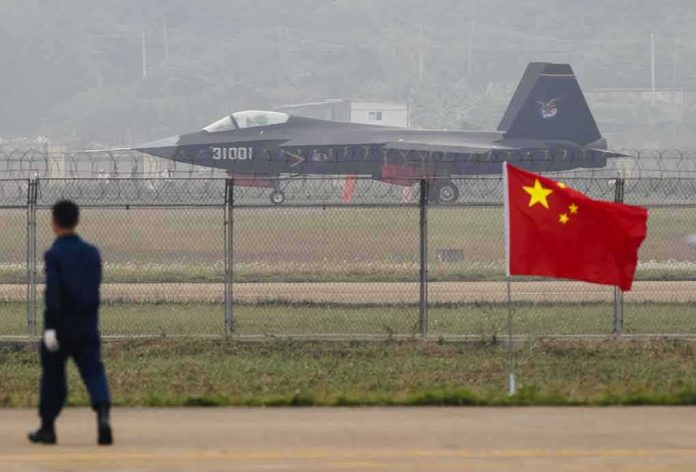
The PL-15 itself—associated with an active electronically scanned array (AESA) radar seeker and widely assessed as a longer-range class of missile—has rebalanced the beyond-visual-range (BVR) equation. Strategically, this compresses the maneuvering and sensor timelines for U.S. fighters operating in contested airspace. Public defense analysis from the International Institute for Strategic Studies has documented how the PL-15’s reach is driving allied missile design priorities, a view consistent with U.S. officials launching JATM to restore the standoff envelope and tactical initiative.
Design intent and platform compatibility: Longer legs inside the weapons bay
JATM’s core design choice is as important as its range: it must fit internal weapons bays and standard hardpoints across the U.S. fighter inventory. That requirement forces a demanding optimization—maximizing endgame energy, sensor performance, and resistance to countermeasures within an AIM-120-sized form factor—so that F-22s and F-35s can preserve stealth while carrying it internally, and F/A-18s and other legacy platforms can employ it externally without rearchitecting pylons. Contemporary reporting at program launch identified Lockheed Martin as the developer for both the Air Force and Navy, explicitly as a successor or replacement class for AMRAAM aimed at the PL-15 challenge.
Although specific performance figures remain classified, the program’s own leadership characterized JATM as having “longer legs” than AMRAAM; that is the only range claim the public record can support with named sources. The tactical import is clear: a larger no-escape zone—a missile’s envelope within which a target cannot evade kinematically—buys shooters more firing opportunities at tactically relevant ranges. In practice, that improves the odds of deterring, disrupting, or destroying opposing fighters before they can employ their own weapons effectively.
From plan to flight test: What we have actually seen
Programs prove themselves in the air, not on PowerPoint. On May 13, 2026, an aviation photographer captured images at Eglin Air Force Base showing a U.S. Navy F/A-18F carrying a missile with the external identifiers of the AIM-260. The article bore the red and yellow bands typically associated with a live test round, indicating progression beyond inert shapes to energetically representative test assets. While a single sortie does not illuminate seeker logic or endgame kinematics, it confirms what matters to the fielded force: JATM hardware is flying in an operationally relevant integration with fleet aircraft.
That visible progress complements the money trail associated with full-rate programs. Reporting tied to budget documents lays out a scale of investment that matches a core air-dominance imperative: roughly $1.47 billion earmarked for research and development over five years, nearly $369 million for fiscal 2026 procurement, and a planned $8.8 billion procurement line from 2027 through 2031. Put plainly, this is not an experiment on the margins; it is a funded transition path from AMRAAM toward a new BVR baseline.
Schedule reality and the acquisition pattern it reflects
Early public remarks in 2019 pointed to flight testing in 2021 and initial operational capability in 2022. The first widely circulated imagery of a test article arrived in 2026, a lag that will surprise no one who follows U.S. weapons acquisition. Across decades, Government Accountability Office reviews have documented consistent schedule stretch and cost growth as complex systems mature, particularly when programs compress technology development and fielding timelines in response to emergent threats. The arc of JATM’s public milestones fits that base rate: aggressive intent at launch, followed by a more measured march through integration and testing.
This does not imply failure; it does explain why defense leaders often speak in relative capability terms—longer range than AMRAAM; designed to counter PL-15—rather than publishing performance tables. In competitive air-to-air regimes, the details that would satisfy outside analysts—effective engagement ranges by aspect, seeker acquisition probabilities in dense jamming, endgame energy at altitude—are exactly the parameters a rival would most like confirmed.
What “parity” really means in BVR combat
Missiles are the visible tip of a deeper stack: offboard sensing, data links, electronic support measures, and the pilot’s ability to fuse those inputs into a timely shot. JATM’s significance is thus twofold. First, it restores or extends the standoff needed for F-22s, F-35s, and F/A-18s to prosecute shots without ceding the first engagement to PL-15-equipped adversaries. Second, it preserves magazine flexibility by fitting within existing carriage schemes, an essential attribute for stealth platforms that must husband internal volume carefully. The IISS assessment underscores the broader competitive logic: the PL-15 has shifted the BVR calculus; JATM is the American answer designed to reclaim decision distance.
Because performance specifics are classified, public debate often reduces to single-number range claims. That is a poor proxy for combat effectiveness. A missile’s “maximum range” in brochure terms bears little resemblance to its effective combat envelope against a maneuvering, jamming target executing defensive tactics at altitude. What can be said confidently is what the program has declared and demonstrated: JATM is built to outrange AMRAAM, it is integrating on U.S. frontline fighters, and it is proceeding through flight test with sizable procurement programmed to follow.
The F-22 can hold the AIM-424 and AIM-260, both of which outrange the PL-15
— Ulyx Priv (@UlyxysIV) October 21, 2026
What to watch next
Three milestones will signal JATM’s full arrival. First, formal declarations of operational capability on one or more fighter platforms, confirming that the missile has cleared not just captive-carry and separation testing but the software, envelope, and sustainment gates for squadron service. Second, visible procurement acceleration—matching the multiyear funding lines—with deliveries into operational units. Third, evidence of broad integration across the F-22, F-35, and carrier air wings, which would validate the design’s central promise: longer reach without sacrificing carriage or stealth. On the public record so far, the program is oriented to achieve all three.
Sources:
19fortyfive.com, aircraftinsider.com, theaviationist.com, globalsecurity.org, airandspaceforces.com, zona-militar.com, defensenews.com