

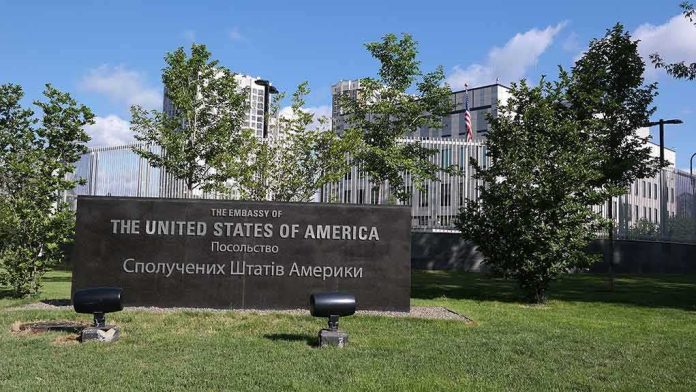
When Washington orders an “ordered departure,” it is not a panic button but a precise risk-management tool: a way to shrink exposure quickly while preserving the core of a mission under threat. That is exactly what the United States did in Saudi Arabia amid intensified Houthi attacks, pulling non-emergency personnel and family members while keeping essential operations running.
At a Glance
- The State Department ordered non-emergency U.S. government employees and family members to depart Saudi Arabia, amending an earlier authorization for voluntary departure.
- Officials anchored the decision in the security environment, highlighting recent Houthi attacks on Red Sea shipping, airports, and critical infrastructure.
- Embassy operations continue with essential staff; “ordered departure” is not synonymous with a full evacuation.
- Confusion in early reporting reflects a recurring gap between technical personnel categories and shorthand media framing.
What Washington Ordered — And Why It Matters
On March 8, 2026, the U.S. Embassy in Saudi Arabia announced that the State Department had moved from authorizing to ordering departure for a defined population: non-emergency U.S. government employees and their family members, citing safety risks in the Kingdom’s operating environment. The notice explicitly referenced recent Houthi attacks on vessels in the Red Sea as part of the threat landscape, situating the decision within a pattern of cross-border targeting and maritime disruption linked to Yemen’s conflict. The department’s public spokesperson reinforced that the order applied in Saudi Arabia and that it covered non-emergency personnel and family members — the standard formulation used when a post reduces its footprint while keeping essential functions in place.
This shift from authorized to ordered departure is the inflection point in State’s risk calculus. Authorization lets eligible populations choose to leave on the government’s dime; ordered departure narrows the choice — they must go. For families and nonessential staff, it is a clear signal: risk has moved from elevated to unacceptable. For the mission, it is continuity planning under duress, not abandonment.
How “Ordered Departure” Works
Inside the diplomatic system, “ordered departure” (OD) is a personnel status, not a headline. It triggers administrative authorities — travel, allowances, education and housing logistics for family members — and a rapid reconfiguration of who remains to perform emergency, consular, security, and liaison duties. Crucially, OD does not mean shuttering the embassy. In previous crises, posts have operated for months under OD, retaining security, medical, consular, and political-economic cores to maintain presence, manage crises, and coordinate with host-nation counterparts. The Saudi order follows that established playbook: thin the nonessential footprint, reduce attack surface and family vulnerability, and keep professional continuity where it is most impactful.
The rationale cited publicly fits the threat profile. The embassy advisory identified recent Houthi attacks on Red Sea shipping, a campaign that has periodically surged and forced complex rerouting for commercial vessels, while the spokesperson connected the decision to Houthi strikes against civilian airports and critical infrastructure — attacks that create both direct risk and cascading travel disruptions for families and staff who would otherwise rely on commercial aviation and predictable logistics.
Why Reporting Looked Messy at First
Early accounts from wire services and regional outlets varied widely in scope, with some suggesting all staff and families were told to leave Saudi Arabia and others implying a multi-country Gulf drawdown. That range was not malice; it was vocabulary. “Evacuation” is a public shorthand that collapses distinct personnel categories into a single dramatic frame. Inside the system, however, the terms are granular. The State Department’s named on-record clarification — Saudi Arabia only; non-emergency employees and family members — is the controlling public statement, and it is consistent with the embassy’s published advisory.
This communications friction is perennial. In Afghanistan, the department placed Embassy Kabul on ordered-departure status months before the catastrophic endgame; the label enabled drawdown authorities while the mission still performed additional, even expanded, duties during the withdrawal sequence. In Ukraine, Washington moved from authorized to ordered departure as conditions deteriorated, again leaving essential operations intact. The Saudi move belongs to that same family of calibrated, bureaucratically specific risk decisions — not to the cinematic image of embassy rooftops and helicopters.
The Threat Environment Driving the Decision
The Houthis have long used a mixed arsenal of cruise and ballistic missiles, drones, and naval mines to create leverage beyond Yemen’s borders. Their maritime attacks in and around the Bab el-Mandeb gateway affect the Red Sea’s north–south artery, raising insurance premiums, disrupting schedules, and occasionally damaging hulls. U.S. maritime-security advisories catalogued renewed incidents, including strikes off Saudi Arabia’s western coast, underscoring the persistent if uneven nature of the threat to commercial shipping and, by extension, to logistics lifelines diplomats and families depend on.
Beyond the sea lanes, airports and energy infrastructure become symbolic, high-payoff targets: they concentrate civilians, attract media attention, and implicate international stakeholders. That combination — episodic but severe risk to transportation nodes and infrastructure — is precisely the type of environment that argues for removing dependents and nonessential staff while preserving the professional cadre needed to operate, coordinate, and report.
U.S. Gulf Embassy Evacuations: Iran War and Airline Disruption: U.S. Gulf embassy evacuation plans raise Iran escalation fears as Saudi airport attacks threaten airlines, tourism and… dlvr.it/TW10D4 #AirspaceRestrictions #Gulfairlines #Iran #Qatar | breaking news | pic.twitter.com/nJNJqVnzi2
— eTurboNews | Trends | Travel News (@eTurboNews) October 21, 2026
What Stays When People Go
Ordered departure is not a policy retreat; it is the precondition for maintaining policy. With non-emergency personnel and families out of harm’s way, the mission can redirect bandwidth to crisis engagement: coordinating with Saudi security and civil aviation authorities, shaping maritime advisories with U.S. interagency partners, maintaining consular services for American citizens still in-country, and sustaining the political-military dialogue central to any de-escalation or defense posture. Embassy emergency action committees — the cross-functional bodies that own these plans — are designed for exactly this balance of continuity and care.
Practically, that means leaner teams, longer duty cycles, and heavy reliance on host-nation counterparts. It also means clear outbound messaging to the private sector: expect disruptions; keep STEP enrollment current; know where safe-haven options exist; and follow carrier and port-advisory guidance. If the risk picture improves, authorized return follows; if it worsens, Washington has already executed the hardest step — moving families and nonessential staff out safely and early.
Lessons for Readers: How to Read These Moves
First, treat “ordered departure” as a technical term with concrete implications. It narrows who must leave and who must stay, and it signals that the U.S. is managing risk, not abandoning the field. Second, look for the named, on-record anchor: here, the embassy’s public advisory and the State Department spokesperson’s clarification are the definitive public statements of scope. Anonymous early characterizations often use broader language that compresses important distinctions.
Third, connect the personnel move to the operating environment rather than to geopolitics in the abstract. Strikes that threaten airports, energy nodes, or shipping corridors change the calculus for families and nonessential staff long before they force a closure of core diplomatic functions. That is the pivot point the Saudi order reflects — a prudent contraction that preserves capability where it matters while reducing avoidable exposure.
Sources:
nampa.org, sa.usembassy.gov, trtworld.com, worldisraelnews.com