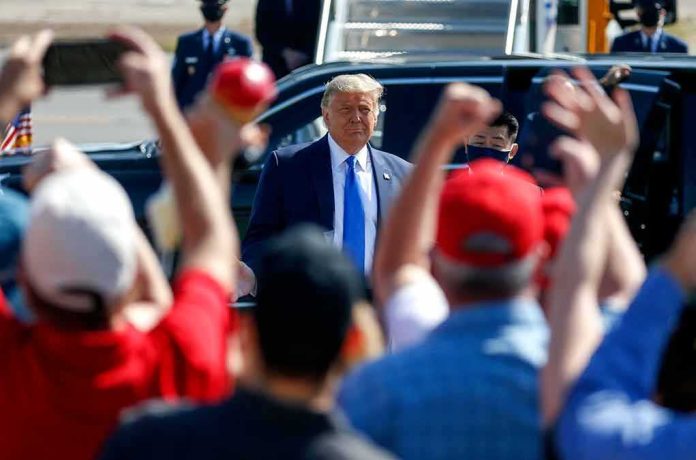
Political stamina is not just what a candidate says at a microphone; it is the operational decision-making that gets them to the microphone when logistics go sideways. In Durant, Oklahoma, President Trump turned a weather scrub into a show of momentum by ditching aircraft and pushing through by motorcade to keep the rally on — and he made that pivot part of the message.
The Short Version
- Bad weather grounded planned air travel from Texas to Durant; Trump shifted to a ground motorcade and still held the rally.
- Onstage, Trump said staff wanted to cancel; he insisted they drive, framing it as resolve under pressure.
- Local and national outlets documented the transportation change and delayed arrival, not a cancellation.
- The episode fits a familiar campaign pattern: operational hiccups become narrative fuel when a rally proceeds despite disruption.
What actually happened: a grounded plan, a motorcade, and a kept date
The sequence is straightforward and well-documented. After an earlier event in Texas, deteriorating weather eliminated the option to fly to Durant. The protective travel plan, which typically layers helicopter or fixed-wing legs with ground contingencies, defaulted to the convoy. Pool reports and local stations tracked the switch in real time as the presidential motorcade took North Texas highways toward southeast Oklahoma; the timeline slipped, but the rally went forward as scheduled at the Choctaw Event Center. Onstage, Trump cast the decision to drive as his call to defy a proposed cancellation — the memorable line, “Get your asses in that car,” became the rhetorical centerpiece of the night.
Two things can be true at once: operationally, weather forced a change and the event proceeded; politically, Trump’s telling of the scramble amplified the impression of momentum. In campaign logistics, preserving the event is the win. The audience saw a delayed start; they heard a story of insistence and follow-through. Both are accurate descriptions of the same evening.
How these pivots work: logistics, risk, and the protective bubble
Presidential movements are built around layered contingencies. Air legs compress time and exposure; when weather collapses that option — low ceilings, storm cells, or crosswind limits — the fallback is a hard-locked motorcade with pre-cleared routes, closure support, and medical and communications assets threaded throughout. Ground moves are slower, noisier in the media market, and risk-manage different hazards (road obstructions, traffic unpredictability), but they are standard practice. On days like Durant, the question is not “fly or don’t go,” it is “fly if parameters are met; otherwise execute the ground plan and modify the run-of-show.” That is what happened: flight parameters failed, ground plan executed, program slid later, rally remained intact.
The political upside of a ground pivot is visual and visceral: miles of police lights and a motorcade rolling through adverse weather convey effort and inevitability. The operational downside is fatigue — long car legs compress prep time, strain staff, and ripple downstream schedules. Campaigns accept that trade when the event’s strategic value justifies the push. Durant, with a packed house and statewide coverage, met that threshold.
The onstage narrative and the public record
At the microphone, Trump said advisers recommended canceling because the aircraft were off the table; he said he overruled them and ordered the drive. That framing is on tape and was captured by national wires in live updates the night of the rally. Independent of the applause line, the public record from local newsrooms and the traveling press confirms the two concrete facts that matter to a skeptical reader: air travel was scrubbed by weather, and the rally happened after a delayed ground transit.
Could a protective team or staffer have floated a cancellation in the scramble? Possibly; that kind of risk-reward conversation is routine when timelines start to break. But even if such counsel occurred, the outcome is dispositive: the plan shifted, and the principal appeared. For voters, that end state — showing up — carries the political weight.
Why this fits a long-running campaign pattern
Campaigns regularly metabolize logistical setbacks into narrative proof points. The security services, bound by doctrine not to disclose real-time decision matrices, rarely publish granular after-action detail; that silence leaves the campaign’s version to dominate the public square. The Durant episode follows the template: operational change, visible inconvenience, successful event, and a distilled story of willpower from the stage. The press corroborated the operational core — weather forced the drive; rally held — and the campaign harvested the symbolism.
There is a practical reason the symbolism works. Keeping a commitment under strain is a proxy for reliability. For partisans in the building, the path taken to the lectern is proof of priority. For undecideds watching coverage, the fact of appearance matters more than the mode of transit. Campaigns understand this calculus; they engineer redundancy into movement plans precisely to preserve that appearance.
The strategic consequence: momentum is a schedule, not a slogan
In the closing weeks before an election, the calendar itself becomes an argument. A cascade of kept rallies signals organizational fitness: advance teams locking venues, comms operations resetting timings on the fly, protectees threading multi-state days without visible fray. Durant contributed to that signal. The rally energized local allies and fed regional media with images of a capacity crowd; the travel hiccup, properly managed, reinforced the intended impression rather than marring it.
Even the choice of words — blunt, directive, memorable — serves a long tail beyond the hall. Quotable lines become the shard of a night that survives in coverage and supporter retellings. When the underlying facts are solid, as they were here on transport and follow-through, the quip strengthens rather than strains credibility. The inverse is also true: without the motorcade and the speech, the same line would ring hollow. Execution, not rhetoric, made the phrase land.
The crowd at President Trump's Oklahoma rally erupts into chants of "U-S-A!" as the president welcomes two supporters to the stage:
⠀
"You work harder than any American I know," one voter says to Trump.
⠀
"Absolute honor of a lifetime to be with pic.twitter.com/L21NLgqyOq— Donald Trump' Jr 🇺🇸 (@DonaldTrumpJrQl) October 2, 2026
Bottom line
Strip away the theatrics and you are left with competent crisis handling in miniature: a plan breaks, the team deploys the fallback, and the principal arrives. In politics, that is not routine — it is the job. Durant offered a clear case study: weather grounded the aircraft; the rally went on. The campaign turned the adjustment into a narrative edge, but the backbone was a disciplined movement pivot that preserved the event’s value. That is how momentum is built: one kept commitment at a time, especially when it would have been easier to cancel.