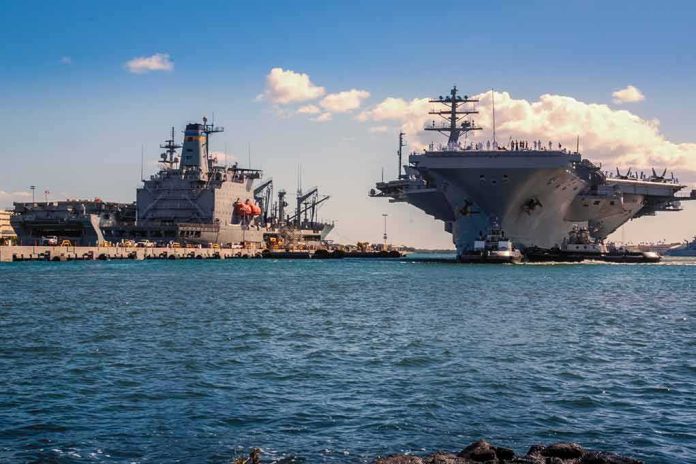
In the Gulf, visible military power is policy communication: the United States is surging a carrier strike group, Marines, and additional air defenses not to advertise a new war plan, but to harden critical infrastructure and signal deterrence while preserving options if escalation is ordered.
At a Glance
- The Pentagon is deploying the USS Theodore Roosevelt carrier strike group and roughly 9,000–10,000 sailors and Marines toward the Persian Gulf/Middle East theater, according to U.S. officials cited by major outlets.
- Two additional Patriot air-defense batteries have been sent in recent weeks—one to Saudi Arabia and one to Qatar—to shield oil and gas facilities.
- Officials frame the moves as defensive and deterrent, giving commanders more options while protecting energy infrastructure.
- When the Roosevelt arrives, the U.S. presence could restore a three-carrier posture in the broader region, depending on rotational decisions.
What is moving and why it matters
U.S. officials say the Pentagon is sending another carrier strike group—the USS Theodore Roosevelt—and approximately 9,000–10,000 additional sailors and Marines toward the Persian Gulf and adjacent waters. Bloomberg, The Japan Times, and regional outlets independently report the Roosevelt departed San Diego bound for the Middle East, restoring a larger, more flexible maritime posture at a time of sustained Iran-related tension. As a complement ashore, two Patriot batteries—Army-operated surface-to-air systems designed to intercept ballistic missiles, cruise missiles, and some classes of drones—were recently positioned to protect energy infrastructure in Saudi Arabia and Qatar, according to Axios and corroborating reports. The declared purpose is not new: deter Iranian attacks and reassure partners whose oil and gas installations are prime targets in any flare-up.
The scale and composition of this package matter operationally. A Nimitz-class carrier such as the Roosevelt brings embarked air wings capable of air defense, strike, and surveillance; the escorts add Aegis air and missile defense; Marines embarked with amphibious forces contribute crisis response, limited forcible entry, and maritime security. Together, they expand the menu of calibrated actions a regional commander can recommend—from persistent air patrols over sea lanes to rapid reinforcement of threatened garrisons. In practical terms, more hulls and aircraft compress response times; they also complicate an adversary’s planning by multiplying axes of U.S. presence.
How this fits decades of Gulf signaling
Washington has long used conspicuous deployments—carriers at choke points, air-defense assets at partner bases—as both shield and semaphore. In the Gulf, that signaling serves three audiences at once: allies who must be reassured, Iran and its proxies who must be deterred, and global markets that punish supply risk. The specific addition of Patriots to Saudi Arabia and Qatar maps directly onto known threat vectors—ballistic and cruise missiles, as well as one-way attack drones—against refineries, liquefaction trains, storage farms, and offshore export terminals. The logic is straightforward: harden the most lucrative targets of coercion while stationing mobile sea-based airpower to patrol the approaches.
Analytically, this is defense-first framing. Across the reporting, officials present the moves as protective, designed to blunt or dissuade strikes while keeping options available if President Trump orders additional action. That duality—defend now, retain latitude later—is typical of U.S. Gulf posture. And it is why carrier counts command headlines: a third deck in theater does not declare new rules of engagement, but it shortens the distance between a policy decision and its executable force package.
The force package: capability and purpose
What does one additional carrier strike group change? First, air tasking elasticity. With multiple decks, a commander can simultaneously sustain air defense of maritime traffic, run persistent intelligence-surveillance-reconnaissance orbits, and hold time-sensitive targets at risk without starving any line of effort. Second, layered missile defense at sea and ashore improves with more Aegis warships and additional Patriot fire units protecting fixed sites. While Patriots are not a panacea, their presence complicates an opponent’s salvo calculus and forces greater munition expenditure to achieve the same probability of damage. Third, Marines embarked with an amphibious ready group extend crisis-response reach for evacuations, discrete raids against coastal enablers, or reinforcement of partner facilities—missions that often sit below the threshold of major combat but above routine presence.
The Roosevelt’s departure from San Diego anchors the maritime piece; open-source reporting identifies a total uplift in personnel in the 9,000–10,000 range, consistent with a carrier strike group plus associated Marine and amphibious elements. Some outlets frame the amphibious component around the Makin Island Amphibious Ready Group, a formation tailored for distributed littoral operations; others emphasize the aggregate sailor and Marine count rather than named ships. The operational through-line is the same: more aviation, more missile defense, and more maneuver options in and around the Gulf.
Energy security and the Strait of Hormuz
Deterrence in the Gulf is inseparable from energy security. Saudi Arabia’s eastern province and Qatar’s gas infrastructure are both within reach of Iranian missiles and drones; Patriots positioned to guard those sites are a literal insurance policy for the global market. Any credible attempt to threaten flows through the Strait of Hormuz—a corridor that routinely carries a significant share of seaborne oil and liquefied natural gas—will first target the export systems that feed it. By thickening point and area defenses where hydrocarbons become cargo, Washington raises the threshold for a successful coercive strike and buys time to organize escorts, reroute traffic, or surge depot-level repair if damage is done.
Carrier aviation complements that mission set by policing the maritime approaches to critical terminals and by providing airborne early warning, electronic warfare, and counter-swarm capabilities against small boats and drones. In recent crises, the speed with which airpower can sanitize a lane or suppress a launch site has been the difference between a localized disruption and a regional panic. The point of a visible surge is to persuade would-be attackers that any gambit meets a layered, ready defense rather than a brittle or distracted one.
🔴WAR ON TERRORISM: IRAN 🇮🇷🔴/Bloomberg/
US Adds Carrier and 10,000 Troops to Mideast, Official Says
By Anthony Capaccio
The Pentagon is deploying an additional aircraft carrier and 10,000 sailors and Marines to the Persian Gulf, according to a US official, a move that gives… pic.twitter.com/p4JdZZUXxj
— JAVIER YEARSON 🇮🇱 Journalist. Broadcaster 🌱 (@javieryearson) October 2, 2026
What remains fluid—and what does not
Two elements are inherently dynamic. First, the exact composition and dwell time of a three-carrier posture can change with maintenance and relief cycles; some accounts hedge with language about “could” or “may” as the Roosevelt approaches theater. Second, public accounts of Patriot siting rely on officials speaking without names attached, a common feature of fast-moving defense posture updates; host-nation disclosures and satellite imagery often lag reporting by weeks. Neither caveat alters the central facts: the Roosevelt is deploying to the region with thousands of sailors and Marines, and additional Patriots have been emplaced to protect Gulf energy infrastructure.
Does this deter Iran?
There is a real debate among defense analysts about whether carriers and rotational surges impose enough cost to change Tehran’s behavior, particularly given Iran’s investment in missiles, drones, and proxies that can stress layered defenses at relatively low cost. Some research argues that repetitive carrier presence has strained U.S. fleets without delivering durable deterrent effect against gray-zone tactics; still, in acute crises, rapid-reaction airpower and thickened defenses have repeatedly blunted damage and constrained escalation ladders. In policy terms, Washington is choosing the known instruments of reassurance and denial—more interceptors, more airborne sensors, more ready aircraft—while keeping the political decision space open.
Bottom line
The United States is adding a carrier strike group, thousands of sailors and Marines, and extra Patriot batteries to the Gulf and surrounding waters. The message is consistent: protect critical energy infrastructure, reassure partners, and expand operational options if ordered. In a region where perception shapes risk as much as hardware does, the combination of visible sea power and quietly emplaced air defenses is the grammar of deterrence—meant to prevent miscalculation today while preserving leverage for tomorrow.
Sources:
jfeed.com, jpost.com, kurdistan24.net, en.yenisafak.com, bankingnews.gr, japantimes.co.jp, bloomberg.com, theprint.in