Counterfeit GLP-1 drugs flourish wherever demand outruns lawful supply, and federal prosecutors say a Florida-based hub for fake Ozempic exploited exactly that gap—moving imitation product sourced from unauthorized suppliers in China into U.S. distribution channels at cut-rate prices.
The Short Version
- A federal grand jury indicted two defendants, Swapnadip Roy and Vicky Ramancha, for an alleged transnational counterfeit Ozempic scheme centered in the Middle District of Florida.
- Charges include conspiracy, smuggling, and selling/holding for sale counterfeit prescription drugs.
- Prosecutors allege sourcing from unauthorized Chinese suppliers, deceptive packaging to mimic authentic Ozempic, and discounted downstream sales to U.S. distributors.
- The case lands amid a broader enforcement surge against counterfeit and unapproved GLP-1 products as demand and shortages accelerated.
What prosecutors say happened
According to the Justice Department and the unsealed indictment, two Indian nationals—Roy and Ramancha—are charged with orchestrating a counterfeit-prescription-drug distribution scheme involving Ozempic, a brand of semaglutide, with operations touching the Middle District of Florida. The charging instrument lists one count of conspiracy to commit smuggling and to defraud the United States, three counts of smuggling, and two counts of selling and holding for sale counterfeit drugs. The government’s theory is straightforward and familiar in counterfeit cases: beginning in or around July 2023 and continuing to April 2024, the defendants allegedly obtained counterfeit Ozempic from unauthorized sources in China, imported it, and sold it into U.S. channels at deeply discounted prices.
Prosecutors add an element that often distinguishes pharmacy-grade counterfeiting from mere diversion: materials allegedly included counterfeit packaging, package inserts, pen labels, and needles—artifacts designed to deceive downstream buyers into believing the product was legitimate, manufacturer-authorized supply. In the government’s telling, discounted pricing was not a courtesy; it was an accelerant, priming distributors to overlook anomalies in provenance and documentation while moving inventory quickly.
Where this fits in the GLP-1 enforcement landscape
GLP-1 medicines, including Ozempic and Wegovy, sit at an unusual intersection of genuine medical need, off-label cultural demand, and tight supply. That mix has drawn unauthorized compounding, gray-market imports, and outright counterfeits. FDA has repeatedly warned of counterfeit Ozempic circulating in the U.S. supply chain, emphasizing the risks of wrong dose, wrong ingredient, or sterility failures—each a different, serious hazard profile—with public alerts updated as recently as 2025. Customs data points to the scale pressure at ports: CBP has seized shipments labeled as GLP-1 products, including semaglutide, in multiple operations, reflecting how frequently these consignments attempt to breach entry controls. Congressional testimony has underscored gaps in foreign-facility compliance and the volume of suspect shipments, a structural challenge that enforcement can mitigate but not wholly eliminate.
Against that backdrop, the narrative described in the Florida indictment is not an outlier; it follows the characteristic markers of transnational counterfeit-drug prosecutions. Authorities highlight overseas sourcing from unauthorized suppliers, misbranded or counterfeit presentation meant to pass cursory inspection, and domestic distribution through intermediaries sensitive to price advantages. The legal posture frames this as both a consumer-protection and a border-integrity problem: counterfeit drugs undermine the closed, regulated system that ensures chain-of-custody, documented storage conditions, and lot-level traceability.
The mechanics of a counterfeit Rx scheme
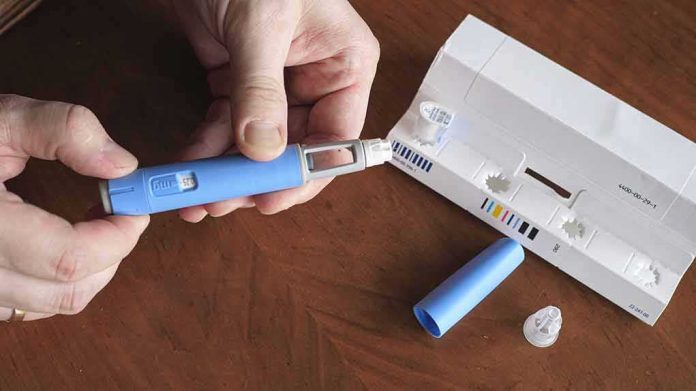
Counterfeit pharmaceutical operations succeed by imitating the hard-to-fake parts of legitimacy: serialization, labeling, inserts, and device appearance. When the product is a prefilled injection pen, the bar for visual mimicry rises; hence, prosecutors’ emphasis on counterfeit pen labels and needles. Those artifacts serve two roles—first, to persuade a first purchaser (a distributor or reseller) that the goods are genuine; second, to survive downstream scrutiny by a clinician, clinic buyer, or patient whose knowledge of packaging subtleties is limited. If the price is far below wholesale acquisition cost, the packaging has to “explain away” the discount; counterfeits attempt that through plausibility, not perfection.
From a logistics perspective, unauthorized foreign sourcing typically exploits e-commerce parcels, re-labeled bulk shipments, or transshipment through third countries to lower inspection risk. Once in the United States, the goods must move fast to monetize the arbitrage before complaints surface. Deep discounts drive velocity; private messaging and informal terms reduce paper trails. Each of those tactics appears, in broad strokes, across counterfeit Rx cases and is consistent with the government’s description here.
The charges and what they require the government to prove
The central conspiracy count requires proof of an agreement to commit smuggling and to defraud the United States, plus overt acts in furtherance. Smuggling counts turn on unlawful importation, often keyed to misdeclaration, contraband status, or violation of import restrictions. The counterfeit-drug counts hinge on demonstrating that the items bear unauthorized trademarks or otherwise constitute counterfeit within the meaning of federal law, and that the defendants sold or held them for sale. Prosecutors typically rely on a combination of customs records, communications, payment flows, and expert authentication—sometimes including the manufacturer’s own records on legitimate lot numbers and packaging features—to prove counterfeit status.
FDA’s role usually includes laboratory analysis, sterility testing, and comparison against authentic reference standards. Those findings—paired with chain-of-custody documentation—connect seized items to shipment records and downstream buyers. In parallel, financial and messaging evidence builds the transaction map: who ordered, who paid, which freight forwarder touched the goods, and how the price spread compares to legitimate wholesale pricing. Each element shores up the government’s theory that the goods were not merely diverted, but counterfeit, trafficked through an intentional scheme.
Two Indian nationals charged with smuggling counterfeit Ozempic from China: DOJ – The criminal indictment in Florida comes as the use of GLP-1 drugs such as Novo's Ozempic for weight loss has hit new highs among U.S. adults. Via @CNBC:https://t.co/tW0x8SOEW4
— 🌊💙 Viking Resistance 💙🌊 (@BlueCrewViking) September 29, 2026
Consumer risk and system consequences
Consumers and clinicians often equate “it looks like the box” with “it is the drug.” That is a dangerous shortcut with injectables. Counterfeit GLP-1 products can deliver too little active ingredient (eroding efficacy), too much (provoking adverse events), the wrong compound entirely, or a contaminated solution that introduces infection risk. FDA’s counterfeit Ozempic alerts have emphasized exactly these scenarios, because they are not hypothetical—each is a known failure mode in counterfeit supply chains. The damage extends beyond individual harm: every counterfeit episode questions the integrity of the closed distribution system on which U.S. pharmacy safety rests.
What to watch next
Indictments are allegations; guilt or innocence will be determined in court. From a public-health vantage, however, the through-line is already clear. High-demand therapies with supply constraints—especially injectables—attract counterfeiters who understand that price and packaging can override buyer skepticism. The enforcement response will continue to track three lines: interdiction at the border, criminal prosecution of organizers and distributors, and market guidance that keeps prescribers and patients inside the authorized supply chain. Expect more emphasis on serialization verification, more public alerts keyed to specific product lots and packaging anomalies, and steady casework targeting the logistics and finance nodes that make these schemes profitable.
Sources:
cbsnews.com, justice.gov, cnbc.com, foreignpolicyjournal.com