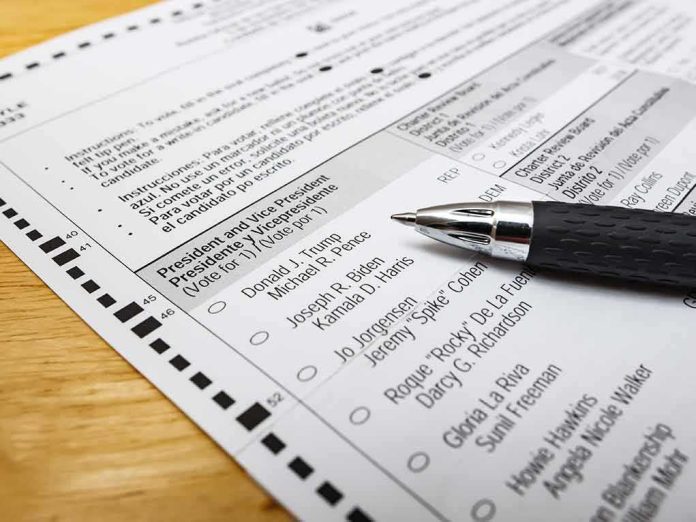
The fight over mail ballots is not really about fraud statistics or envelope designs; it is a constitutional struggle over who gets to set the machinery of voting when federal authority, state prerogatives, and operational realities of the Postal Service collide in the final weeks before an election.
At a Glance
- President Trump’s March 2026 order sought federal voter-eligibility lists and tied mail-ballot handling to those lists, with DOJ enforcement priority against officials who issue ballots to ineligible voters.
- Lower courts blocked key provisions, but the Supreme Court has granted partial, interim relief while broader litigation proceeds, creating a patchwork of what can move forward.
- The Justice Department has returned to the Court repeatedly with emergency applications to implement the order and Postal Service rules during ongoing litigation.
- The core legal clash centers on federal power and timing: whether USPS and DHS can condition ballot delivery and data exchange without intruding on state election authority—and whether late-cycle changes risk chaos.
What the order does—and how the federal case is framed
President Trump’s March 2026 executive order directs the Department of Homeland Security to assemble state-by-state lists of adult U.S. citizens and provide them to states at least 60 days before federal elections. It also instructs the Attorney General to prioritize investigation and, where appropriate, prosecution of state or local officials who issue federal ballots to ineligible voters. The administration paired those directives with U.S. Postal Service rules that, according to multiple reports, would limit ballot delivery to recipients appearing on submitted eligibility lists and require states to use a federal portal to upload those names. The Justice Department’s filings portray these measures as constitutionally sound coordination tools that do not displace state control of elections. The government has repeatedly sought emergency Supreme Court intervention to implement the framework nationwide while challenges proceed, underscoring the administration’s view that delay itself causes irreparable harm to federal interests and to election integrity.
In late August 2026, the Supreme Court granted partial relief, lifting a block that had frozen elements of the order and allowing some aspects to move forward while litigation continues on the merits. That interim decision did not resolve the core questions of statutory authority and federalism, but it signaled that at least part of the administration’s theory could proceed pending fuller review. Subsequent filings have asked the Court for additional leeway on the USPS rules, which remain the focal point of several injunctions and appeals.
Why this dispute sits at the fault line of federalism and election mechanics
American election administration is a shared enterprise with asymmetrical obligations: states run elections; Congress can set certain rules for federal contests; federal agencies like DHS and USPS carry out supporting functions with statutory limits. When a president directs DHS to generate citizen lists and USPS to condition ballot delivery, the practical question—how quickly could agencies stand up accurate lists and operational screening—sits atop the constitutional one: whether Congress has actually delegated such gatekeeping authority to the executive branch. Courts often resolve late-cycle election disputes not on abstract integrity claims but on federalism, statutory text, and timing. Here, the administration insists its rules coordinate mail logistics without dictating state voter eligibility; opponents argue the rules effectively federalize voter screening by conditioning delivery on federal lists.
Timing amplifies everything. By midsummer, some jurisdictions had already begun mailing ballots or finalized envelope specifications. A system that requires redesigned envelopes, barcode standards, and real-time matching against a new federal list imposes real costs and operational risk when implemented within weeks of Election Day. The government argues the benefits of preventing ineligible voting justify moving ahead; plaintiffs counter that the compressed calendar courts associate with election “chaos” counsels restraint. Those calendar facts have figured prominently in emergency motions at the Supreme Court.
The counter-case: limits on presidential and USPS authority
Opponents have posted early wins in federal district court. In Boston, Judge Indira Talwani enjoined key provisions, concluding the executive branch lacks inherent power to regulate elections and that USPS had no statutory authorization to adopt binding rules conditioning ballot delivery; she read Congress’s postal statutes to require delivery of the mail without assigning the Service an election-regulatory role. That reasoning places the case squarely in the long line of decisions treating state authority as primary absent a clear congressional directive. A related Reuters account underscored the practical stakes by reporting that, under the USPS scheme, ballots from noncomplying states would not be delivered—a concrete consequence that sharpened judicial skepticism.
State attorneys general and voting-rights plaintiffs have pressed the same theme in their filings and public statements: rules governing who receives a ballot, and under what conditions, belong to states and Congress, not to the President or USPS. They argue that conditioning delivery on a federal list usurps state control, risks disenfranchising eligible voters whose records diverge from federal datasets, and sows confusion among election administrators with little time to adapt. Those claims, while advocacy, map closely onto the legal posture of the injunctions now on appeal.
Where the Supreme Court has landed so far—and what that means
The Supreme Court’s late-August order lifting one injunction delivered a tangible though preliminary win for the administration, allowing parts of the executive order to move forward while preserving the lower courts’ role in hashing out the rest. The opinion was an emergency ruling, not a final merits decision; it turns on stay standards—likelihood of success, irreparable harm, and equities—rather than definitive statutory interpretation. Still, it confirms that some components of the federal plan can proceed while litigation continues, and it shapes the tactical choices of both sides in the remaining weeks. The Department of Justice’s subsequent emergency applications aim to expand that green light to the USPS rules; states and private plaintiffs continue to defend injunctions that frame those rules as ultra vires, or beyond statutory authority.
This interim posture produces a patchwork familiar to election lawyers: partial implementation under Supreme Court oversight, with district courts adjusting relief as agency behavior and operational facts evolve. It also means administrators on the ground must parse which federal requirements are live, which are stayed, and how to avoid violating either a court order or an agency directive—precisely the kind of uncertainty courts tend to avoid when changes are proposed late in the cycle.
Trump administration files another Supreme Court emergency appeal over USPS mail ballot rules https://t.co/l3KkgedXRW pic.twitter.com/GaJT17TPj8
— Eyewitness News (@ABC7NY) September 7, 2026
The operational hinge: lists, matching, and delivery rules
Set aside the rhetoric and the legal abstractions, and the case turns on two operational questions. First, can DHS produce a sufficiently accurate, up-to-date list of adult U.S. citizens, matched by state, that states will accept as a screening input for mail-ballot delivery within the election window? Second, can USPS lawfully and reliably condition the handling of election mail on adherence to that list and associated envelope standards? The public record to date is rich on litigation and sparse on the underlying technical showing—matching protocols, error rates, audit trails, and reconciliation procedures for known edge cases like military voters, naturalized citizens with recent paperwork, and voters with name/address changes. Courts often insist that a policy designed to prevent ineligible voting not generate an intolerable rate of false positives that blocks eligible voters; whether the agencies can make that showing at scale remains a pivotal, and open, question in the litigation.
How to read the road ahead
Two dynamics will decide the endgame. The first is statutory: if appellate courts accept that Congress has not delegated USPS the power to condition ballot delivery on federal eligibility lists, the rules will fail regardless of any asserted benefits; if they find a sufficient statutory hook in postal operations authority and federal interests in safeguarding federal elections, more of the framework survives. The second is timing: even a legally sound policy can be enjoined if a court concludes it upsets settled expectations and risks disenfranchising voters when rolled out late. The administration’s partial Supreme Court relief shows its theory is not frivolous; the Boston injunctions show its reach is not unconstrained. Expect additional emergency applications, narrow orders that preserve status quo ante in specific states, and a final merits confrontation that reads congressional text closely while weighing real-world election administration costs.
Sources:
scotusblog.com, cnn.com, pbs.org, reuters.com, washingtonpost.com, aclu.org, thehill.com, ag.state.mn.us, brennancenter.org