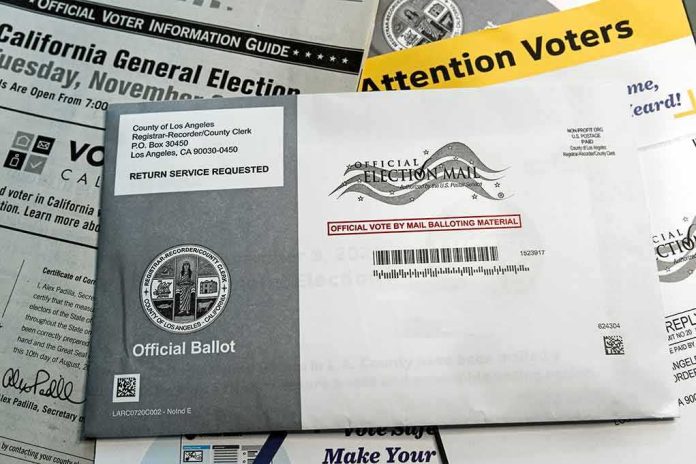
The fight over President Trump’s mail-voting executive order is not chiefly about fraud or access; it turns on who, under our constitutional structure, is allowed to make the rules. Early rounds in court have repeatedly concluded that neither the White House nor the Postal Service may unilaterally set binding conditions for how states conduct mail voting, and judges have been willing to halt key parts of the program on that threshold ground.
At a Glance
- Federal judges have blocked core provisions of the administration’s mail-voting program on separation-of-powers and statutory-authority grounds, not on final merits about policy wisdom.
- The League of Women Voters won a nationwide preliminary injunction against USPS implementation of Section 3 of the executive order; subsequent rulings have produced fits-and-starts relief.
- USPS’s own filings acknowledge it cannot implement the rule for the 2026 election unless injunctions are lifted, underscoring the legal fragility of the initiative.
- The administration frames the policy as election-integrity modernization; challengers argue it functionally gatekeeps ballots by conditioning delivery on federalized lists and design mandates.
What courts have actually said: authority, not anecdotes, is carrying the day
When a federal court pauses a government program at the outset, it usually rests on a clear view that the plaintiffs are likely to prevail on a specific legal theory and that the harms of immediate implementation are unacceptable. In Boston, U.S. District Judge Indira Talwani did exactly that, concluding the president lacked authority to order the Department of Homeland Security to assemble voter-eligibility lists for state use and that the Postal Service lacked statutory authorization to promulgate binding mail-voting regulations. That ruling blocked implementation of the executive order’s mail-voting restrictions and set the tone for subsequent litigation.
Separately, litigation brought by the League of Women Voters secured a nationwide preliminary injunction against Section 3 of the executive order, which targeted USPS implementation mechanics; the injunction covered all fifty states. While later procedural developments introduced churn, that early relief reflected courts’ skepticism that USPS rulemaking could displace state election administration without clear congressional direction.
What the executive order and USPS rule tried to change
The order directed DHS to compile and transmit state-by-state lists of “confirmed” U.S. citizens, envisioned as a baseline for who may receive federal election ballots by mail, and directed USPS to initiate a rulemaking to set uniform standards for mail-in and absentee services. The Postal Service’s final rule tracked that vision: it required states to provide lists of voters to whom mailed ballots were sent and to affix unique barcodes on outbound and return envelopes, with noncompliant outbound ballot mail to be rejected at acceptance. The program’s core mechanism—federal lists plus USPS design and acceptance control—shifted gatekeeping power from state election officials to a federal delivery agency.
This is where law and logistics meet. USPS long has a vital, but operational, role in elections: move ballots quickly, treat election mail as First-Class equivalent, and ensure predictable delivery windows. It has not, however, historically conditioned acceptance of official ballot mail on state compliance with USPS-devised eligibility screens or design standards backed by refusal authority. That novelty explains why even before a final merits decision, multiple courts were willing to freeze parts of the program.
Litigation whiplash is real—but the pattern still points in one direction
The docket has seesawed: emergency motions, stays, and a Supreme Court intervention narrowed or lifted some relief on standing or timing grounds, only for district courts to reassert narrower blocks on the rule’s core acceptance-and-design mandates. That back-and-forth can be misread as indecision on substance. It isn’t. The most durable through-line is judicial doubt that either the president or USPS has the authority to federalize mail-ballot conditions absent clear statutory delegation from Congress. In one telling passage, USPS itself signaled it would refrain from implementing the rule for the 2026 election unless it obtained relief from pending injunctions—a public acknowledgment of the legal headwinds.
Where preliminary injunctions have landed is also instructive. Judge Talwani issued a temporary restraining order against provisions requiring uniform design standards and authorizing USPS to refuse outbound federal ballots that did not conform—precisely the provisions that most directly shift control over whether a ballot even enters the mailstream. Courts did not need to opine on ultimate disenfranchisement counts to see the leverage inherent in those rules.
The constitutional and statutory fault lines
This dispute sits atop two durable pillars of election law. First, the Elections Clause assigns the “Times, Places and Manner” of federal elections primarily to the states, with Congress empowered to “make or alter” those regulations. Executive power runs through statute; it does not replace statutory delegations with free-standing presidential direction. Second, USPS’s organic statute authorizes it to “regulate the mails” as an operational carrier, not to administer elections. Courts assessing the executive order and USPS rule have repeatedly grounded their rulings in these allocations: the president cannot draft DHS into building voter-eligibility infrastructure for state use, and USPS cannot convert operational standards into binding eligibility and acceptance rules for ballots without congressional authorization.
Defenders of the rule invoke integrity, chain-of-custody, and modernization: unique barcodes improve tracking, standardized envelopes accelerate processing, and state-provided participation lists prevent mailing to ineligible recipients. These are not frivolous aims. But the legal question is threshold and binary: who decides? Absent a statute that squarely empowers a federal agency to impose those conditions, policy justifications cannot fill an authority gap. That is why courts have reached for preliminary relief quickly even while acknowledging that fuller merits determinations will take time.
Practical consequences for election officials and voters
Even partial implementation would have immediate operational ripple effects. Requiring states to compile and transmit participation lists keyed to USPS acceptance, to retool envelope stock with specified barcodes, and to clear designs through a federal process compresses lead times and introduces a new single point of failure: if the list upload lags or a design nuance misses the target, inbound rejection at the post office becomes a systemic risk rather than an isolated clerical error. That risk intensifies for military and overseas voters and for jurisdictions with lean election staffs that finalize materials close to statutory deadlines. Courts weighing irreparable harm have consistently flagged that front-end gatekeeping—“ballots not accepted” at origin—poses a different and greater danger than back-end counting disputes.
Because this litigation is still largely at the injunction stage, we do not yet have audited, election-wide tallies of voters who would have been denied. But preliminary relief does not require post hoc body counts; it requires a credible showing that, under the rule’s structure, lawful ballots could be prevented from entering the mail. The combination of mandatory lists, barcode design standards, and USPS refusal authority makes that showing plausible on its face, and courts have treated it accordingly.
#ELB: District Court, as Expected, Issues Preliminary Injunction in Trump/USPS Mail-In Ballot Case: Why This Should Be an Easy Case for the Supreme Court to Deny a Stay https://t.co/wIKk8sjnJJ
— Rick Hasen (@rickhasen) September 5, 2026
What to watch next
Three developments will determine the endgame. First, whether Congress weighs in—explicitly delegating (or restricting) USPS’s authority to set acceptance standards for election mail—would resolve the statutory ambiguity. Second, the administrative record: if challengers surface internal analyses showing anticipated rejection rates or conflicts with prior USPS election-mail obligations, that will sharpen the arbitrary-and-capricious and authority claims. Third, appellate consolidation may replace injunction churn with a clear rule of decision before the next federal election cycle. Until one of those occurs, the safest working assumption for election administrators is that courts will continue to police the line between USPS’s operational role and the states’ regulatory control—and halt federal attempts to cross it without a statute that says they may.
Sources:
cnbc.com, lwv.org, axios.com, aclum.org, congress.gov