

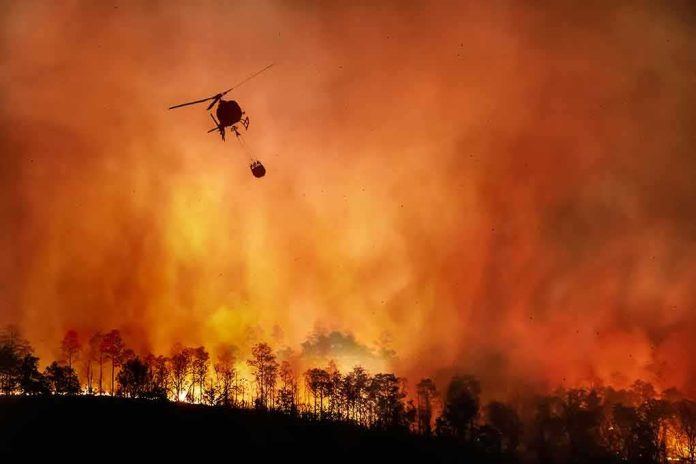
When a man with a prior manslaughter conviction for killing his father is arrested on suspicion of deliberately igniting Washington’s largest Spokane-area wildfire, you see in one case the intersection of violent criminal history, fire behavior, and the high‑stakes challenge of proving arson in court.
Key Points
- Spokane resident Aaron F. Farinacci, 37, has been arrested and charged with first-degree arson, accused of intentionally starting the Old Trails Fire near Spokane.
- Investigators say a witness saw Farinacci crouching at the fire’s point of origin and that he was later found carrying matches and a lighter, supporting probable cause for the arson charge.
- The Old Trails Fire is the largest of three blazes around Spokane, destroying hundreds of structures and forcing tens of thousands of residents to evacuate.
- Farinacci previously served 12 years in Arizona prison after pleading guilty to manslaughter for fatally shooting his father in 2010 during a household dispute.
From Witness Tip to Arrest: How Investigators Built the Arson Case
The Old Trails Fire, one of three major wildfires that erupted around Spokane on a Saturday in early August, quickly stood out as the largest and most destructive of the cluster. As firefighters battled fast-moving flames driven by dry grass and summer heat, major crimes detectives and state fire investigators focused on a seemingly small but critical detail: the exact spot where the fire began, and who was there.
According to Spokane County Sheriff John Nowels, the investigation started with a citizen’s tip about a man acting nervously and bending or kneeling in roadside grass at the location that later proved to be the fire’s origin. Fire investigators working that scene concluded the blaze started precisely where that witness reported seeing the man, giving law enforcement a specific ignition point to match against other evidence. When deputies made contact with the suspect, they identified him as Aaron F. Farinacci, a 37‑year‑old Spokane resident, and noted that he had matches and a lighter on him at the time.
From there, detectives and Washington Department of Natural Resources fire investigators treated the area as an arson scene. Origin-and-cause work in a wildland setting relies on systematic reconstruction: tracing burn patterns back to their convergence point, ruling out downed power lines, lightning, accidental machinery sparks, or other non‑human sources, and assessing fuel, wind, and terrain at the first ignited patch. With the witness account and physical items in hand, investigators said they were able to develop probable cause that the Old Trails Fire was deliberately started using matches or a lighter, and that Farinacci was the person who ignited the grass.
On that basis, Spokane County Sheriff’s Office detectives obtained both an arrest warrant and a search warrant for Farinacci’s residence, then arrested him at his Spokane home on August 3. He was booked into jail on a single count of first-degree arson under Washington law and is being held on $1 million bond, reflecting both the severity of alleged conduct and the scale of the resulting damage. Prosecutors indicated he was expected to appear in court shortly after the arrest for an initial hearing and bail review.
The Old Trails Fire in the Context of Spokane’s Wildfire Crisis
Even before investigators named a suspect, the Old Trails Fire had become a defining event in eastern Washington’s fire season. It was the largest of three fires burning north and west of Spokane, a city that serves as the commercial and medical hub for much of the Inland Northwest. Together, the fires destroyed hundreds of buildings — homes, outbuildings, and other structures — and forced tens of thousands of residents to evacuate, many unsure whether they would have anything to return to.
Reports from the region place the fire’s footprint in the thousands of acres and its structural toll in the hundreds of units, numbers that move it into the top tier of recent Washington wildfires in terms of damage. A punishing stretch of hot, dry weather compounded the danger: temperatures well above 90 degrees and no rain in the forecast meant fire crews were fighting not just flame fronts but a broader environment primed for ignition and spread. In that context, allegations that someone intentionally lit the largest of the fires are more than a criminal charge against one individual; they speak to the broader vulnerability of communities on the wildland–urban interface, where a single ignition at the roadside can become a regional disaster.
Authorities have emphasized that, as with any felony case, the arson count against Farinacci remains an allegation to be proven in court. But the decision to bring a first-degree arson charge — Washington’s most serious fire‑setting offense — signals prosecutors’ view that both intentional ignition and severe harm to persons or property are at issue.
A Violent Past: The 2010 Killing of Farinacci’s Father
What distinguishes this arrest from many wildfire arson cases is the suspect’s documented violent history. Long before his name appeared in fire-investigation briefings in Washington, Aaron Farinacci served a substantial prison term in Arizona after a fatal shooting inside his family home.
Court records and police accounts from Mesa, Arizona, describe a 2010 incident in which a domestic dispute over household chores escalated to lethal violence. Then 21 years old, Farinacci argued with his parents about not washing dishes properly. When his father later unlocked the door to Farinacci’s bedroom and entered, Farinacci shot him in the face at close range, then fired again into his father’s back as he tried to flee down the hallway. The father died of his injuries. Farinacci then turned the gun on himself, shooting but surviving his own wound.
An Arizona grand jury initially indicted him on first-degree murder and aggravated assault. Two years later, on October 12, 2012 — one day after the second anniversary of his father’s death — Farinacci pleaded guilty to manslaughter and aggravated assault as part of a negotiated resolution. The court sentenced him to 12 years in state prison for the manslaughter conviction and imposed three years of probation on the assault count, reflecting both the seriousness of the offense and the plea agreement’s terms.
According to Arizona Department of Corrections records, he was released from prison in late December 2020. By the time of his 2026 arrest in Washington, Farinacci was living in Spokane and, by local accounts, had no documented history of prior arson offenses. The Manslaughter conviction, however, meant he was a convicted felon, a status Sheriff Nowels explicitly referenced when announcing the wildfire arrest.
Criminal History and Arson Allegations: How Courts Treat the Two
The resurfacing of Farinacci’s Arizona case in coverage of the Old Trails Fire reflects a broader pattern in how criminal histories are woven into public narratives after a new arrest. Legally, his prior manslaughter conviction and prison term do not themselves prove he set the Washington fire. Under evidentiary rules, prosecutors seeking to introduce prior acts must show that they are relevant to issues like motive, intent, or absence of mistake, and not merely propensity — a general suggestion that “he did something violent before, therefore he did this.” Judges often draw careful lines here to keep trials focused on the specific conduct at issue.
Practically, though, a prior homicide conviction colors public perception. In Farinacci’s case, the earlier shooting involved a sudden escalation of an argument into fatal violence within a domestic setting, followed by an attempted suicide. The new allegation involves a roadside ignition in a dry landscape, allegedly carried out with simple tools — matches or a lighter — and resulting in widespread damage. There is no evidence in the record that directly connects the Mesa incident’s circumstances to the Spokane fire’s mechanics, but both episodes involve a single person’s actions leading to harm far beyond the immediate moment.
Fire investigators and prosecutors are trained to resist conflating prior violence with technical proof of arson. The origin-and-cause determination stands or falls on physical traces, witness accounts, and the elimination of alternative causes. What a prior manslaughter conviction can influence more directly is bail, sentencing exposure, and public risk assessments: a person with a recent serious violent felony in their record is more likely to face high bond amounts and closer scrutiny of community safety if released pretrial. Farinacci’s $1 million bond in the arson case fits that pattern.
The Mechanics and Challenges of Proving Wildfire Arson
Cases like the Old Trails Fire highlight why intentional wildland ignition is difficult to prove and why early law‑enforcement narratives tend to hinge on timing and proximity. Unlike structure fires with interior ignition sources and predictable utility layouts, roadside grass fires often begin with transient human activity — a single vehicle, a pedestrian, or someone stopping briefly and leaving before smoke is visible.
Investigators reconstruct these moments with a mix of fieldwork and traditional detective tools. Field teams map burn patterns, fuel continuity, and directional indicators to pinpoint origin, then look for physical artifacts: discarded matches, cigarette butts, burn marks suggesting accelerant use, or evidence of mechanical sparks. Detectives overlay that with time‑stamped witness observations, cell‑site data, and any nearby cameras. In the Spokane case, the core evidentiary spine described publicly is narrow but specific: a witness placed Farinacci kneeling at the future origin, and deputies found him later with matches and a lighter.
From an investigative standpoint, this combination matters. In a dry roadside environment with no plausible non‑human ignition source, finding a person at the epicenter of the first flames, equipped with tools capable of starting a fire, is often the factual basis for a first-degree arson accusation. But the same circumstantial nature of that evidence is what defense attorneys typically probe: Was the witness’s vantage point clear? How close in time was the sighting to ignition? Could matches and a lighter have been carried innocently, for smoking or other lawful uses? Those are the questions courts, not sheriffs’ news releases, ultimately answer.
Nationally, fire investigation standards such as those reflected in widely cited guides emphasize this disciplined origin-and-cause work and warn against inferring intent purely from presence. In practice, however, communities experiencing mass evacuations and property loss often encounter the case first through headlines and press conferences, where the arrest and criminal history understandably dominate attention.
What This Case Means for Spokane and Beyond
For Spokane County residents, the alleged intentional ignition of the Old Trails Fire adds a layer of anger and unease to an already traumatic event. Wildfires driven by drought and heat are hard enough to accept when they are the product of natural forces or accidental sparks. When authorities say a person chose to light dry grass along a roadway, knowing or ignoring the risk of an uncontrolled blaze, the question becomes not only how to rebuild, but how to prevent similar acts.
The criminal justice system’s response in this case — rapid identification, a coordinated investigation between county detectives and state fire specialists, and swift filing of a first-degree arson charge backed by a high bond — is one version of that prevention strategy. It signals to would‑be copycats that intentional ignition is treated as a serious violent felony, especially when it endangers entire communities. At the same time, the case underscores that the tools for prevention are limited once someone is determined to act: matches and lighters are ordinary items, roadside grass is ubiquitous, and ignition can occur in seconds.
For readers watching from outside Washington, Farinacci’s path from a 2010 domestic homicide in Mesa to a 2026 arson charge in Spokane is a reminder of how long the shadow of a serious offense can extend. He completed his manslaughter sentence and, on paper, reentered society having served the time the law required. Yet the reappearance of his name in connection with a large‑scale disaster revives public questions about rehabilitation, supervision, and risk assessment that are not unique to any one state or case.
Ultimately, the legal system will decide whether the evidence in the Old Trails Fire meets Washington’s standard for first-degree arson. Whatever that outcome, the fire has already carved its place in Spokane’s history — thousands of acres burned, hundreds of structures lost, tens of thousands displaced. And the man accused of lighting it carries with him a prior story of lethal violence that ensures this case will be studied not only as a wildfire investigation, but as part of a broader conversation about how criminal pasts and present dangers intersect.
Sources:
apnews.com, spokanecounty.gov, abc15.com, clickorlando.com, facebook.com, timesnownews.com, livemint.com, wgme.com