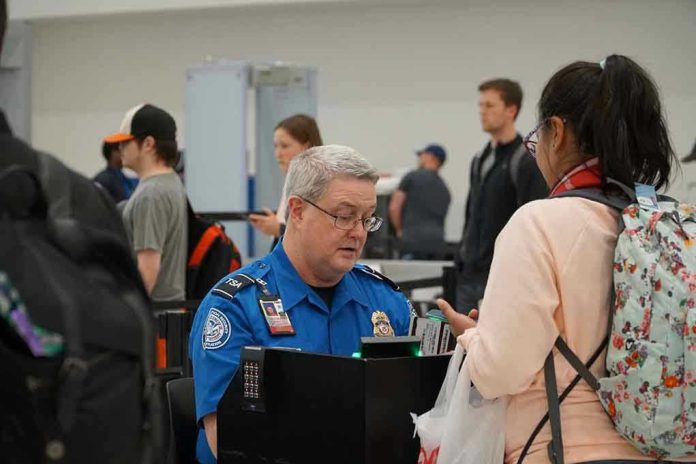
Americans in Congo, Uganda, or South Sudan now face a 21‑day delay before coming home, raising fresh fears that Washington is protecting itself while leaving its own citizens stuck abroad.
Story Snapshot
- The U.S. government has ordered strict Ebola travel limits tied to a deadly Bundibugyo outbreak in central Africa.
- Foreign nationals and green card holders who were in Congo, Uganda, or South Sudan in the last 21 days are temporarily barred from entering the United States.
- U.S. citizens are not banned outright but can be rerouted, screened, or even placed on “do‑not‑board” lists that block commercial flights home.
- Health experts question whether broad travel rules actually stop Ebola, warning they may do more to signal control than provide real safety.
What the new Ebola travel orders do
The U.S. Department of Health and Human Services issued a formal order in May 2026 that suspends entry into the United States for many people who have recently been in the Democratic Republic of the Congo, Uganda, or South Sudan. The order covers foreign nationals and later lawful permanent residents if they were present in those countries within the past 21 days, which matches the known incubation period for Ebola disease. The Centers for Disease Control and Prevention (CDC) says this step is meant to prevent Bundibugyo-strain Ebola from entering the country and threatening public health.
The CDC explains that there have been no confirmed Ebola cases in the United States linked to this outbreak so far, but it still labels the move an extra precaution. The 21-day window is central to the policy, since most Ebola infections show symptoms within that time after exposure. The initial order is time-limited to 30 days, with a continuation order already issued into July 2026, showing that officials expect the emergency to last beyond the first month. This structure gives the administration broad power while delaying a full public debate on the rule’s long-term impact.
How the rules treat U.S. citizens differently
Unlike foreign travelers and green card holders, U.S. citizens and nationals are not flatly banned from re-entering the country after travel to Ebola-affected regions. Instead, they face rerouting to specific airports, enhanced health screening, and possible restrictions on using commercial flights. The CDC says American citizens arriving from Congo, Uganda, or South Sudan will be sent to certain airports, such as Washington Dulles, for questioning and temperature checks before they can continue to other destinations. Separate transportation orders allow officials to place some citizens on “do-not-board” lists that block them from flying while they are considered at risk.
This split approach creates a strange reality. On paper, U.S. citizens still have the right to come home, but in practice, they may be forced to wait out the 21-day risk period in another country or at a foreign observation site. Reporting shows the Trump administration even planning to send some Americans exposed to Ebola to Kenya for monitoring rather than repatriating them for care in U.S. hospitals. For many travelers, the difference between a formal “ban” and a blocked flight or foreign quarantine may feel small, especially if they are sick, short on money, or far from family.
Why the government says the 21-day rule matters
The government frames the 21-day rule as a direct match to the science of Ebola infection timing. Most Ebola patients develop symptoms within three weeks after exposure, so requiring that travelers spend at least 21 days outside the outbreak zone before entering the United States aims to ensure that active infections are detected abroad. The CDC and State Department both reference the Bundibugyo strain’s lack of a vaccine or proven treatment, noting that this makes prevention at the border more important. Officials stress that keeping even a single case from landing undetected in a busy U.S. city could avoid large costs and public fear.
World Health Organization guidance also recommends that Ebola contacts avoid international travel for 21 days after exposure, which gives U.S. policymakers cover to say their timeline tracks global advice. However, the international guidance focuses more on monitoring and isolation of known contacts, not broad bans on all recent travelers from affected countries. This difference matters because it shifts policy from targeted public health steps toward sweeping rules that treat every traveler as a potential case, whether they were actually exposed or not.
Expert doubts and the deeper trust problem
Many infectious disease experts argue that broad travel bans sound tough but rarely stop viruses once an outbreak is underway. During earlier Ebola crises and even the Covid-19 pandemic, researchers found little proof that banning travelers from whole regions reduced total case numbers in a lasting way. One specialist quoted in reporting says travel bans can even backfire by pushing movement into unofficial routes that escape screening, or by making governments less willing to share data for fear of punishment. These views clash sharply with the administration’s message that entry bans are “necessary” for safety.
Over 1,900 Ebola cases and 702 deaths have been confirmed in the DRC. The IRC @RESCUEorg warns that transmission is accelerating, reaching major transit hubs and drastically raising the risk of cross-border spread into South Sudan https://t.co/ZQXalfMHsK
📷: WHO pic.twitter.com/qdm7q6WA8z— ReliefWeb (@reliefweb) July 13, 2026
For many Americans, especially those already skeptical of the federal government, the 2026 Ebola rules feel like another sign that the system works better for officials than for ordinary people. Conservatives see more proof of global chaos and weak borders, while liberals see another case of heavy-handed security rules hurting vulnerable travelers. Both sides share a deeper worry: powerful agencies can now block citizens from coming home or steer them to foreign holding centers, using complex legal tools that most people never voted on or fully understand. That fear goes beyond Ebola and feeds the growing belief that Washington’s first instinct in a crisis is to protect itself, even if citizens are left waiting in another country.
Sources:
cbsnews.com, straitstimes.com, stacks.cdc.gov, statnews.com, cd.usembassy.gov, cdc.gov, govinfo.gov, nytimes.com, reuters.com, facebook.com, npr.org, pmc.ncbi.nlm.nih.gov, youtube.com