

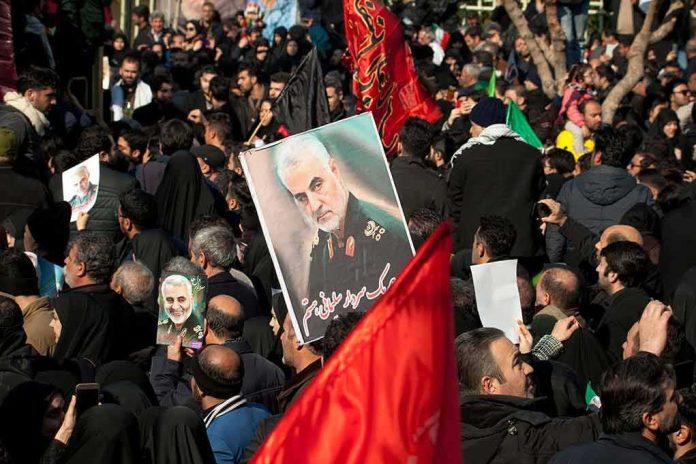
Iran is preparing to parade Ayatollah Ali Khamenei’s body through millions of mourners after keeping it out of public view for more than four months, turning a funeral into a raw test of regime power and control.
Story Snapshot
- Iran has set a six-day, multi-city funeral for Khamenei from July 4–9, after a 100‑plus day delay that breaks normal Islamic burial customs.
- Officials project 15–20 million mourners and declared a three-day holiday in Tehran, while critics say turnout is being organized by regime forces, not driven by real grief.
- Massive security plans and feared mobilization of the Basij paramilitary highlight how authoritarian governments use crowds to signal strength and crush dissent.
- Mixed public reactions, the absence of new Supreme Leader Mojtaba Khamenei, and no top Western leaders attending raise doubts about claims of national unity.
Iran’s delayed funeral plan and what it signals
Iran’s state media now say Khamenei’s funeral will stretch from July 4 to July 9, with ceremonies in Tehran, Qom, and Mashhad and burial in his hometown. Officials first planned to bury him in March, but they delayed the event as United States and Israeli strikes on Iran continued. The delay means Khamenei’s burial comes more than 100 days after his death, far outside the usual Islamic practice of burial within about 24 hours. That long pause alone tells us this is not a normal funeral.
Iranian authorities describe the funeral as one of the biggest events in the nation’s history, with some calling it the most important event of the 21st century. State outlets and friendly foreign channels talk about “massive crowds” already gathering and project 15–20 million mourners across the three cities. At the same time, they report special arrangements, including a three-day public holiday in Tehran, to push people to attend and clear roads for the processions. For many Americans, this looks less like simple mourning and more like a scripted show of strength.
Security lockdown and feared Basij mobilization
Reports describe a huge security operation around the funeral, with thousands of security personnel, checkpoints, and even helicopter plans to move VIPs and manage crowds. Officials say they want to avoid deadly stampedes that have marred large gatherings in Iran’s past, including funerals in 1989 and 2020. But in authoritarian systems, security is not just about safety. Research on such regimes shows they often use loyal militias and security forces to control crowds, scare critics, and create the image of unity. In Iran, that role often falls to the Basij, a paramilitary force tied to the Islamic Revolutionary Guard Corps.
Human rights reporting over the years has linked the Basij to beating protesters, forcing attendance at rallies, and silencing dissent. The funeral’s size and the regime’s survival stakes make it very likely that Basij members are being ordered to turn out, manage chants, and watch for anyone who looks too happy about Khamenei’s death, though hard proof of those specific orders is not yet public. For citizens who already fear state power, seeing tens of thousands of uniformed or plainclothes forces blending into a “mourning” crowd sends a chilling message: the system is still strong, and it is watching.
Mixed reactions and questions about real mourning
Western and independent outlets describe a more complicated public mood than state television admits. Some Iranians are clearly grieving, especially older supporters who saw Khamenei as a religious father figure and a shield against Western power. But reports also note shock, anger, and even celebration in parts of Tehran and in exile communities, including crowds in Los Angeles who cheered when his death was announced. That mix of emotions clashes with talk of a united nation flooding the streets in sorrow.
Critics inside and outside Iran have mocked the long delay, calling the funeral an “organized turnout” designed to showcase control more than heartfelt mourning. They point out that senior commanders killed in the same conflict were buried quickly, while Khamenei’s body has remained out of public reach. Some analysts ask whether his body is in cold storage and whether everything is ready for a carefully staged viewing. There is no official proof on the body’s condition, but the timing and scale of the event line up with patterns researchers see in other authoritarian regimes, where big rallies and funerals are used to prove the government can still mobilize millions.
The missing successor and Iran’s isolation on the world stage
One of the strangest parts of this story is the near-total absence of Khamenei’s reported successor, his son Mojtaba. Iran International and other outlets note that Mojtaba has not appeared in public since the strikes that killed his father, even as officials talk about him as the new Supreme Leader. For Iranians, not seeing the new leader during funeral planning and national mourning raises questions about his health, his authority, or possible power struggles behind closed doors. In any system, that kind of opacity feeds distrust.
Foreign delegations from countries like India, Pakistan, Iraq, Russia, and China plan to attend, often sending mid-level leaders or representatives rather than heads of state. Reports say no top North Atlantic Treaty Organization (NATO) or European Union leaders will join the ceremonies, highlighting Iran’s deep rift with the West even at this “historic” moment. For Americans who worry about global instability and elites cutting deals behind the scenes, this funeral shows two truths at once: the Iranian regime still wields powerful tools of control at home, yet remains dangerously isolated abroad.
Why this matters for Americans watching their own government
For many on the American right and left, Iran’s funeral drama feels uncomfortably familiar. An unpopular ruling class uses grand events and emotional language to claim unity, while real voices on the street are divided or silenced. State media push glowing narratives, and big tech platforms tilt what people see about the event. Academic studies on authoritarian mobilization warn that such mass gatherings often mark moments when regimes double down on control and drift even further from true representation.
Americans see something similar at home when leaders from both parties stage big shows but avoid hard questions on war, debt, surveillance, or the growing gap between citizens and the elite. Iran is not the United States, and its system is far harsher. Still, Khamenei’s funeral is a reminder that when governments lean on choreographed crowds instead of genuine consent, ordinary people on every side of the political divide have reason to worry about where power really lives—and whose grief, or anger, is allowed to be seen.
Sources:
foxnews.com, nytimes.com, i24news.tv, reuters.com, facebook.com, timesofisrael.com, youtube.com, iranintl.com, timesofindia.indiatimes.com, aljazeera.com, instagram.com, yahoo.com, brookings.edu