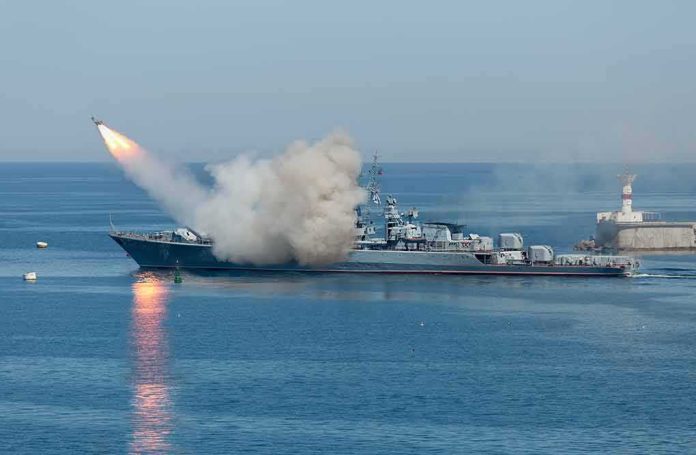
A fresh Iranian drone attack on a cargo ship has pushed Trump’s fragile ceasefire to the breaking point and put freedom of navigation — and your wallet — back on the line.
Story Snapshot
- U.S. forces struck Iranian missile, drone, and radar sites after a cargo ship was hit near the Strait of Hormuz.
- President Trump says Iran violated the ceasefire, while some officials call the response “ceasefire management,” not a full restart of war.
- The clash threatens global energy supplies and could drive up gas and grocery prices again.
- Iran claims it controls the strait and blames ship routes, challenging U.S. self-defense claims and raising constitutional and sovereignty questions.
Drone attack on cargo ship tests Trump’s ceasefire deal
U.S. Central Command says American forces hit Iranian missile and drone storage sites and coastal radar stations after a drone struck a cargo ship near the Strait of Hormuz on Thursday.[2] The ship was sailing through one of the world’s most important trade lanes when it was targeted, shaking confidence in a ceasefire deal reached only a week earlier between Washington and Tehran.[2] President Donald Trump told reporters the drone attack “violated the ceasefire,” making clear he saw it as direct Iranian aggression.[2]
Trump’s public comments came just before the strikes, after he teased reporters with “You’ll find out” when asked if the United States would respond.[1] That answer now looks like a warning shot to Iran and to allies who feared he might let the attack slide to keep diplomacy alive.[2] For many Americans, this is yet another reminder that hostile regimes do not respect truces or Western patience, especially when they sense weakness in defending shipping lanes and energy flows.[5]
U.S. says ‘self-defense’; Iran cries ‘aggression’ and plays the victim
Central Command framed the operation as “self-defense strikes” aimed at stopping “unprovoked Iranian attacks” and protecting freedom of navigation for commercial vessels and U.S. Navy destroyers moving through the Strait.[4] Officials say Iran used missiles, drones, and small boats to threaten three American warships headed toward the Gulf of Oman, and that U.S. forces destroyed launch sites and surveillance nodes tied to those attacks.[5] No American assets were reported hit, but the message was clear: attack a ship, and your strike capability gets taken apart.[4]
Iran, meanwhile, claims the United States is the aggressor and insists that the Strait of Hormuz is under its control.[7] Iranian officials argue that foreign ships must follow narrow “designated routes,” and suggest the targeted cargo vessel may have broken those rules, even though they have not released navigation data to prove it.[7] Their foreign minister also mocked American concerns by pointing out the strait is “thousands of miles away from U.S. shores,” trying to cast Washington’s actions as overreach instead of lawful defense of international shipping.[20]
Ceasefire ‘management’ or mini-war? Confusing signals from Washington
The ceasefire itself is murky, and that should worry anyone who cares about clear limits on war powers and executive authority. The initial truce began as a two-week pause on April 8 and was later extended unilaterally by Trump, not through a full treaty process.[5] Some senior officials now describe Friday’s strikes as “ceasefire management” rather than breaking the deal, a phrase that lets Washington keep hitting Iran while claiming the ceasefire still stands.[2] This fuzzy language makes it harder for regular Americans to know when we are at peace and when we are at war.
Trump has at times downplayed the broader fighting as a “mini-war,” even as Central Command continues large operations to “degrade” Iran’s ability to target ships and coastal infrastructure.[5][15] That gap between tough military action and soft political wording feeds confusion in the media and gives global critics ammo to say the United States is hiding a wider war. For constitutional conservatives, this raises serious questions about how far presidents can go with “self-defense” strikes without a formal declaration of war from Congress.[8]
Why this clash hits your gas bill, your grocery cart, and your values
The Strait of Hormuz is a choke point for global oil, and every missile or drone launched there threatens the world economy.[5] Earlier waves of U.S.–Iran clashes in the strait have already pushed up energy prices, and markets are bracing for more volatility when trading opens after these latest strikes.[1] Central Command even timed some operations after markets closed, showing Washington knows how quickly military moves there can hit gas prices and everyday costs for American families.[1]
Iran’s Revolutionary Guard says US strikes on military sites in southern Iran will not go unanswered, warning that any further “folly” will face a swift and decisive response. #Iran #usa #Geopolitic pic.twitter.com/z50nbooWi4
— Meridian Point (@PointMerid254) June 26, 2026
For conservatives, this is about more than oil charts. It is about whether the United States will defend free navigation, stand up to terror-linked forces, and avoid being boxed in by global institutions that often second-guess American self-defense.[8] Iran’s push to control shipping lanes echoes other regimes that test U.S. resolve and hope to weaken Western economies through chaos. At the same time, Americans have a right to demand clear limits, honest language about war, and strong oversight so “self-defense” does not become an open-ended blank check for forever conflicts.
Sources:
[1] YouTube – Iran war: Trump says US strike after attack on Strait of Hormuz ship …
[2] Web – U.S. and Iran trade attacks again after Trump pledges Tehran will …
[4] Web – 2026 Iran war | Deal, Explained, United States, Israel, Strait of …
[5] Web – US launches new strikes on Iran, targeting missile sites and boats
[7] YouTube – U.S. strikes targets on Iran’s Kharg Island
[8] Web – US military launches strikes ‘against multiple targets in Iran’ – CNN
[15] YouTube – Analysis Of Iran Conflicts First Day As US And Israeli Strikes Hit …
[20] YouTube – US degrades Iran’s strike capabilities in the Strait of Hormuz