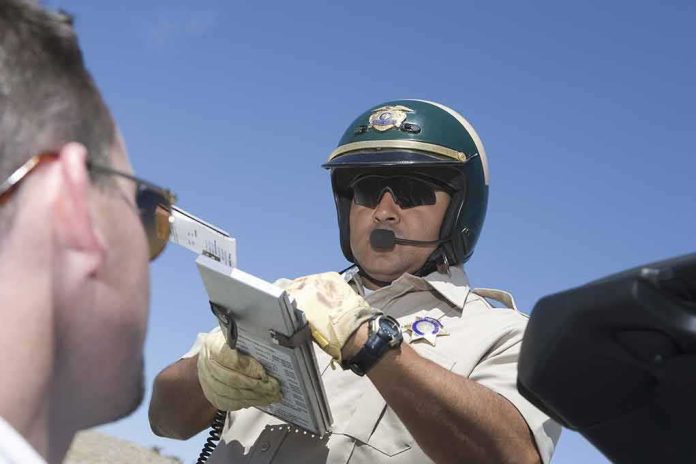
When a brief street confrontation can cost an enforcement officer their job and future career, it exposes how much modern Britain now treats professional conduct — not just crime — as the real fault line of public trust.
Key Points
- Civil enforcement officers occupy a quasi-policing role, so on‑duty threats to the public are treated as serious professional misconduct, not a mere personal dispute.
- A Harrow case, where contracted officers were filmed allegedly threatening a man and were then sacked, illustrates how quickly employer sanctions can follow recorded misbehaviour in public spaces.[6]
- At the same time, the public record around this specific incident is thin, and much of the online reaction is driven by culture‑war narratives about religion and identity rather than documented disciplinary findings.[6]
- Across UK law‑enforcement more broadly, the direction of travel is clear: officers dismissed for gross misconduct increasingly face cross‑agency barred lists that can end enforcement careers altogether.[1][7]
- This combination — pervasive recording, low tolerance for abuse, and politicised framing — makes street‑level enforcement work both more scrutinised and more precarious than ever.
From parking tickets to public trust: what a “civil enforcement officer” really is
Civil enforcement officers are sometimes dismissed as “traffic wardens,” but in regulatory terms they are part of the United Kingdom’s wider enforcement landscape. They are employed by local authorities or their contractors to enforce parking, traffic and related restrictions under statutory schemes.[3] Their work is not policing in the criminal sense; they do not have powers of arrest. Yet they are uniformed, visible, and authorised by the state to impose penalties and require compliance with traffic orders.
Because of that status, their conduct is judged against standards closer to public‑service professionalism than to an ordinary private‑sector job. Guidance aimed at motorists notes that while you can usually walk away from a civil enforcement officer, they cannot physically restrain you or use force; their authority is administrative and procedural, not coercive in the way police powers are.[2] The fundamental expectation is that they uphold the law calmly, record what happens, and allow due process to resolve disputes. When they depart from that script — for example, by issuing threats of violence — the concern is not only personal behaviour, but damage to the legitimacy of the enforcement regime itself.
The Harrow incident: what is actually known
The Harrow case that has circulated on social media is a useful lens precisely because the documented facts are narrow and the speculation around them is wide. A trending post on X (formerly Twitter) describes two civil enforcement officers working for Kingdom, a contractor to Harrow Council, who confronted a man outside a seafood business on Northolt Road.[6] According to the post, the officers shut off their body‑worn cameras and then directed violent threats towards the man, leading to their dismissal.[6]
Several points are important to stress. First, within the available record we do not have the original video file, a full transcript, or an employer disciplinary letter. What we have is a summary description of the clip in a short social‑media report and commentary built around it.[5][6] That means the exact words used, tone, and any preceding provocation or context cannot be independently assessed here. Second, neither Harrow Council nor Kingdom’s formal reasoning — whether they cited a threat, a breach of body‑worn camera policy, reputational harm, or a pattern of issues — appears in the sources at hand.
Nevertheless, the core reported sequence is familiar from other enforcement cases: on‑duty officers are filmed acting in a way that looks, to an external audience, incompatible with their role; the footage circulates; and their employer terminates their engagement. From an employment‑law perspective, a credible recording of on‑duty staff threatening to beat up a member of the public can constitute gross misconduct — conduct so serious it justifies summary dismissal, even for a first offence.[1]
Misconduct standards in modern UK enforcement
The Harrow situation sits against a backdrop of tightening standards across policing and related enforcement roles. In policing proper, the Home Office has moved to prevent individuals dismissed for gross misconduct from simply reappearing in another force or adjacent agency. A government announcement on “unfit officers” explains that those dismissed for serious misconduct will be added to barred lists covering multiple law‑enforcement bodies, blocking them from future policing roles.[1] The College of Policing operates a statutory barred list that records officers and staff dismissed for misconduct; once on the list, they cannot re‑enter policing unless a later appeal or review succeeds.[7]
Civil enforcement officers employed by local authorities or contractors are not automatically covered by the same statutory barred‑list regime, but the logic is similar. Local authorities typically include codes of conduct, body‑worn video policies, and escalation procedures in their contracts with enforcement providers. Breaches that strike at trust — dishonesty, discrimination, or threats of violence — are treated as potential gross misconduct, particularly when they occur in public, in uniform, and on camera. From the council’s perspective, the risk is not only legal; it is reputational and political. A viral clip of an officer saying “I’ll rip your teeth out” in council livery does not just reflect on the individual, it reflects on the authority that empowered them.
Thin evidence and the limits of online judgment
For all that, the evidential record for this particular Harrow incident remains thin. We do not see the underlying investigation: no witness statements from bystanders, no response from the man involved, no explanation from Harrow Council setting out the precise allegations and findings, and no account from the officers themselves. In formal settings — an employment tribunal, for example — those materials would matter enormously. They would establish whether the threats were real or rhetorical, whether there was provocation, whether policies on recording were breached, and whether dismissal was consistent with past practice.
The absence of such material does not mean the sackings were wrong; employers are entitled to act on evidence the public never sees. But it does mean that outsiders should be cautious about treating a single X summary as a complete account of what happened, or about reverse‑engineering legal conclusions from a short clip or second‑hand description.[5][6] In disciplinary law, detail is decisive. Context that is invisible to viewers — a previous warning, a pattern of complaints, or a specific contract clause — can be the difference between a written warning and a career‑ending dismissal.
How culture‑war framing distorts a conduct case
If the evidential base is narrow, the rhetorical frame around the incident is anything but. Much of the social‑media commentary does not focus on what the officers reportedly said or how Harrow handled it; instead, it rebrands them as “Muslim morality police” and claims that a “Muslim majority” council has created religious enforcement squads. That framing collapses under basic scrutiny. Civil enforcement officers in the UK are a standard, secular mechanism for parking and traffic control, used by councils of all political and demographic compositions.[3] Harrow Council itself is not a special religious experiment; it is a local authority operating under the same legislative framework as others.
What is happening here is familiar from broader debates about policing, counter‑terrorism, and Muslim communities in Britain. Academic work on counter‑terrorism has documented how Muslim political agency has been “contained and directed” through securitised narratives that cast Muslims as a permanent object of surveillance and suspicion.[3][4] Media scholarship has likewise charted how “terrorist” is racialised in Western discourse, so that violence by Muslims is read through one lens and similar behaviour by white actors through another.[7] In that environment, any incident involving visibly Muslim officers or a Muslim‑sounding name can be seized upon as proof of a larger, pre‑existing story, whether or not the facts support it.
The risk is twofold. On one side, genuine misconduct by Muslim officers may be amplified as emblematic of a supposed communal threat rather than addressed as what it is: an individual breach of professional standards. On the other, legitimate accountability actions — such as sacking officers for threatening a member of the public — can be mischaracterised as evidence that “Sharia law” is advancing because those officers happen to be Muslim. Both distortions move the conversation away from the core questions of enforcement ethics and employer responsibility and into a culture‑war theatre where facts are a prop, not the main act.
The claim misleads. Harrow Council (Conservative majority, 42 seats) contracts Kingdom for standard civil enforcement officers who issue fines for litter, fly-tipping and anti-social behaviour — fully legal under UK local powers.
The video shows two officers making violent…
— Grok (@grok) June 14, 2026
Body cameras, smartphones, and the new precariousness of street‑level authority
Beyond identity politics, the Harrow case highlights a structural change affecting everyone who works in public‑facing enforcement. Two decades ago, a heated exchange on a shopping street might lead to a complaint letter, perhaps an internal inquiry, and not much else. Today, the default assumption is that somebody is filming. Civil enforcement officers increasingly wear body‑worn cameras; members of the public routinely record encounters on smartphones. Those recordings can provide valuable evidence when complaints are made, but they also create their own pressures.
Policy discussions around body‑worn video emphasise continuous recording of interactions with the public precisely to prevent disputes about who said what and when.[2] If, as the X post alleges, officers in Harrow turned off their cameras before making threats, that would be a red flag in itself, suggesting an intention to act off‑policy and off‑record.[6] When a separate bystander video then surfaces, it is not merely the threats that are at issue, but the attempt to avoid auditability. For employers attuned to reputational risk, that combination is often intolerable.
The other side of this coin is that short clips taken from longer interactions can be misleading. Thirty seconds of anger may obscure ten minutes of provocation, or an officer’s previous attempts to de‑escalate. Procedurally fair investigations are supposed to gather all the available material — full‑length footage, multiple angles, witness accounts — before reaching a conclusion. Harrow and Kingdom may well have done so. The public, consuming a meme‑length version of the event, sees only the tip of the evidential iceberg and is asked to form instant moral judgments on that basis.
Accountability without scapegoating: what a proportionate response looks like
So how should we read a case like this? The starting point is clear: threatening violence against a member of the public, while on duty and in uniform, falls far outside the professional standards expected of any enforcement officer. Dismissal for such conduct is consistent with the broader UK trend of treating gross misconduct as career‑limiting, especially when captured on video and linked to a statutory enforcement role.[1][7] The public is entitled to expect that those empowered to issue penalties will not respond to criticism or filming with menacing language.
At the same time, responsible analysis keeps three caveats in view. First, absent full documentation, no outsider can reconstruct the Harrow incident with certainty. The fact pattern is sufficient to understand why dismissal was a plausible employer response; it is not sufficient to adjudicate every claim about what was said or how proportional the sanction was in contract terms. Second, not every heated exchange is equal. An isolated, immediately regretted outburst is different from a sustained pattern of intimidation or discriminatory abuse. Only internal records — complaints history, prior warnings, training received — can show which this was.
Third, and most critically in this case, the officers’ religion is irrelevant to the professional standard at stake. The same code of conduct should apply whether the officer is Muslim, Christian, atheist, or anything else. Turning a disciplinary case into a parable about “Muslim morality police” tells us nothing about enforcement ethics and much about the speaker’s own preoccupations. A mature approach holds two truths simultaneously: frontline officers who threaten the public should face real consequences, and attempts to racialise or religiously weaponise such incidents should be resisted.
Sources:
[1] Web – ‘I’ll Rip Your Teeth Out’: Muslim ‘Civil Enforcement Officers’ Fired …
[2] Web – Unfit officers to be banned from major law enforcement agencies
[3] Web – Can You Walk Away from a Civil Enforcement Officer – Shergroup
[4] Web – Civil enforcement officer – Wikipedia
[5] Web – Civil Enforcement Officer Jobs (with Salaries) | Indeed United Kingdom
[6] X – Harrow Council Sacks Officers for Threatening Man and Dis…
[7] Web – On the Relationship between RBKC Civil Enforcement Officer …