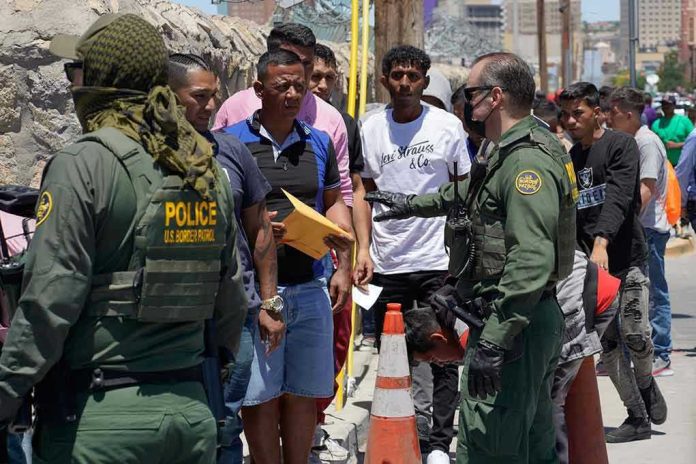
Michigan’s Senate race just turned into a referendum on whether the nation should scrap the Immigration and Customs Enforcement agency—no hedging, no half-measures.
Story Snapshot
- Abdul El-Sayed said Immigration and Customs Enforcement cannot be reformed and should be abolished [6].
- He argued immigration enforcement is civil, not criminal, and likened it to ticketing, not paramilitary raids [6].
- Opponents counter that Immigration and Customs Enforcement performs national security and immigration law duties that cannot simply vanish [6].
- The “abolish” frame resurfaces a post-9/11 fight over how much state power belongs on America’s streets [7].
El-Sayed nails his colors to the mast on abolishing Immigration and Customs Enforcement
Michigan Democratic Senate candidate Abdul El-Sayed told a national audience that “you cannot reform this,” concluding “the only logical path is to abolish Immigration and Customs Enforcement,” pushing the debate past tinkering and straight into teardown. He defended the stance by characterizing immigration law as civil, not criminal, and by casting Immigration and Customs Enforcement activity as outsized for that standard [6]. Supporters heard moral clarity. Skeptics heard a plan to yank one leg from the stool of border enforcement without a sturdier replacement.
Campaign messaging doubled down rather than softened. El-Sayed’s camp circulated abolition language as a marker separating him from rivals who prefer reform. The posture signals to progressive activists who have long treated “abolish” as a litmus test that he intends to carry the banner into the general election, not just the primary scrum [5]. That choice raises a practical question every voter understands: if you remove an agency, who carries the badge tomorrow morning, and under what rules?
Why the civil-versus-criminal frame matters to voters
El-Sayed’s claim rests on a legal distinction that immigration violations often fall under civil law, not criminal law, so government response should look more like code enforcement than special operations. He leveraged that contrast to argue that a paramilitary posture erodes trust and justice [6]. Critics reply that the same agency also targets cross-border crime and detains dangerous offenders; abolishing it because some matters are civil ignores the hybrid reality of immigration and national security work [6].
The framing choice is strategic. By shrinking the perceived threat profile to “civil,” the candidate lowers the acceptable ceiling of force and surveillance in the public mind. By expanding the mission set to crime and security, opponents raise that ceiling. The winner of that framing contest effectively defines what “commonsense” looks like when agents knock on a door or show up at a job site.
From a 2003 creation to a 2026 litmus test
Immigration and Customs Enforcement is not a century-old fixture but a post-September 11 creation inside the Department of Homeland Security, assembled to consolidate immigration enforcement and parts of transnational crime work. That youth makes it easier for abolitionists to argue the country lived without it and can do so again, while defenders argue its dissolution would scatter critical functions across a bureaucracy already spread thin. The campaign spotlight forces that structural question into nightly news cycles [7].
Media exchanges amplified the stakes. On-air, El-Sayed reiterated the abolition case and cast reform as a dead end; hosts pressed the security angle and the practical “what replaces it tomorrow” test [6]. Outside the studio, his team highlighted the pledge as a moral imperative and a differentiator, a sign he would not triangulate away from activists who want sharper contrasts with the status quo [5].
Security, sovereignty, and the conservative test of seriousness
Opponents ground their case in a simple proposition: a sovereign nation enforces its borders, detains those who break the law, and dismantles criminal networks. If you abolish the Immigration and Customs Enforcement structure, you must present a replacement that preserves deterrence, due process, and public safety on day one. On the record, El-Sayed supplied the moral why; the operational how remains the missing plank that matters to swing voters who prize order alongside compassion [6].
Will Cain did a fantastic job here refusing to allow Michigan Democrat Senate candidate Abdul El-Sayed take control of the interview or dodge Cain's question about El-Sayed's proposal to Abolish ICE.
El-Sayed says ICE going after illegal aliens is akin to arresting people for a… pic.twitter.com/pUowYWmwjJ
— Andrew Kolvet (@AndrewKolvet) May 26, 2026
A campaign that promises abolition without an implementation blueprint invites the critique that it swaps a flawed present for a vacuum. A plan that specifies which agencies assume detention, worksite enforcement, trafficking investigations, and removals, and under what use-of-force and oversight rules, could change that calculus. Until then, the political gravity favors the side that can answer who shows up when the phone rings at 2 a.m.—and who is accountable when they do [5].
Sources:
[5] Web – Rep. Eric Swalwell vows to push back on ICE in bid for California …
[6] Web – Abdul El-Sayed is calling to Abolish ICE. His Opponents Won’t.
[7] Web – Controversial Democrat Senate candidate grilled on call to abolish …