
California’s governor just turned a federal 250th-anniversary passport rollout into a social-media brawl—underscoring how America’s biggest fights now happen online instead of in legislatures.
Story Snapshot
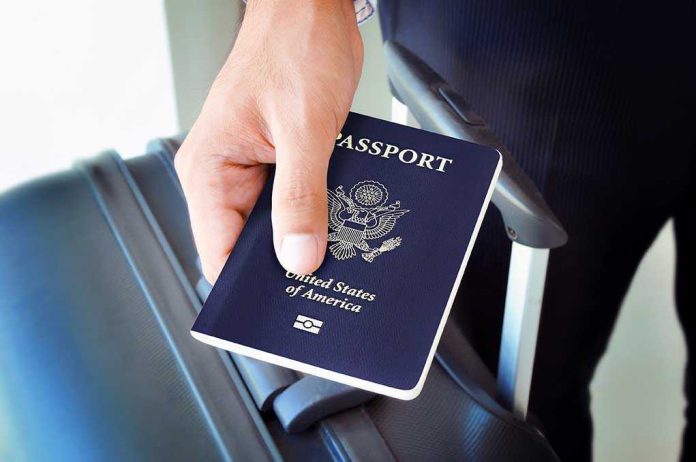
- The State Department announced limited-edition U.S. passports tied to America’s 250th anniversary, featuring President Trump’s image and gold signature.
- Gov. Gavin Newsom’s press office responded on X with a parody California driver’s license using all-caps, Trump-style promotional language.
- Newsom reshared the mock license the same day, amplifying the jab and drawing national coverage.
- The episode has no immediate policy effect, but it highlights how partisan messaging increasingly substitutes for governance.
A commemorative passport becomes a partisan flashpoint
Washington’s latest culture-war skirmish started with an official announcement, not a campaign rally. On April 28, 2026, the U.S. State Department unveiled limited-edition passports to commemorate the country’s 250th anniversary, and the design prominently includes President Donald Trump. Multiple outlets reported the design elements include patriotic imagery alongside Trump’s portrait and a gold signature, setting off immediate debate over what belongs on core government documents.
Not to be outdone by the President of the United States, California Gov. Gavin Newsom is once again trolling President Trump by mocking his unveiling of the limited-edition U.S. passport, prominently featuring Trump's image on the document. https://t.co/SbhSzHzNvu
— KTVU (@KTVU) April 29, 2026
Coverage also emphasized the historical claim at the center of the controversy: Trump is reportedly the first sitting U.S. president to be featured on a passport. Supporters frame the limited edition as a celebration tied to upcoming national events expected in summer 2026. Critics see it as a political personalization of a document tied to citizenship, travel, and national identity—exactly the kind of symbolic dispute that tends to harden partisan lines fast.
Newsom’s parody leans into Trump’s online style
On April 29, Newsom’s press office posted a satirical “announcement” on X depicting a mock California driver’s license featuring Newsom’s portrait. The text deliberately mimicked Trump’s social media tone—capital letters, sweeping self-praise, and a wink toward vanity—claiming the license would include a “handsome, high-quality photo” of the governor. Newsom then reshared the post on his personal account, ensuring the message traveled far beyond Sacramento.
The parody also used an official-sounding justification—California’s 175th anniversary—mirroring how the federal passport was justified as a 250th-anniversary commemoration. In other words, the state message wasn’t simply a joke; it was an argument by analogy: if a commemorative document can spotlight the sitting president, why not spotlight a sitting governor? That framing is why the exchange landed as political criticism, not just late-night humor.
Mockery escalates, and the message displaces policymaking
Reporting described the episode as part of an established pattern: Newsom frequently uses social media to troll Trump, and this latest post was characterized as an escalation because it parodied Trump’s recognizable style while targeting the legitimacy of the passport imagery. The same day, outlets reported Newsom’s office circulated another provocative mock image involving Trump and Jeffrey Epstein—content designed to inflame, not deliberate—further turning a government-design debate into a viral political fight.
What this says about trust, institutions, and who’s “in charge”
The immediate practical impact is limited: Americans’ regular passports and everyday travel rules do not change because of a parody post. The bigger significance is institutional. Passports and driver’s licenses are not campaign flyers; they’re documents tied to rights, identity, and the state’s authority. When elected leaders treat those symbols as props—either for commemoration or ridicule—it can deepen public cynicism that politics is becoming performance while everyday problems go unresolved.
For conservatives already frustrated with a culture that feels dominated by elite messaging and online manipulation, this episode reads like another reminder that opposition leaders can generate headlines through mockery rather than policy alternatives. For liberals, the passport design itself can look like government power leaning into personality branding. Either way, the shared takeaway is uncomfortable: when governing becomes secondary to trolling, Americans across the spectrum have more reason to doubt that institutions are focused on serving ordinary citizens.
Sources:
Gavin Newsom mocks Trump passport
Newsom trolls Trump’s unveiling of limited-edition U.S. passport
California governor trolls Trump with new driver’s license