As Silicon Valley embraces secular dogma, Elon Musk just told a conservative Christian audience exactly where he stands on God.
Story Snapshot
- Elon Musk discussed his belief in God and a higher power on Katie Miller’s podcast.
- The conversation reached a politically aware, faith-friendly audience close to Trump’s inner circle.
- Musk’s comments contrast sharply with the tech world’s usual hostility toward religion and traditional values.
- The exchange highlights a growing split inside Big Tech over faith, free speech, and the culture war.
Musk Talks God with a Podcast Host Close to Trump’s Inner Circle
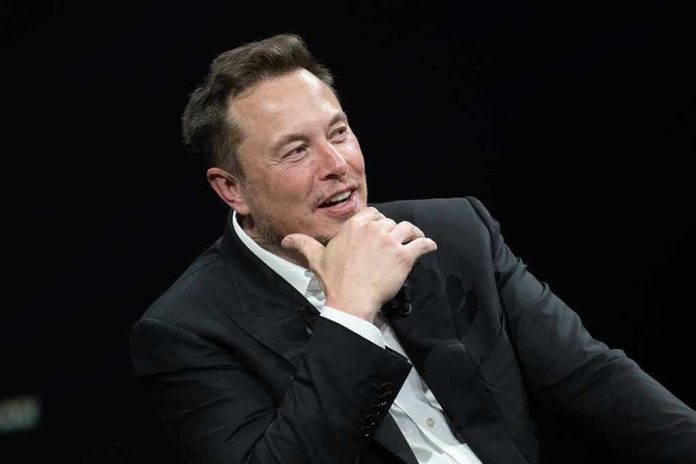
Tech mogul Elon Musk used a long-form conversation with podcaster Katie Miller, wife of White House Deputy Chief of Staff for Policy Stephen Miller, to open up about his views on God and faith. During the interview, Musk did more than promote a product or talk markets; he chose to speak directly about whether he believes in a higher power, moral order, and purpose, topics the corporate tech world usually treats as off-limits or backward.
Miller’s audience is not the typical Silicon Valley crowd. Her connection to Stephen Miller, a key policy strategist in the Trump orbit, means many listeners are conservative voters who care deeply about faith, family, and the Constitution. By taking their questions seriously and engaging on theology instead of mocking it, Musk positioned himself as one of the few tech leaders willing to treat religious belief as rational, respectable, and central to America’s public conversation.
Why Musk’s God Talk Matters in the Big Tech Culture War
Elon Musk’s decision to publicly discuss God matters because the modern tech establishment often treats traditional faith as a problem to manage, not a viewpoint to respect. Corporate HR departments push DEI dogma and gender ideology while suppressing Christian viewpoints. When one of the world’s most influential innovators entertains the reality of God, objective morality, and accountability beyond government or corporate power, it quietly undercuts the secular orthodoxy driving censorship and “woke” policies online.
Conservatives frustrated by Big Tech censorship see this as more than a philosophical discussion. A tech CEO who recognizes a higher authority than the state is less likely to see citizens as data points to be manipulated or speech as something bureaucrats should regulate. Musk has already shown a willingness to question government narratives and defend open debate on contentious issues, from COVID policies to gender politics. Grounding that skepticism in a sense of divine order strengthens arguments for limited government and robust First Amendment protections.
Faith, Freedom, and the Rejection of Progressive Moral Engineering
For many in Miller’s Trump-friendly audience, belief in God goes hand-in-hand with belief in fixed truths about human nature, male and female, and the sanctity of life. When Musk entertains the idea that the universe has a purpose and that humans answer to something greater than the state, it implicitly challenges progressive projects built on moral relativism and social engineering. Centralized schemes to redefine family, erase biological sex, or police “hate speech” appear less legitimate if there is a transcendent moral law above fashionable ideologies.
Under previous left-wing administrations, federal agencies, corporate partners, and universities often worked together to marginalize conservative Christians as extremists. That climate celebrated secularism while mocking faith in God as unscientific. A figure with Musk’s stature saying, in effect, that rational people can consider God real gives cultural cover to millions who feel pressured into silence. It also reminds policymakers that religious liberty is not a fringe concern but a foundational American right that still resonates in elite spaces.
A Tech Titan Signaling Respect for Traditional Believers
Elon Musk did not suddenly become a pastor or theologian on Katie Miller’s podcast, and he has plenty of positions conservatives will continue to debate. Yet his willingness to discuss God respectfully with someone tied directly to Trump’s policy team signals that serious, high-level conversations about faith are not going away. Instead of treating conservative Christians as a problem to deplatform, Musk treated them as adults capable of wrestling with big questions about meaning, responsibility, and eternity.
For a conservative audience exhausted by years of woke lectures, government overreach, and cultural contempt, this moment offers a small but important shift. A leading architect of our technological future is at least open to the truth that human rights and human dignity flow from a Creator, not from bureaucrats or party platforms. That openness, voiced on a Trump-world podcast, suggests that the battle for Big Tech’s soul is not finished—and believers still have a voice in it.
Sources:
Elon Musk affirms belief in Creator, says ‘universe came from something’