

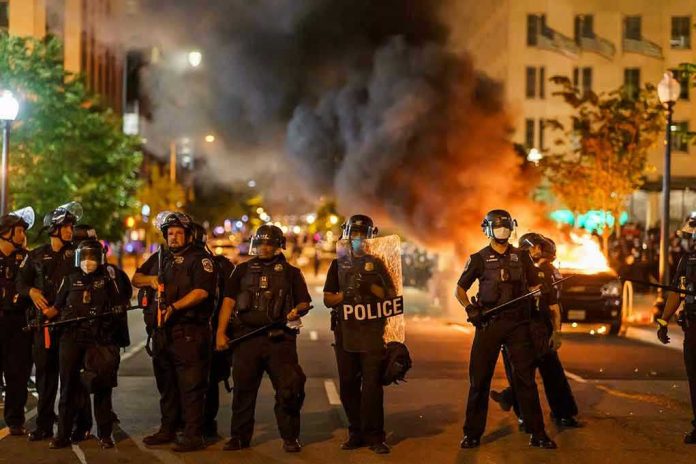
In a Chicago sanctuary stronghold, agitators literally threw rocks and snowballs at federal agents to shield a suspected Tren de Aragua gang member from arrest.
Story Snapshot
- Anti-ICE activists in the Chicago area pelted federal agents with snowballs and rocks during the arrest of a Venezuelan national tied by officials to Tren de Aragua.
- The confrontation highlights how sanctuary politics and anti-enforcement activism increasingly clash with efforts to remove alleged transnational criminals.
- Tren de Aragua, a Venezuelan prison gang turned multinational criminal network, has ridden mass migration routes into the hemisphere and onto U.S. law-enforcement radar.
- Previous high-profile Chicago raids show how politicized narratives and weak follow-through can both undermine trust and complicate serious gang enforcement.
Anti-ICE Agitators Confront Federal Agents During Chicago Arrest
Federal immigration officers attempting to arrest a Venezuelan national in the Chicago area found themselves under literal fire from anti-ICE agitators hurling snowballs and rocks. The target, described in public reporting as an illegal immigrant alleged to be linked to the Tren de Aragua gang, was taken into custody despite the hostile crowd’s efforts to interfere with the operation. Available open-source accounts do not indicate serious injuries to agents or confirm whether any protesters were charged for obstructing enforcement.
The incident took shape in a city that has spent years advertising its sanctuary credentials while federal officers continue to execute immigration and gang-related operations. During the arrest attempt, protesters appeared quickly and escalated from verbal opposition to physical interference, a step beyond typical chanting or sign-waving. By pelting officers with projectiles as they moved to detain the suspect, agitators signaled a willingness to cross the line from political expression into hampering federal law enforcement in real time.
Tren de Aragua’s Violent Footprint and the Migration Pipeline
Tren de Aragua began inside Venezuela’s Tocorón prison and evolved into a sprawling criminal enterprise that tracks with regional migration flows. As millions of Venezuelans fled economic collapse, gang operatives allegedly used migrant routes as convenient cover to expand into countries like Colombia, Peru, Chile, and Brazil. Their rackets reportedly range from extortion and kidnapping to migrant smuggling, making the organization a central concern for security agencies increasingly worried that the same pattern could extend into American cities receiving large migrant populations.
U.S. officials under President Trump’s prior term framed Tren de Aragua as a terrorist-level threat and a top enforcement priority, and his current administration has gone further by formally designating the gang a terrorist group alongside MS-13 and the Sinaloa Cartel. That designation reflects a broader conservative insistence that border security, gang suppression, and citizen safety are inseparable. When a suspected member surfaces in a place like Chicago, where large numbers of Venezuelan migrants have been resettled under sanctuary policies, federal agents now move with the understanding that they are confronting not just an immigration violator but a potential transnational criminal actor.
Chicago’s Sanctuary Politics and the Legacy of Prior ICE Raids
Chicago’s long-standing sanctuary posture restricts local cooperation with federal immigration enforcement, forcing ICE and allied units to operate with limited municipal support. That climate has nurtured organized rapid-response networks dedicated to confronting or monitoring federal agents in the field. During earlier years, activists refined tactics such as live-streaming operations, chasing ICE vehicles, and mobilizing street protests. The latest snowball-and-rock confrontation fits that pattern but raises the stakes by directly testing how far activists will go to shield individuals whom officials describe as tied to violent foreign gangs.
At the same time, prior local experience with so-called Tren de Aragua operations has left many residents and some observers skeptical of official claims. A widely publicized helicopter-assisted raid on a Chicago apartment building several years ago was trumpeted as a major anti-terror win against a building supposedly filled with Tren de Aragua terrorists. Later investigative reporting found no criminal charges stemming from that operation, no publicly verified links between those detained and the gang, and no documented seizures of weapons or explosives, fueling accusations that the raid was more political theater than solid police work.
Balancing Tough Enforcement With Proof and Public Trust
Those earlier missteps matter because they shape how both activists and ordinary Chicagoans interpret the latest arrest. When federal officials describe a suspect as a Tren de Aragua member but provide little follow-up detail, civil-liberties groups and immigrant advocates cite the helicopter raid as evidence that terrorism claims require independent verification. Conservatives, by contrast, focus on the pattern of progressive activists reflexively siding with suspected criminals over agents trying to protect neighborhoods, especially when a gang’s regional record includes ruthless violence and exploitation of migrants themselves.
Agitators Pelt ICE Agents During Chicago-Area Suspected Tren de Aragua Arrest https://t.co/xSaL29hMA4
— TrumpIsMyPresident (@Trump_Force1) December 9, 2025
From a rule-of-law perspective, the snowball and rock attack underscores a dangerous trend: political movements normalizing physical resistance to lawful federal actions. When crowds feel entitled to obstruct officers making a targeted arrest, they not only jeopardize public safety but also erode the constitutional framework that assigns immigration and border enforcement to the federal government. For conservatives who have watched years of open-border policies, rising crime concerns, and attacks on police, this Chicago clash is another warning that restoring order requires both tougher enforcement and a clear stand against mob interference.
Sources:
Dramatic Chicago ICE raid touted as anti-terror win results in no criminal charges
Furious anti-ICE protesters threw snowballs at feds to protect suspected Tren de Aragua gang member