
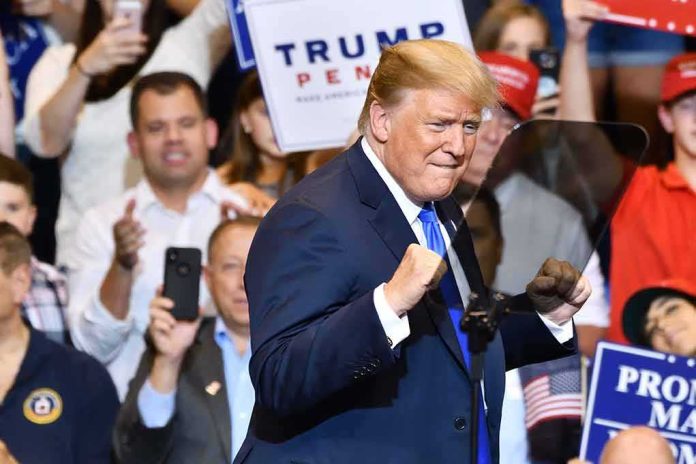
The story of Trump’s “waning influence” dissolves once you separate national approval from intra-party power: his broad standing has eroded, but inside Republican primaries and party machinery, his leverage remains unusually durable and, in key channels, still decisive.
The Short Version
- Trump’s national job approval has slid to the low 30s, constraining his reach beyond the GOP coalition.
- Within Republican primaries, his endorsement remains the single most valuable asset in the field, aided by a strategic shift to earlier, field-clearing support.
- Claims of a perfect record are overstated; losses exist. But the aggregate picture still shows a very high primary success rate, not a collapse.
- Influence is segmented: weaker in broad public opinion and on some Hill priorities, stronger in shaping GOP candidate supply and party incentives.
Influence is not singular: different metrics tell different truths
Political influence isn’t a monolith; it is a network of channels that can strengthen or fray unevenly. Presidential approval captures breadth of public standing, which affects bargaining space with Congress and credibility with swing voters. Endorsement power and intra-party leverage, by contrast, are narrower instruments that determine who wins primaries, how the party allocates resources, and how elected Republicans calibrate loyalty. The research tradition is clear that approval conditions opportunity but does not translate mechanically into control; salience, issue complexity, and the trust environment mediate how much approval actually buys on Capitol Hill. In short, a president can bleed in national standing while still exercising strong, targeted power where his coalition is tightest.
Apply that lens to Trump and a coherent picture emerges: falling broad approval paired with persistent — often commanding — leverage inside Republican nomination politics and party signaling. That duality, not a simple rise or fall, explains the current moment.
National standing has eroded — and that matters, but not everywhere
The top-line number is stark. In nationwide surveys, Trump’s job approval has fallen to roughly a third of the electorate; Pew recently placed it at 34%, the lowest point of his second term. That erosion narrows the feasible set of bipartisan legislative bargains and reduces cross-partisan deference to presidential priorities. It also raises the cost of advancing controversial policies, because wavering legislators read low approval as political risk. Reporting has captured some of that friction: notable Senate pushback to unpopular spending proposals and a more complicated path for elements of his agenda suggest thinner margins of legislative compliance than earlier in the term.
Scholarly work helps decode why this matters. Approval increases a president’s leverage on roll-call coalitions, but most strongly on issues with lower salience or higher complexity — where legislators can borrow presidential credibility without immediately paying an electoral price. On visible, polarizing fights, weak approval drags heavily. This is where falling national standing exacts real costs.
Inside the GOP, endorsement power remains a high-yield instrument
Now shift to intra-party dynamics, where the mechanics are different. Trump’s endorsement continues to carry outsize weight among Republican primary voters and operatives. A national Marquette Law School survey found that 71% of Republicans said they would vote for a candidate Trump endorsed; among MAGA-aligned Republicans, that figure rose to 87%. That is a large and direct lever over candidate selection. It also creates strong incentives for would-be nominees to pre-align with Trump on tone, personnel, and issue emphases well before voters cast ballots.
Two features sustain this power. First, Trump’s base popularity inside the Republican Party remains high even as his national numbers sag, a divergence that concentrates influence exactly where primaries are decided. Second, his campaign apparatus has evolved: compared with 2018, Trump now endorses earlier and more strategically, often backing incumbents or plausible front-runners months in advance — effectively clearing the field or deterring credible opposition. Early endorsements transform a “nudge” into a resource signal: donors, activists, and local elites coordinate around the anointed candidate, making the endorsement self-fulfilling more often than not.
Sorting the record: very strong, not immaculate
Public claims of a perfect 2026 endorsement record oversell the case; reputable coverage and election tallies show losses in the mix, particularly late in the primary calendar and in some higher-profile contests. Still, the broad pattern remains a high success rate, and a White House defense citing roughly 98% wins out of 238 endorsements — while a press-shop gloss — is directionally consistent with independent snapshots from mainstream outlets describing a near-perfect primary slate through midsummer. The precise percentage varies with definitions (what counts as an “endorsement,” whether late co-signs of safe incumbents are included, which races are tallied), but the throughline is clear: strong net wins, not collapse.
Two caveats temper the headline. First, selection effects matter; endorsing earlier and favoring safer candidates raises the batting average. Second, the power of an endorsement in primaries does not automatically carry into general elections, where the electorate is larger, less ideologically sorted, and more sensitive to national conditions. Experimental and observational work has found that a Trump endorsement can even depress support among out-party and some swing voters in general-election scenarios. That asymmetry — boost in primaries, potential cost in Novembers — is the strategic trade-off Republicans live with.
Legislative leverage: muscular signals, conditional outcomes
Does primary leverage convert into governing clout? Sometimes. Members who owe their nominations to Trump are likelier to align rhetorically and vote with the administration’s priorities. But Congress is a collective-action arena with its own equilibria. Reporting portrays a Republican conference broadly under Trump’s banner yet tactically resistant at moments when constituency risk spikes or policy details sour — an “it’s complicated” equilibrium rather than simple obedience. The upshot is muscular agenda-setting capacity from the White House, tempered by episodic intraparty friction, especially on high-cost or low-salience items where approval headwinds raise the price of loyalty.
This is textbook presidential politics. Approval expands or narrows the window for ambitious pushes; party control and endorsement leverage populate the chamber with friendlier votes; but converting that into law still runs through issue salience, policy design, and member risk calculus — the variables political science has long emphasized.
What durable influence looks like from here
Three practical implications follow. First, expect Trump to keep front-loading endorsements to pre-wire primaries and shape the candidate pipeline. That strategy is rational: it preserves high success rates and entrenches loyalty. Second, anticipate periodic legislative standoffs when proposals collide with low approval and local political risk; these episodes will read as “waning influence” but actually reflect the conditional nature of presidential leverage. Third, watch the handoff from summer primaries to fall general elections. The very endorsement power that unifies the GOP ticket can impose costs where electorates are less MAGA-aligned — a structural tension visible in survey experiments and interest-group modeling of backlash effects.
The bottom line, stripped of wishful thinking from either camp, is straightforward. Trump’s breadth of national appeal has weakened; that constrains governing latitude and general-election coattails. But the mechanism that most directly defines party leadership — the capacity to make or break Republican nominees — remains strong, bolstered by base loyalty and a savvier endorsement architecture. Reports of waning influence, if taken to mean a collapse of practical power inside the GOP, overstate the case. Influence has shifted venues; it has not vanished.
Sources:
pjmedia.com, mexc.co, politico.com, pewresearch.org, usatoday.com, news.meaww.com, nytimes.com, cnbc.com, chathamhouse.org, spotlightpa.org, washingtonexaminer.com, nypost.com, law.marquette.edu, tandfonline.com