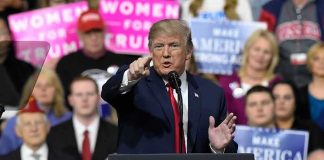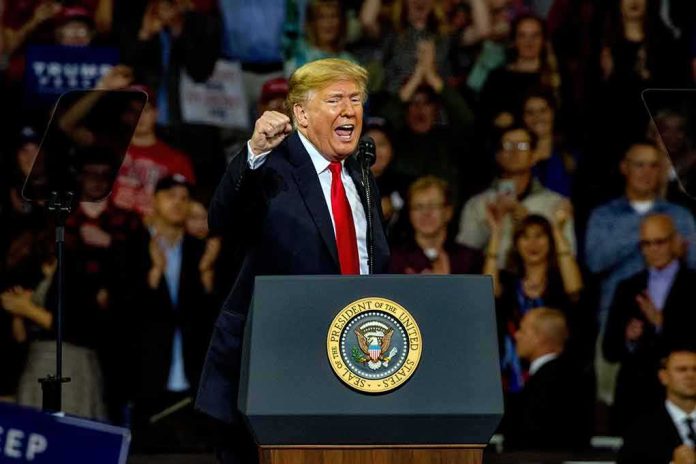
Presidential campaigning works best when it is visibly tethered to local stakes; in Grand Island, Nebraska, President Trump fused the ritual of a midterm rally with a concrete policy action, turning a partisan mobilization event into an on-site demonstration of governing power aimed squarely at a core regional constituency.
At a Glance
- President Trump headlined a midterm-branded rally in Grand Island, Nebraska, positioned to boost Republican candidates Pete Ricketts and Jim Pillen.
- The event was staged at the Pinnacle Bank Expo Center at Fonner Park and drew a large, energized crowd, with lines forming well before doors opened.
- Trump signed an executive order at the rally easing limits on the tax-free use of red-dyed diesel, a tangible policy nod to agriculture and freight interests.
- The stop fits a broader midterm strategy: prioritize base-heavy locations to maximize turnout, earned media, and message discipline in the campaign’s closing stretch.
What Happened in Grand Island and Why It Mattered
The Grand Island rally was explicitly framed as a midterm push: Republican event listings and televised scheduling slotted President Trump as the marquee speaker for a “Midterm Rally” with GOP candidates, underscoring that this was a party-building stop in the campaign’s closing weeks. The Allied goal was straightforward—reassure and rally Republican voters in a reliably conservative pocket while transferring presidential attention, crowd energy, and media coverage to Nebraska candidates Pete Ricketts and Jim Pillen. National wire coverage placed the visit within Trump’s broader “midterm rescue mission,” and quoted the president tying his presence to their electoral prospects.
Local outlets anchored the event to a precise place and pulse: the Pinnacle Bank Expo Center at Fonner Park in Grand Island, with supporters queueing early and turnout estimates in the low thousands, consistent with a well-executed regional rally in a venue designed for scale. These are the mechanics of modern presidential politicking—site selection that can absorb logistical demands, a travel day that creates a saturation burst of local coverage, and a program that blends campaign messaging with local validation from down-ballot allies.
The Policy Move That Gave the Rally Its Edge
What made Grand Island more than a standard stump speech was the on-site executive action: Trump signed an order to ease limits on the tax-free use of red-dyed diesel, the off-road fuel widely used in agriculture and certain industrial applications. Red-dyed diesel is a niche topic to most voters; in farm country, it is a cost line, a compliance regime, and a symbol of how policy touches everyday work. By choosing that lever—visible, sector-specific, and administratively actionable—the White House attached an immediate, localizable benefit claim to the rally’s message architecture.
Politically, the move did double duty. It gave Republican candidates in Nebraska a fresh, high-salience talking point tailored to their electorate—producers, haulers, and rural small businesses—and it reframed the rally as not just exhortation but delivery. Substantively, the order aligned with a long-standing conservative argument that regulatory and tax friction in the energy and freight stack compounds through supply chains; relief at the margins for inputs like diesel can resonate beyond the farm gate. Whether such changes deliver the full downstream price impact campaigns tout is the subject of economic debate, but as a mobilization tactic targeting a clearly defined constituency, it is textbook politics—and it happened in the room, not as a later press release.
Mechanics and Venue: How These Events Are Built
Rallies of this type depend on three operational pillars: predictable access, massing capacity, and controllable optics. Fonner Park’s Pinnacle Bank Expo Center checked each box. It is large enough to host several thousand attendees, provides staging and media positions that allow crisp broadcast visuals, and sits in a region that simplifies security and traffic management compared to dense urban cores. Local reporting captured the telltale signs of well-run advance work—overnight lines, orderly entry, and visible volunteer and staff mobilization—signals that the political apparatus on the ground understood both demand and throughput.
Attendance figures at rallies are rarely definitive; estimates are, by definition, estimates. What matters more analytically is momentum and engagement: were supporters moved to travel and wait, did the event generate a sense of shared cause, and did it create reusable content for local and national media? The answer in Grand Island appears to be yes on all counts. That is the practical metric campaigns optimize toward, and it is why these stops cluster where they do.
Context: Why Campaigns Go Where They’re Already Strong
If you map presidential travel in the month before midterms, you will find a recurring pattern: heavy investment in states and districts that already lean your way. That is not timidity; it is mathematics. Late-stage persuasion is difficult and expensive, while base mobilization in favorable terrain offers a higher yield per hour of candidate time. Analysts described Trump’s 2026 itinerary in precisely these terms—prioritizing “safe” states to push Republican turnout and saturate local news with supportive frames. Nebraska’s Third District, where Grand Island sits, is deep red; a rally there does not change minds so much as it changes the probability that friendly voters will cast ballots.
In that light, the Grand Island stop does more than pad a schedule. It shores up the statewide ticket, generates content that campaigns can redeploy in ads and social feeds, and ties national brand energy to local names. Add a policy action—like the red-dyed diesel order—and the stop also functions as a demonstration of alignment between Washington and local economic priorities. That layering, event plus action, is an old tool; it persists because it works.
The Nebraska Ticket and Message Transfer
The stated beneficiaries of the rally were Pete Ricketts and Jim Pillen, Republicans with deep roots in state politics. By appearing with them and attaching upbeat predictions to their prospects, Trump lent presidential stature to their campaigns and localized the national narrative: Washington may be noisy, but in Nebraska the party is organized, energetic, and delivering material wins. National reporting reflected this handoff dynamic, quoting Trump’s confident linkage between his visit and their electoral fortunes and framing the stop as part of a broader midterm push.
For voters, this format offers a simple heuristic. If you approve of the president and feel the economy’s inputs—fuel, freight, farm costs—bear too much friction, then the image of a signature turning into a rule change at a rally is potent. If you are undecided, the blend of spectacle and specificity can still move you at the margins. For campaigns, margins decide midterms.
🚨 President Trump brought Angel Mom Jacqueline Medina on stage at his Nebraska rally to remind America exactly why ICE and mass deportations MATTER
Her daughter Lizabeth was brutally STABBED 25 TIMES by an illegal:
pic.twitter.com/f0Ac4fnjMC— Tironianae 🍊 🍊 Z. – Ultra Verbum Vincet (@Tironianae7e) October 6, 2026
What Endures After the Rallies End
Rallies fade; structures remain. The venues will be repurposed within hours, and the crowd will be back at work the next morning. What lingers is the architecture of mobilization—volunteer lists expanded, small-dollar donors pinged by text, local surrogates filmed for later clips, and a fresh round of talk radio segments set to iterate the message. In Grand Island, there is also a paper trail: an executive action affecting a ubiquitous farm input that state Republicans can now cite in every speech between now and Election Day.
That is the essential takeaway from Nebraska. The event was clearly framed as a midterm rally for Republican candidates, it unfolded in a venue built to project scale, it drew robust participation, and it attached a concrete policy benefit to the political message. As a case study in modern presidential midterm strategy—activate the base in friendly ground, convert attention into turnout, and leave behind a policy marker that travels with the ticket—Grand Island is a clean example of how the machinery is supposed to run.
Sources:
ajc.com, nebraska.tv, wowt.com, events.gop.com, thegatewaypundit.com