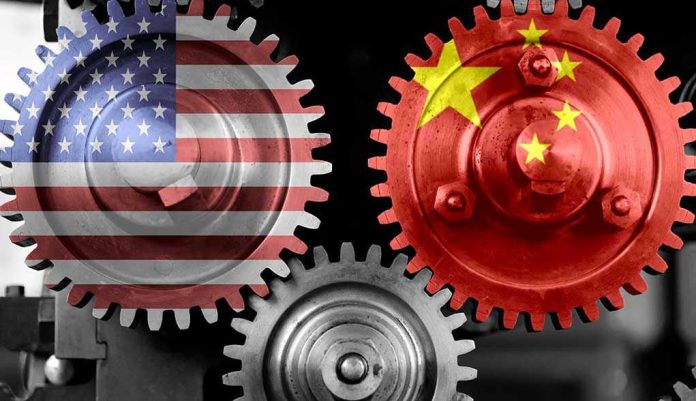
Trump’s 2025 policy shift allowing Nvidia chip exports to China risks accelerating Beijing’s artificial intelligence capabilities, contradicting America First principles and potentially handing strategic advantage to a geopolitical rival.
Quick Take
- Trump administration reversed Biden-era export controls, permitting Nvidia to sell advanced AI chips to China under new licensing framework
- Analysts warn relaxed restrictions could compress America’s technological lead in AI development and military applications
- Policy reversal contradicts Trump’s stated goal of protecting American technological dominance and national security
- China gains immediate access to cutting-edge GPU technology previously restricted, accelerating domestic AI model training and autonomous systems development
- Decision reflects transactional approach prioritizing corporate revenue over long-term strategic positioning against Beijing
Trump’s Chip Export Reversal Undermines US Strategic Position
The Trump administration’s decision to permit Nvidia exports to China represents a fundamental reversal of national security policy established under the Biden administration. Since October 2022, the Commerce Department had barred advanced GPU exports to limit China’s capacity to develop military-grade artificial intelligence systems. Trump’s 2025 policy shift reopens access to Nvidia’s A100, H100, and newer B-series processors, eliminating restrictions that protected American technological superiority in the critical AI race.
This policy pivot contradicts the administration’s own rhetoric about protecting American interests. Trump campaigned on an “America First” platform emphasizing technological dominance and limiting Chinese access to advanced computing infrastructure. Yet the chip export approval demonstrates how transactional dealmaking can override stated strategic principles. By allowing Nvidia to pursue Chinese market revenue, the administration prioritizes short-term corporate profits over the long-term security advantage that export controls were designed to preserve.
China Gains Immediate Advantage in AI Development Race
Beijing faces immediate benefits from relaxed export restrictions. Chinese hyperscalers including Alibaba, Tencent, and Baidu can now access the same advanced processors that power American AI laboratories. This access eliminates hardware bottlenecks that previously forced Chinese researchers to cluster lower-performance chips or rely on older technology. Unrestricted access to Nvidia’s latest architectures compresses the development timeline for Chinese frontier AI models and autonomous military systems.
The strategic implications extend beyond commercial AI applications. Chinese defense laboratories and state-linked research institutes can now procure hardware previously restricted for national security reasons. Military applications including autonomous weapons systems, cyber warfare capabilities, and intelligence analysis tools depend on the computational power that export controls were specifically designed to deny Beijing. Allowing Nvidia sales eliminates this critical constraint on Chinese military modernization.
Domestic Pressure and Corporate Interests Override Security Concerns
Nvidia’s lobbying efforts and revenue pressures influenced the policy reversal. The company controls approximately 70-80 percent of the data-center AI chip market, making it a powerful political actor in Washington. Nvidia’s argument that export restrictions harm American competitiveness by driving business to foreign competitors resonated with Trump’s pro-business orientation. The company warned that sustained controls would push customers toward non-American alternatives and reduce R&D funding available for maintaining American technological leadership.
This corporate pressure illustrates the tension between national security and market incentives. While Nvidia’s revenue interests align with unrestricted access to Chinese markets, America’s strategic position depends on maintaining technological advantages that export controls were designed to preserve. By prioritizing Nvidia’s commercial interests, the administration accepts the risk that China will accelerate its AI capabilities and eventually develop indigenous alternatives that reduce American leverage in future negotiations. The short-term revenue gain comes at the cost of long-term strategic positioning.
Long-Term Consequences for American Technological Dominance
Relaxing export controls accelerates China’s path toward semiconductor self-sufficiency and AI leadership. Beijing’s “Made in China 2025” industrial policy explicitly targets achieving dominance in artificial intelligence and advanced computing by 2030. Unrestricted access to Nvidia technology provides the hardware foundation necessary for Chinese researchers to train frontier models, refine domestic chip designs, and establish a robust parallel AI ecosystem independent of American technology.
The policy reversal also signals unpredictability to American allies and partners. Japan, South Korea, Taiwan, and the Netherlands coordinate with the United States on semiconductor export restrictions through the Wassenaar Arrangement. Unilateral American policy shifts undermine allied confidence in consistent security cooperation and create incentives for countries to pursue independent technology strategies. This fragmentation weakens the collective Western position against Chinese technological advancement and increases the likelihood that Beijing will eventually achieve the self-reliant AI and semiconductor ecosystem it actively pursues.