

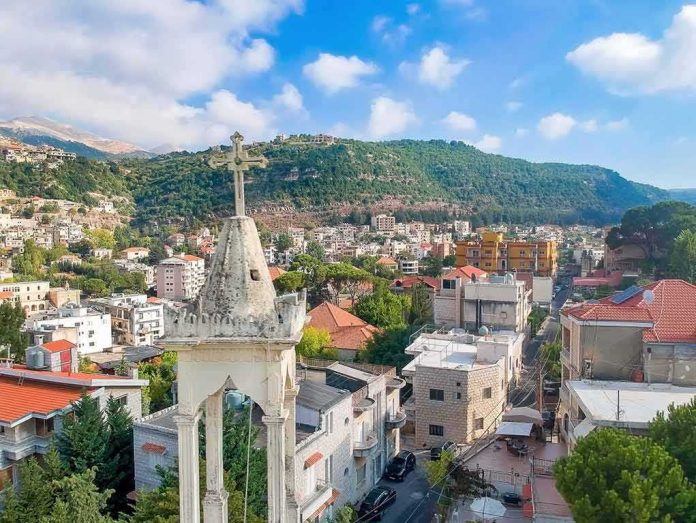
As violence and fear spread across the West Bank, priests warn that one of the Holy Land’s last fully Christian villages could be pushed to the breaking point.
Story Snapshot
- Settler attacks and new outposts are threatening the Christian village of Taybeh and nearby towns.
- Church leaders describe the West Bank as a “large prison” and say communities are “burning” under growing raids and arson.
- United Nations data and Christian groups report hundreds of attacks and a pattern of impunity for settlers.
- These events feed a wider fear, shared by many Americans, that powerful systems ignore ordinary families on both sides.
Priests sound the alarm from a Christian village under pressure
In the hilltop village of Taybeh, one of the last entirely Christian Palestinian communities in the West Bank, the parish priest is pleading for help as settler violence escalates. Local witnesses say Israeli settlers have begun building an illegal outpost on village land in the Jabal Al-Massis area, raising fears of land loss and more attacks. Priests from Catholic and Orthodox churches report homes, cars, and olive groves set on fire and accuse settlers of trying to drive out a community rooted in the Bible.
These warnings do not come from activists alone. The Latin Patriarchate of Jerusalem and other church bodies have circulated appeals saying Taybeh’s residents face “brutal assaults” on their property and lives and need direct support to stay. Reports describe repeated nighttime raids, vandalism of religious sites, and harassment of villagers on roads leading in and out of town. For Christians who see the Holy Land as the cradle of their faith, the idea that a historic Christian village could be emptied under pressure feels like a deep moral alarm.
Violence turning the West Bank into a “large prison”
Across the West Bank, church leaders speak of something larger than one village: a territory they say now feels like a “large prison.” Archbishop Atallah Hanna, a Greek Orthodox leader in Jerusalem, warns that armed colonizers, backed by the Israeli army, roam Palestinian towns and camps, terrorizing residents in their streets and homes. He points to racist attacks against Taybeh and assaults near the historic Church of Saint Barbara in Aboud as part of a wider pattern of intimidation meant to keep civilians in constant fear.
International observers back up the claim that violence is rising. The United Nations deputy special coordinator for the Middle East has reported that escalating attacks in the occupied West Bank have led to ongoing civilian casualties, displacement, and damage to property. Another United Nations office says that since the Israel–Hamas war began in 2023, settler violence has grown more severe, including arson, expulsion of farmers from their land, theft of livestock, and blocking of access roads. These accounts support the priest’s image of a land that is “burning” and “bleeding,” even if they do not use those exact words.
Data on settler violence and fears of impunity
Humanitarian groups are now trying to measure what families feel every day. The United Nations Office for the Coordination of Humanitarian Affairs reports that Israeli settlers carried out more than 1,770 attacks in 2025 alone, injuring Palestinians, destroying homes and fields, and terrorizing hundreds of communities. Separate United Nations figures say settlers had killed at least 18 Palestinians by mid-July 2026, already more than the total for all of 2025. An international conflict-data project finds that while some armed clashes have dipped, “settler violence continues unabated,” especially in rural areas.
For the past two years, I've been monitoring Israeli attacks and obstructions against Palestinian ambulances and emergency medical teams across the occupied West Bank. I've interviewed paramedics, tagged along medical teams, and distributed protective gear for the safety of those… pic.twitter.com/xRwlUsZWvI
— Physicians for Human Rights Israel (PHRI) (@PHRIsrael) July 27, 2026
Church and human rights leaders warn that the problem is not only the number of attacks but the lack of justice afterward. A Catholic magazine reports what it calls an “unspoken policy of impunity,” alleging that soldiers and police often stand by as settler gangs burn homes and cars or intimidate villagers and rarely face real punishment. This matches what many Americans on both the right and left fear at home: that when powerful groups break the rules, the system looks away, while ordinary people pay the price.
Christians targeted and the risk to Holy Land presence
Attacks are not only hitting Muslims or mixed towns. Bishop William Shomali, an auxiliary bishop of Jerusalem, says aggressions against Christians in the West Bank are “multiplying” as settlements expand. Reports from Catholic and ecumenical agencies describe churches, cemeteries, and Christian symbols vandalized, along with direct threats and physical assaults on Christian residents. Local leaders worry that if this pressure continues, more Christian families will feel forced to leave, shrinking a community that has been present since the earliest days of the faith.
Pope Leo XIV has also spoken publicly about these dangers. In a recent Angelus address he urged Israel to stop both military operations and settler attacks in the West Bank, warning that pogrom-style assaults have surged after a deadly incident near Nablus. He referred to settlers attacking towns, beating residents, and setting a mosque on fire near Tulkarm, as the army reinforced its presence across the territory. When a pope, bishops, and village priests all use language of “pogroms,” “terror,” and “large prison,” many believers feel the ground of basic human dignity is being shaken.
Competing narratives and a shared sense of abandonment
Israeli officials and some settlers offer another story. President Trump’s allies often highlight statements from Israeli leaders who call Israel a “nation of laws” and say most settlers are law‑abiding citizens, blaming violence on a small fringe. Settler spokesmen argue that many restrictions on Palestinian movement are driven by real security threats after terror attacks, not by a desire to punish civilians. They say roads and areas must be closed at times to protect Israeli lives, and they dispute claims that the state is turning a blind eye on purpose.
Yet even among Israelis, there are growing warnings that the state may be “losing control” in the West Bank and that institutions are bending to settler interests. Human Rights Watch accuses the Israeli government of enabling daily invasions of Palestinian communities, with settlers firing live ammunition and burning property while families flee their homes. For many Americans watching from afar, this looks uncomfortably familiar. On the right, people see globalist elites and permanent bureaucracies ignoring border chaos and crime. On the left, people see powerful actors widening the gap between rich and poor and trampling minority rights. In the West Bank story, both instincts meet: ordinary families, including Christians in a village like Taybeh, feel trapped between armed groups, distant politicians, and systems that talk about law but seem unable—or unwilling—to protect them.
Sources:
youtube.com, aljazeera.com, news.un.org, washingtonpost.com, palestine.un.org, un.org, bbc.com, cfr.org, theguardian.com